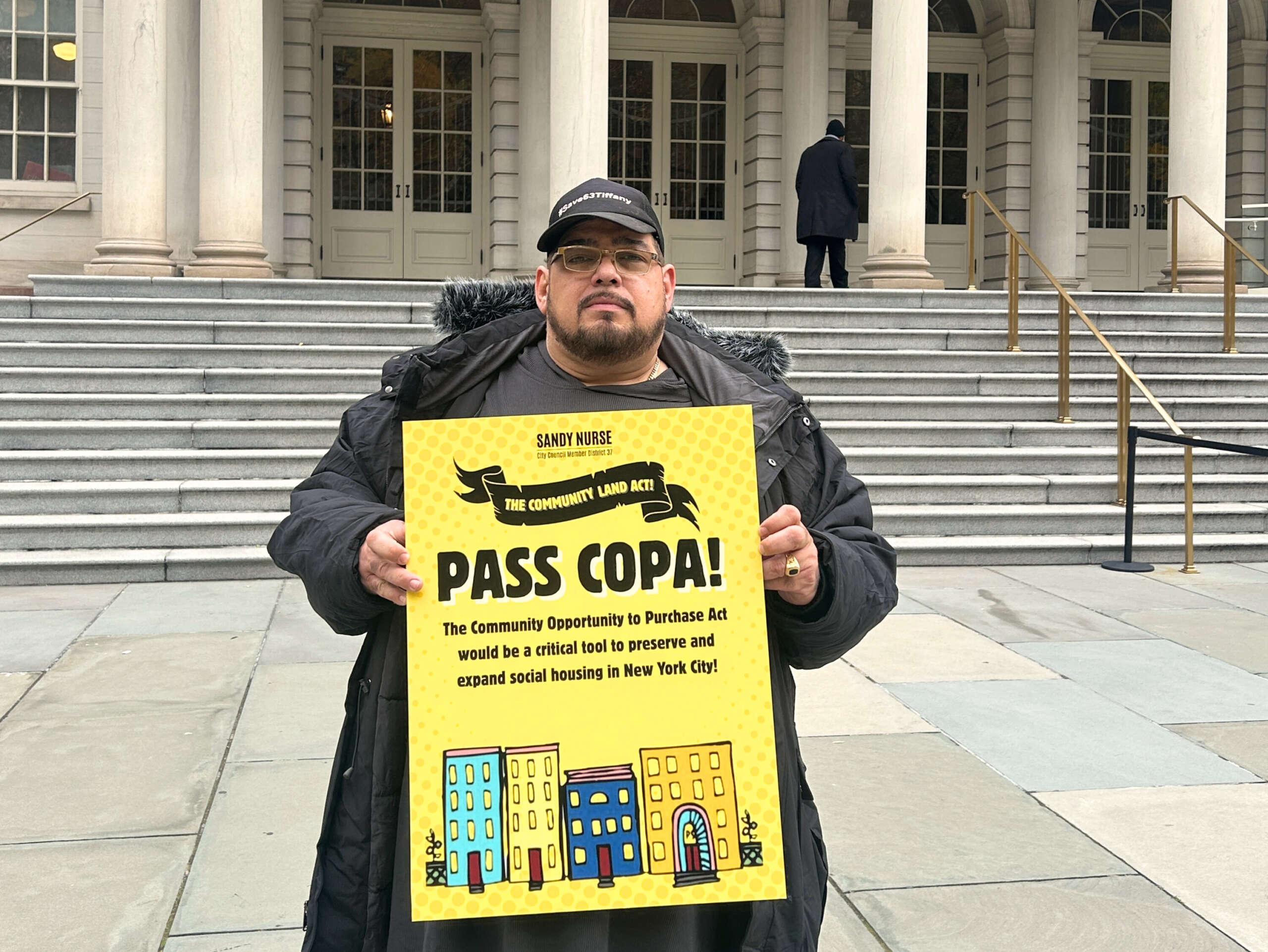
The Community Opportunity to Purchase Act (COPA) will give community land trusts and other community groups first dibs at buying distressed properties. Supporters expect it to pass with support from housing officials.
John Leyva at a rally for the bill last week, saying his own building in Cobble Hill where rent regulations are expiring could have benefited from the legislation. (Patrick Spauster/City Limits)
It’s been a long time coming.
Over five years after it was first proposed, the Community Opportunity to Purchase Act (COPA) is expected to pass the City Council before the end of the year. The bill would give groups like community land trusts and tenant associations the first opportunity to bid on some apartment buildings when they go up for sale.
The idea has long had the backing of groups that preserve affordable housing, but has encountered resistance from the real estate industry and city housing officials. But in a deal being finalized this week, the city’s housing agency is finally getting on board, sources say.
Councilmember Sandy Nurse, the bill’s sponsor, said the legislation is “a great opportunity to preserve more housing.”
“We need COPA because New Yorkers are leaving,” she said. “People are just looking to have an affordable apartment and they can’t compete. And so we want to give our community a chance to stay.”
COPA would be another tool in the toolkit for Mayor-elect Zohran Mamdani, who has made social housing—which looks to put more housing in the hands of the city and community groups, rather than the private market—a part of his platform.
If passed, New York would join Washington, D.C. and San Francisco as cities with community opportunity to purchase laws on the books. Those policies have sometimes been criticized for disrupting an already complex housing market—criticisms echoed by COPA’s opponents.
The bill has the support of the majority of the City Council, sources say, as lawmakers finalize a version the Department of Housing Preservation and Development (HPD) can get behind.
A spokesperson for the mayor’s office did not immediately respond to questions about whether City Hall would support the bill.
“The coalition has made the case,” said Nurse, who said the bill’s 32 co-sponsers and dozens of the city’s community development corporations pushed the issue with HPD. “I think that has forced everyone’s feet to the fire.”
The agreement is expected to trim the universe of eligible buildings somewhat from what was originally proposed. To qualify, buildings must be in “distress”—meaning that they have a certain number of housing code violations—or have an affordability provision that is expiring.
Smaller landlords would be carved out: owner-occupied buildings with less than six units would not be eligible, nor would any building with three units or less.
HPD was opposed to the bill as recently as June, when councilmembers told City Limits they were frustrated with the agency. Housing officials worried prior versions of the legislation would disrupt the housing market, slow an already bureaucratic process, and potentially disadvantage smaller landlords.
HPD did not confirm or deny that it would support the bill, but sources say the agency helped shape the latest version.
“Whenever legislation is proposed that may significantly impact the housing landscape, we are committed to providing input and feedback to ensure that all potential effects are fully considered,” said Matt Rauschenback, HPD’s press secretary.
With the revised bill, potential buyers would have 45 days to inform the seller they plan to bid for the building before it goes up for sale to the general public. Buyers can be nonprofit groups like community land trusts, affordable housing developers, or—added at HPD’s request—for profit developers specializing in affordable housing preservation.
COPA is being considered alongside two other social housing bills.The first would create a city land bank to acquire and develop property. The second would change the process for auctioning city liens, requiring Council approval for competitive sales and enabling sales to the land bank.
Unlike COPA, those bills don’t have the support of city agencies that would be involved in administering them. A smaller package of reforms recommended by the Council’s Temporary Task Force on Tax Liens looks more likely to pass.
Potential buyers, landlords, and policymakers are particularly interested in how COPA could impact distressed rent stabilized buildings.
Landlord groups say some buildings fall into disrepair because rents are not high enough for owners to keep up with rising expenses. They say policies like Mayor-elect Mamdani’s rent freeze proposal will exacerbate the problem.
But the bill’s supporters see it as part of a solution, allowing groups that are interested in preserving affordable housing to acquire those buildings, instead of speculators.
“Rather than having your building sold, and then being unclear who you’re writing your rent check to every month, a trusted community based entity could come in, purchase that building and co-govern the housing with tenants,” said Will Spisak, a senior policy strategist with the New Economy Project.
A scene from a June rally for social housing bills, including COPA. (Adi Talwar/City Limits)
Some nonprofit housing organizations like the Community Preservation Corporation, Enterprise Community Partners, and The Association for Neighborhood and Housing Development have also been sounding the alarm about preservation needs in the city’s affordable housing stock.
“There should be a preservation strategy in [Mamdani’s] housing plan,” Cea Weaver, head of the New York State Tenant Bloc told City Limits earlier this month.
Nonprofits or tenants that buy those buildings might have the same revenue problems as previous ownership, though. “We’ve been pushing HPD to keep the universe focused on distress, but not so distressed to the point where they’re setting everyone up for failure,” said Spisak.
To make COPA work for those severely distressed buildings, supporters suggested the bill be used in tandem with some of HPD’s other programs backed with funding to support community ownership and aid distressed buildings, like the Neighborhood Pillars program.
John Leyva lives in a building financed with low income housing tax credits at 63 Tiffany Place in Cobble Hill, Brooklyn. But the regulatory agreement on his building is expiring, meaning a for-profit developer could take over and raise rents.
“[This bill] would have saved my building once already,” said Leyva, who wants the tenant association to be able to take over. “[The new landlord] wanted to raise the rents and kick us all out of this place. We organized a lot, but it’s been super hard because we don’t have something like COPA that will make it easier for a building like ours.”
To reach the reporter behind this story, contact Patrick@citylimits.org. To reach the editor, contact Jeanmarie@citylimits.org
Want to republish this story? Find City Limits’ reprint policy here.
The post Social Housing Bill Poised for Breakthrough in City Council appeared first on City Limits.
Leave a Reply