
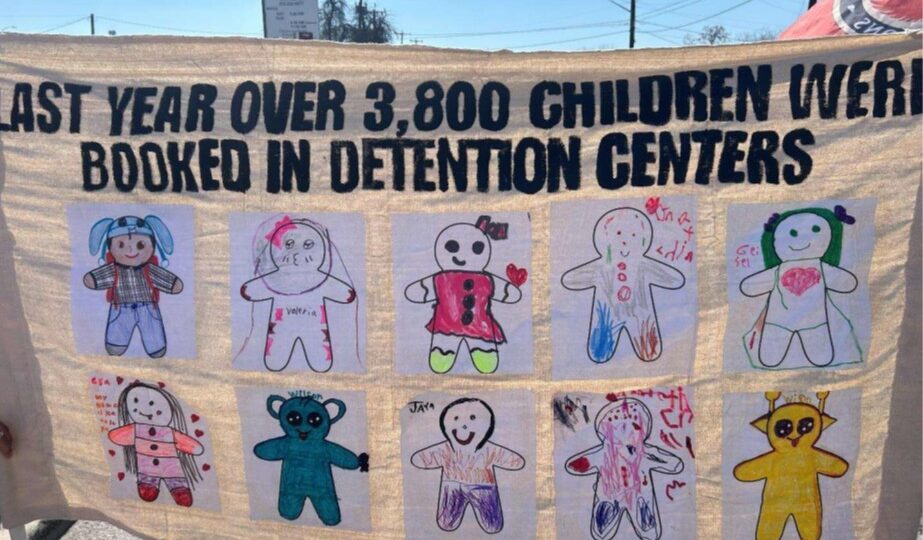
In February, San Antonio pastor Dianne Garcia led a multi-day, 90-mile peace walk across South Texas in solidarity with children and families detained by Immigration and Customs Enforcement (ICE). I had the honor of joining Pastor Dianne for the final leg of her journey, marching across San Antonio with hundreds of people who had gathered from across the country to demand freedom for families and an end to family detention.
As we walked, we chanted, “Kids do not belong in cages!” We sang songs about liberation, and how—as James Baldwin famously wrote—”all of the children are always ours.” At times, we held silence, praying with our feet and holding detained children and families in our hearts.
Our march was a political action, a spiritual practice, a grief ritual, a block party, and a walking love letter to our communities, all rolled into one. Along our route, members of the local community came out to the road to wave, pray, offer us water and food, and express their support. It was a powerful experience that left me feeling deeply connected to the people around me. As an advocate, I found myself thinking afterward: We need more experiences like these.
The current administration relies on a strategy of “flooding the zone” with harmful policies that inundate our nervous systems with fear and sadness to overwhelm and paralyze any resistance to its state-sponsored violence and cruelty. People of conscience empathize with those under attack, we feel grief as we watch lives and families torn apart, and the horror unfolding around us takes a toll on our emotional and even physical health.
The more time we spend anxiously doomscrolling on our phones while separated from each other and from meaningful ways to respond, the more helpless we feel and the more likely we are to numb out or shut down instead of taking action to protect our communities. Yet to give into despair would be to fall for the administration’s bluff and willingly give up our power.
That’s why embodied, communal practices such as singing, marching, and dancing together are so important at times like these: they reconnect us to our bodies, to each other, and to our power. They are ancient, effective tools for shaking off despair, fear, overwhelm, and paralysis. When we come together to share stories, make music, or eat a meal with others—anything that brings us into our bodies and into community—we can access courage and even joy in the face of suffering.
These kinds of shared experiences also open the door to deep connection and belonging that build trust and motivate people to protect and support one another. As we take action alongside each other, this generates further energy and hope, fueling our ability to respond to injustice with creativity and sustain our resistance over time.
All of this is crucial, because it has never been more important for us to advocate for an end to family detention.
First, ICE is detaining families under dangerous, life-threatening conditions. Since Trump took office, ICE has detained more than 3,800 children and the daily number of children in immigration detention has exploded. At the Dilley detention center in South Texas, children are hungry and sick, imprisoned in squalid conditions without access to adequate food, clean drinking water, healthcare, or education. Hundreds have languished there for a month or longer. During a recent oversight visit, U.S. Representative Katherine Clark met a detained toddler who appears to have such a painful tooth infection that she cannot eat. This child is not receiving treatment, which places her in grave danger; a man seeking asylum who was detained in another ICE detention facility recently died from a tooth infection after being denied medical treatment.
Second, a growing number of families are at risk of detention. As ICE moves forward to drastically expand its immigration detention system and to imprison tens of thousands more people, including families and children, in repurposed warehouses, Congress is considering increasing the agency’s budget to fund its deadly violence, kidnappings, family separations, and prison camps for children.
Even now, ICE is detaining children at hotels and in secret hold rooms in unsuspecting communities, in addition to imprisoning them in Dilley.
(Courtesy of Trudy Taylor Smith )
Third, advocacy against family detention is having an effect, and a growing number of members of Congress are beginning to emerge as champions for this cause. After a family of three from her district was arrested in the process of seeking emergency medical care for their seven-year-old daughter, Oregon U.S. Representative Maxine Dexter’s advocacy helped secure the family’s release. Similarly, public outcry and Congressional oversight visits by Congressman Joaquin Castro, Congresswoman Jasmine Crockett, and others have contributed to the release of the Gamez-Cuellar family and five-year-old Liam Conjeo Ramos and his father. Castro has publicly stated that his “goal is to shut down Dilley,” and he notes that the number of people detained there has decreased since he first visited the facility in January.
Meanwhile, those with power or money to lose are attempting to cover up the cruelty of family detention. After ProPublica revealed the truth about distressing conditions at Dilley by publishing children’s artwork, handwritten letters, and recorded interviews, staff at the facility reportedly began raiding children’s cells to confiscate their letters and drawings. Later that month, the Department of Homeland Security released a public statement seeking to discredit reports of medical neglect and other well-documented abuses at Dilley.
We cannot let this cruelty continue. There are so many ways to take action, and even small acts make a difference when we do them collectively. We can volunteer with local mutual aid networks that support immigrants, and we can donate to support trusted advocacy organizations and service providers. We can educate ourselves about our rights when interacting with ICE, and share this information with people we know. We can choose to learn more about family detention, make other people in our lives aware of this issue, and come together to plan an event focused on freedom for detained families. Finally, we can use an online action tool, a specialized advocacy toolkit, or a simple phone call or email to advocate against this inhumane policy by contacting members of Congress and telling them to put a stop to it.
Congress has the power to end family detention right now by passing legislation to make it illegal, such as the Dignity for Detained Immigrants Act or the Melt ICE Act. Congress also has the power to cut off the funding for family detention by refusing to allocate further funding to ICE during the current appropriations process, and by passing the Drain ICE Act to rescind the $75 billion that was allocated to ICE under HR 1 last summer.
As hundreds of voices sang with Pastor Dianne in the streets of San Antonio, the children are always ours, and now is the time to ensure their freedom and safety by calling for an end to family detention. Now is the time to vote, march, pray, sing, dance, grieve, and advocate alongside each other until we bring about the future our children deserve.
The post We Have the Power to End Family Detention in Texas—and We Must appeared first on The Texas Observer.
Leave a Reply