
In widely quoted speeches delivered over the past couple of years, JD Vance has made the claim that he is more American than you. (Well, unless you happen to be his cousin, or a very distant nephew of James Madison.)
“People whose ancestors fought in the Civil War have a hell of a lot more claim over America than the people who say they don’t belong,” he said during one of these addresses last July. In another, he described how his family had been buried in an eastern Kentucky cemetery since the 19th century, arguing that this particular ancestry is what undergirds patriotism: “That’s not just a set of principles. … That is a homeland. That is our homeland. People will not fight for abstractions, but they will fight for their home,” he said.
The vice president remains just a bit slippery in these lectures. Full context sometimes makes the snippets more alarming and sometimes less. In the first quote, for instance, he’s specifically claiming primacy for Americans of Civil War-era descent who also hold views that would cause the Anti-Defamation League to label them domestic extremists. (I’m serious; the transcript is online.) On the other hand, the cemetery quote was part of a sentimental riff about his proposal to his Indian-American wife.
What’s clear, even if he doesn’t use the precise phrase, is that Vance is toying with an idea lately popular on the online right: the so-called heritage American. The idea, per its promulgators, is that a distinct national identity emerged in this country sometime between the early colonial period and the mid-19th century and that this identity, preserved through bloodlines, deserves special privilege today. In theory, this category can include some African Americans and Native Americans, but at least one far-right writer has conveniently doffed the mask, writing for The American Conservative: “Heritage American is more palatable to the public than ‘white.’”
IF CONSERVATIVES ARE GOING TO UNSETTLE WHAT IT MEANS TO BE AMERICAN, MAYBE IT’S BEST TO ACCEPT THE INVITATION.
If this idea sounds equal parts stupid and dangerous, you’ve understood it correctly. One can imagine a heritage-American future where jackbooted federal agents are pulling people over to demand their 23andMe results. The concept’s semi-prominence also owes to Vance, whose political career depends entirely on Donald Trump, whose paternal grandparents and mother were, of course, all immigrants. The very same Trump whose notion of Americanness is so profound that he advertises a “Gold Card” whereby $1 million, plus a $15,000 processing fee, buys you a glide path to citizenship.
Yet the idea also pulls on bloody threads that wind back to our country’s most formative ideological struggle. It is a rejection—which Vance explicitly affirms in his speeches—of the notion that America is principally “an idea,” or a nation formed by a shared creed. In other words, it’s a rejection of the dominant and long-standing interpretation of Lincoln, whom I’ll let speak for himself (with but minor abridgment):
“We have … among us perhaps half our people who are not descendants at all of these men [of the Founding era],” the then-Senate candidate said in July 1858. “If they look back through this history to trace their connection with those days by blood, they find they have none, they cannot carry themselves back into that glorious epoch and make themselves feel that they are part of us, but when they look through that old Declaration of Independence they find that those old men say that ‘We hold these truths to be self-evident, that all men are created equal,’ and then they feel that … it is the father of all moral principle in them, and that they have a right to claim it as though they were blood of the blood, and flesh of the flesh of the men who wrote that Declaration, and so they are.”
On the streets and in the courts more than a century and a half later, we’re seeing the dire consequences that come from attempts to curtail, contra Lincoln, who counts among the nation. The Supreme Court is set to rule this summer on Trump’s bid to deny Americanness to babies born of undocumented immigrants—through his January 2025 executive action titled “Protecting the Meaning and Value of American Citizenship”—which could upend the constitutional legacy of the Civil War’s outcome. Further, in internal guidance late last year, the administration called for an unprecedented increase in denaturalization, meaning the stripping away of citizenship already granted; the president has begun promoting the concept of “remigration,” which is grounded in the idea that some racial or ethnic groups are unassimilable no matter their legal status; official government social media accounts have used white nationalist propaganda to attract recruits; and, in response to Minneapolis, we’ve seen the political right argue that the Constitution should not extend to citizens who use their rights to defend noncitizens targeted by the feds.
With the future of the GOP up for grabs in a few very-long years, far-right ideas like Vance’s that should be fringe can’t be safely ignored—especially if they hold a grain of truth. As dumb and deadly as the heritage American label is, it draws on something that the political left has long recognized as well: American citizenship as presently constructed is often unstable and arbitrary. It is incomplete, unsatisfactory, and even a lie.
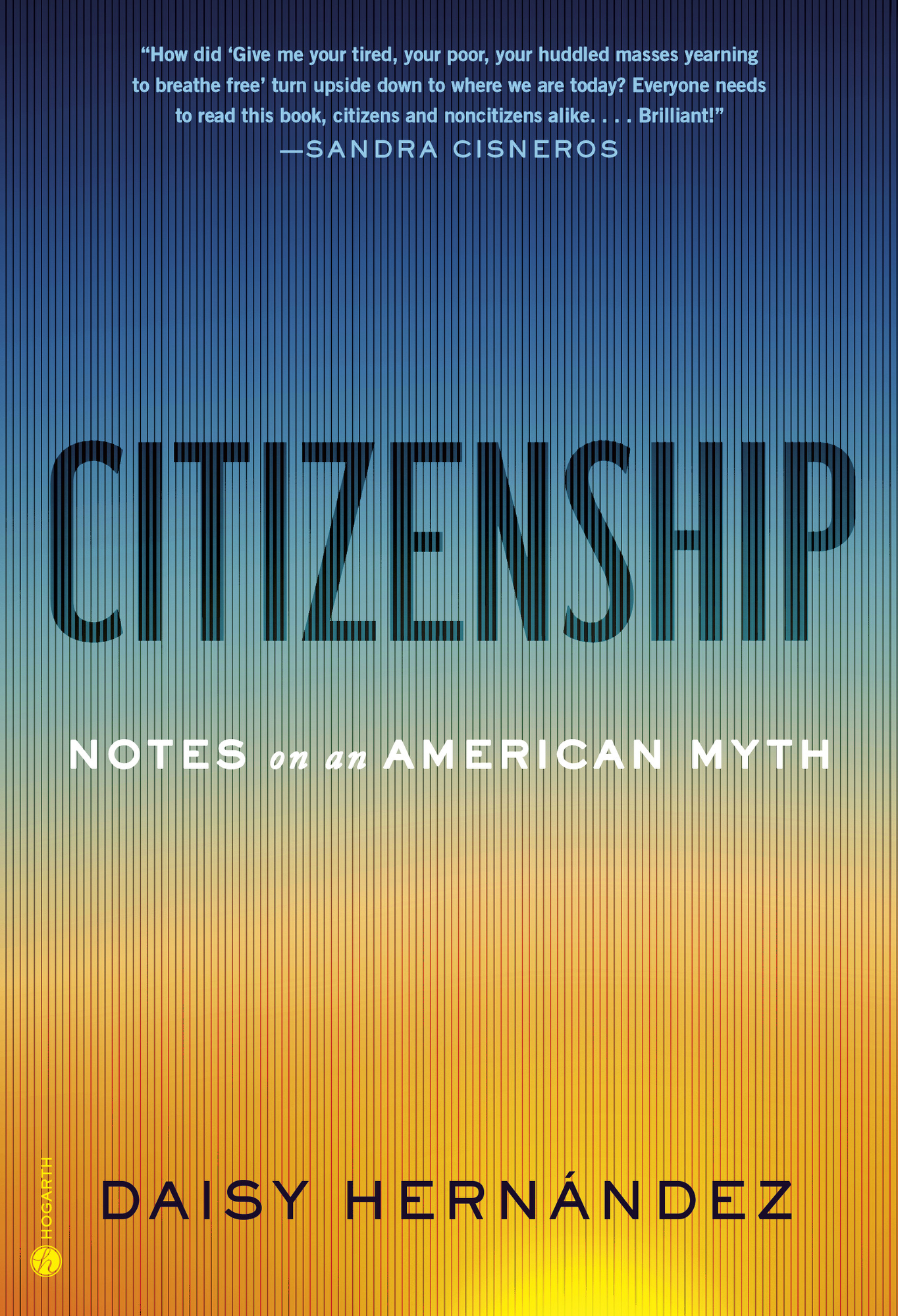
Citizenship: Notes on an American Myth by Daisy Hernández (Courtesy/publisher)
In a new book out this February, Citizenship: Notes on an American Myth, the author Daisy Hernández blends her own story as the daughter of a Cuban father and Colombian mother with a review of academic literature to unsettle the concept of citizenship in this country. Her critiques come decidedly from the identity-conscious left, and they’re expressed in a number of memorable, if somewhat obscurantist, lines.
“I learned as a child that citizenship was a private story, one women told in the dark,” Hernández writes near the book’s beginning. “We are citizens of the stories we tell,” she concludes later on.
Hernández surveys the history of American citizenship, a term with roots in the English language dating back seven centuries, she writes, but whose meaning has always been mercurial. The 14th Amendment and subsequent jurisprudence might seem to have largely settled the question—those born on U.S. soil shall have that “right to have rights,” as Hannah Arendt put it—but Hernández’s view is more expansive.
She discusses how queer Americans have long been essentially semi-citizens, denied “a robust social citizenship.” She also draws on Susan Sontag’s famous line about illness, that “Everyone who is born holds dual citizenship, in the kingdom of the well and in the kingdom of the sick.” And she walks us through the supercharged exclusion of the Trump era.
As a reader, the book for me fell somewhere in between a memoir and an academic treatise, without the payoff of either. But, for another, it might be just the right invitation needed to complicate a notion that many consider self-explanatory. For some liberals who are responding to the right’s hard-nationalist turn, perhaps this book can push them beyond a blithe defense of the status quo circa Obama’s second term. If conservatives are going to unsettle what it means to be American, maybe it’s best to accept the invitation.
The funny thing about Vance’s blood-and-soil patriotism is that he means to add depth to Americanness by grounding it in a few generations’ worth of human ancestors buried in a particular patch of dirt. But this is stunningly shallow. If you’re going to redefine this nation away from its Lincolnian ideals, why not start with something sturdier? Perhaps “America” is just the silly name we give to a sprawling expanse of sacred land that’s hosted many names bestowed by many peoples—a “real” American being someone who stewards that physical land and the nonhuman life that’s filled it since long before Vance’s oldest white American ancestor had a species to emerge within. Maybe an Indigenous Mexican immigrant has far more claim to this land than Vance’s Appalachian Scots-Irish, but maybe the rights of both should carry with them across imagined borders.
Rather than let our citizenship be honed to violence, in other words, perhaps we should expand it past its breaking point to create something new.
The post American Citizenship and Other Myths appeared first on The Texas Observer.
Leave a Reply