
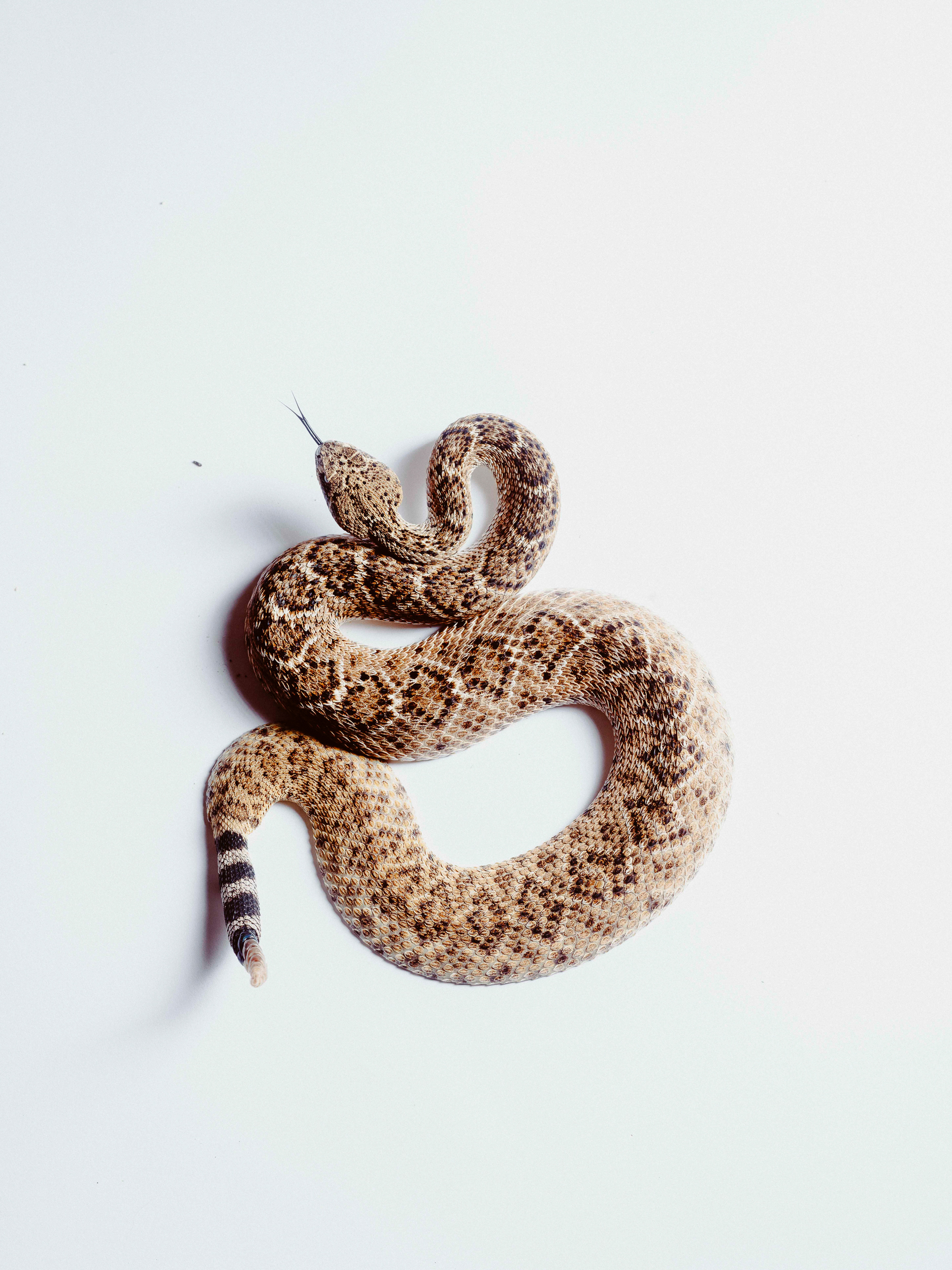
In my early 20s, not long after moving back to Texas, I almost grabbed a rattlesnake.
I didn’t know it was a rattlesnake at the time. I was out walking in a riverside forest outside Austin, exploring a set of long-abandoned buildings in search of reptiles. Spotting a gray-scaled loop of coil poking from a tangle of fallen roofing, I bent automatically to snatch it. But some competing instinct froze my hand. Staring at the coil, I traced it back into the shadows, where the snub-nosed, wary face of a pit viper stared back. Then came the rattle: a short, emphatic buzz that dried my mouth and made me step smartly backward.
The serpent in question wasan adult western diamondback. Of the 10 species of rattler found in Texas, it is the largest—record-holders can hit 7 feet, though 3 to 4 is standard—and by far the most common. It’s also the most famous. Diamondbacks play an outsize role in the Lone Star mythology: “Somehow talk about him seems bigger than elsewhere,” observed the folklorist J. Frank Dobie in Rattlesnakes, his 1965 compendium of state rattler lore.In many of these stories, informants recall rattlers as the menace of the rangeland, the creeping foe of the cowboy: a cold, unthinking set of venomous fangs, forever cocked, loaded, seeking the unwary ankle. “It is an unwritten law [among cowboys],” Dobie wrote, “that whoever sees a rattlesnake will kill it.”
There are many in Texas who still unthinkingly follow that prescription. Whole festivals are devoted to carrying it out. Yet amid that automated hatred, a marked shift has occurred in scientists’ understanding of the rattler family. Increasingly, the folkloric entity and the living animal have little in common. What, then, are these snakes? And what does their legendary rattle truly mean?
Were it up to them, diamondbacks would pass their whole lives without making a sound. Adaptable and generalist predators, they range from the rugged deserts of West Texas to the coastal grasslands and thornscrub of the south, the high llanos of the north, and the rocky karst of the Edwards Plateau. The youngest live on insects and lizards. Adults take rodents, birds, and the occasional bit of carrion. Like all snakes, they rely on external temperatures to maintain a comfortable existence, rather than on the internal engines that run most of their food, allowing the rattlers to go without food for months. As pit vipers, they’re able to sense the wasteful heat generated by higher metabolisms, letting them target prey accurately in the dark. After using their keen, combined sense of taste-smell to locate rodent trails, they find a good ambush spot and wait, counting on stillness and camouflage to keep themselves out of trouble.
But trouble finds them anyway. Bison and their successors, including cattle and horses, can accidentally step on a coiled diamondback; birds of prey, wild hogs, and the powerful indigo snakes of South Texas are all happy to make a meal of them, especially if caught out in the open. Since rattlesnakes aren’t particularly fast, their best option is often to stand their ground. Thus: the rattle. While many snakes rasp their coils together to warn off threats, rattlers have elevated this technique to a high art, activating a special structure of hollow scales with twitches of their black-and-white-striped tails. A threatened diamondback can cut an intimidating figure: half its body raised in a high, tight S-coil like a boxer’s crouch, emitting a thunderous buzz.
Those who fail to heed the obvious warning often find that diamondbacks have a lightning-quick strike—and venom that attacks flesh and nerves, beginning to break down meat for digestion as soon as it’s delivered. Since this venom is generally for taking prey, rattlers are choosy about when they use it: Depending on whom you ask, around 25 percent of defensive bites are “dry,” with no venom injected. Other times they drop their full 700-plus-milligram load. Rattlesnake antivenom is now widespread enough that a bite isn’t generally a death sentence for a healthy adult: While roughly 7,000 snakebites are reported in the United States every year, only five were fatal in the past decade in Texas. But the venom can cause serious injuries to health and pocketbook. An average course of treatment runs $31,000, and sometimes the cost includes a limb.
In other words, a rattler is not an animal to be trifled with. But people do. While accidental bites happen, most people who get bit have put themselves directly in harm’s way, according to Clint Guadiana, curator of Reptiles & Amphibians at the Gladys Porter Zoo in Brownsville and owner of a side business that trains people to carry out rattlesnake removals. Sometimes bites result from people attacking the snakes with sticks or garden tools. But there’s also “a whole bunch of people out there that free-handle rattlesnakes,” Guadiana noted, usually showboating keepers or swaggering snake catchers on social media. “That’s just sending a terrible message to people that it’s possible to do this. More times than not, those influencers end up getting bit.”
What people often miss is that the snakes actively go out of their way not to deliver these dangerous bites. A hunkered-down diamondback often won’t move or rattle at all, so as to avoid giving itself away. The first instinct of a snake surprised in the open is to bolt for cover; even standing its ground is something it would prefer to avoid unless forced. “They don’t want conflict with something they see as a threat,” Guadiana said. “They don’t want to interact with us. They want to avoid us at all costs.”
Diamondbacks and other rattlers are secretive enough that casual observers tend to assume they don’t do much beyond the occasional hunt. But the snakes have a surprisingly active social life, Guadiana said. This is most obvious in spring, when romance-minded males track down females, getting into occasional lengthy—but gentlemanly—wrestling matches with other hopeful suitors. Mother rattlesnakes give live birth, and they’re “very good mothers,” Guadiana said: They’ll guard their newborns for more than a week, seeing their young through their first shed and out into the world.
But it’s not only about mating. Rattlers also spend a great deal of time together in the fall and winter, gathering from far and wide to hibernate in cracks and crevices. They often share these dens with other species like copperheads or garter snakes. (In Arizona, Guadiana noted, diamondbacks will even post up with Gila monsters.) Traditionally, researchers had assumed that these were gatherings of convenience: individuals that were largely uninterested in one another, gathering at a shared spot. But in 2023, a team of researchers demonstrated that timber rattlesnakes—a close relative of diamondbacks—were less stressed by disturbances if they had another rattler to huddle with. A 2012 study found that some rattlers seem to prefer hibernating alongside relatives, doing so year after year, with young snakes often following their mother’s scent trail to den with her and their kin.
In some places, these dens can get very large. Emily Taylor, a specialist in rattlesnake behavior from California Polytechnic State University, is one of the minds behind Project Rattlecam,a donation-funded livestream observing a community of hundreds of prairie rattlesnakes—another diamondback relative—in Colorado. Observations from the livestream have allowed both Taylor’s team and interested viewers a look into the behavior of extraordinarily furtive animals. In the winter, they hibernate; on warm days in spring and fall, they bask together on rocks before leaving to hunt alone on the nearby prairies. Pregnant females gather at the den to give birth, babysit pups that aren’t theirs, and—preliminary research suggests—actively choose to spend a significant amount of time with certain other individuals.
“Pregnant females have strong social bonds with other specific pregnant females, even more so than they [do] with the non-pregnant females that would occasionally be there,” Taylor said. “They like to hang out together.” (One researcher, finding something similar in another species of rattler, described it as friendship.)
In literature and cinema, the rattlesnake den is often depicted as a sinister place. So full of venomous creatures, how could it not be? But when Taylor visited a Colorado den in 2020, she told me, she found it a moving experience: dozens of snakes, babies and adults, curled up peacefully among the rocks and small oaks. The snakes initially panicked at her appearance, rattling and diving for the nearest hideouts. But Taylor sat down 6 feet from the den entrance, crossed her legs, and waited. Eventually, small, nervous faces poked out from the holes, tongues flickering out to taste the air. Taylor stayed still. Slowly, all around her, the snakes emerged to coil back up in the sun, some very close. “To sit there and watch the way that they coiled up together and how truly peaceful it was—and how they weren’t scared of me if I wasn’t a threat—I just felt so privileged to be able to see so many of them doing that together,” Taylor said.
“That’s what Project Rattlecam is … a really nice way of showing people the true, gentle nature of rattlesnakes.”
“Gentility” is not a word that most people would apply to rattlesnakes. But it’s one that’s always seemed right to me in my encounters with them—and since that first meeting by the abandoned building outside Austin, I’ve had my fair share.
There were the rattlers encountered on paths: the young diamondback curled in a perfectly pancake-shaped circle in the dust of a trail at Enchanted Rock, and the pale, 4-foot white rattler stretched over the gravel at the Balcones Canyonlands. There was the thin, hard-luck snake that came down to a friend’s cattle tank to drink on a brutal summer day, gulping up the scummy water with a thirst I well recognized, and the one posted up in a half-collapsed armadillo burrow, staring in clear hopes that I hadn’t noticed her. There were the nervy ones that drew themselves tall when I came across them, out in the brush or by the side of a West Texas road, their rattling echoing out, heads cocked and watchful.
In some cases, I’ve just nodded to them and gone on my way. In others, I’ve squatted down a few feet away and admired them: the shine of their scales, the simple but lovely patterning of their backs, the raccoon banding of their tails, the vibrating flick of their black tongues, the fixed glint of their eyes. In all cases, I’ve found it hard not to read a certain self-possession into them, even when they’re hurrying away. There’s certainly danger there for the unwary or the impolite, but there’s no hint of aggression.
The same, sadly, cannot be said of humans. Bring up rattlesnakes around other Texans, as I have now and then, and what you’ll likely hear are stories of fear or violence. Sometimes the killing is partly understandable: The snake was spotted near a dog, or in a yard where children play. (Though in such cases, you can usually call a removal specialist to simply take it away.) Other times, it’s about naked machismo, or simple cultural expectation. In Rattlesnakes, Dobie relates many offhand accounts of him or his informants killing diamondbacksthat came to human attention; growing up, the great folklorist remarked, he was raised in the knowledge that any “halfway decent” man would “kill any rattlesnake he got a chance at.”
Clint Guadiana holds a Tamaulipan milksnake.
This assumption that rattlesnakes must simply be exterminated reaches its bloody culmination in the “rattlesnake roundup,” a set of wildlife-killing contests where hunters fan out across the landscape, pumping gasoline fumes down burrows to drive out hundreds of rattlers, then dumping them in crowded and filthy enclosures until they can be killed publicly en masse. Since 1958, the most famous of these has been held in the West Texas town of Sweetwater, where the three-day festival held in mid-March funnels cash into local charities ($63,000 in 2023) and $8 million into the local economy. Karen Hunt, head of the local chamber of commerce, told one KTXS reporter that it’s the area’s equivalent of Black Friday.
It’s certainly a dark occasion for the snakes. In most years, hunters kill 5,000 pounds’ worth of rattlers, though it can be more: In 2016, 24,262 pounds of rattlers met their end at the event. Some snakes have their fangs yanked out to render them “safe”; others are ostentatiously milked of their venom or goaded into striking balloons. All are eventually killed with machetes; officials invite children to help, and to make rattlesnake-blood handprints on paper.
Proponents offer various excuses for this behavior, the most common being that the roundups exist to protect people by clearing a dangerous animal out of the surrounding countryside. Yet it’s hard to miss what is actually being sold: a fantasy of naked bloodlust, spectators gathering for casual cruelty, to watch animals they fear being tortured to death. It’s also a spectacle that fewer and fewer people, however, are able to stomach. Intense and mounting pressure has shifted many of the roundups across the South to no-kill festivals. Of the 40 roundups held in Texas in 1980, just five remain, with Sweetwater standing defiantly among the last of them.
Dobie himself occasionally found reason to look on rattlers with a more reflective eye. Once, driving down a rough pasture road west of Austin, stewing over the anti-New Deal government in Texas, Dobie saw a big one moving through the dryland, and he found himself drawn from the car to watch.
“My hackles did not rise as they have risen on many occasions at sight of a rattlesnake,” Dobie wrote, as an unassuming honesty in the serpent appealed to him. “I addressed him thus: ‘Fellow citizen, you belong to the ground; you have never pretended to belong anywhere else. … I prefer being in your company to being in that of the governor of the state of Texas. Go about your business, and I’ll go about mine.”
In October, I headed down to the Rio Grande Valley to meet Guadiana, an old hand at finding rattlers. In the 15 years since he moved to Texas, he’s spent many weekend evenings driving the caliche back ways of Starr County, in search of whatever reptilian riches the Valley chooses to provide.
Reptiles—particularly snakes—are often found on roads, either lured by the residual heat of asphalt or crossing them out of necessity. In the Valley, many are diamondbacks. “They’re super common down here,” he told me as we drove, eyes fixed ahead for potential specimens. “One night in 2015, I got 50 rattlesnakes in a night. Thirty, I think, were babies. There were so many that I had to stop stopping for them, because I would never get home.”
A late-afternoon breeze rolled overhead, rustling the thornscrub behind the cattle fences; caracaras soared over the fields, keeping an eye out for roadkill. We stopped now and then to admire plodding Texas tortoises and to examine the tracks of a great indigo snake in the sand. Driving on as evening fell, we stared hard at the pool of headlights racing up the road ahead of us, looking for the telltale glint of scales.Several times, Guadiana pulled his little pickup into wild U-turns to investigate a bit of road detritus. Sometimes, that detritus was a snake, claimed by the buzz saw of speeding traffic. Two were baby rattlers.
Soon enough, our luck picked up. “There,” Guadiana said, throwing the pickup around and jumping out. Crossing the blacktop was a newborn, barely longer than my finger, with a slightly oversize head and only a miniature button on its tail. Using a snake hook, Guadiana carefully collected it, placing it in a locking bucket. “You have to get them off the road,” he said as he worked. “And take them to whichever side they’re closest to. You don’t want them trying to recross and getting creamed.”
We weren’t on the road much longer before Guadiana pulled around again to collect another, this one a 2-foot young adult. The snake hunched into a wary coil under our flashlights. Black tongue flicking out, tasting the air, it took in the experience with surprising calm, making no attempt to rattle even when Guadiana’s hook carefully plucked it up and deposited it in another bucket.
A little farther up the road, we stopped by a broad berm of sand beneath a tall game fence to take photos. The newborn stayed still, pressed flat against the sand to make itself look big, head turning now and then to follow the motion of the camera. Cars rocketed down the night road like passing death. Guadiana ushered the baby off into the darkness away from the blacktop, then brought out the young adult, which proved similarly pliant—to a point. At first, it hid its head under its coils when Guadiana tried to pose it for the camera, then tucked away its tail in a nervous huddle. As the minutes passed, however, the snake’s patience visibly ebbed. Finally, as Guadiana’s hook came in to make a small adjustment, the rattle came up buzzing, and the snake struck out at the metal. Fangs tinged against the hook.
“That’s probably enough,” Guadiana said. Gently, he prodded the snake again, urging it backward. Still rattling furiously, it edged back up the sandy berm and toward the blackness, finally settling into a bush at the top and staring down at us, tight and tense, rattle humming out its simple desire that we go away.
So we did. Driving off into the night with Guadiana, I found myself thinking again of that moment by the building near Austin, the comparatively short rattle burst that quite possibly saved my hand. Many of us are unaccustomed, in our dealings with nature, to seriously reckoning with the individual lives of the beings around us, those who must steer clear of humanity even as we run them over, crowd them out, blunder into their homes, or pluck them up in our great hands. The simple fact of the rattlesnake’s venom forces us to pause or accept the consequences. It is an assertion of space—of a right to be—that many of us cannot seem to make peace with; we want the rattlesnake to be mastered, or we want it neutralized. We do not want to suffer the restriction of its presence. That, I think, is why so many of my fellow Texans instinctively wish them dead.
It would be easy, and not wholly incorrect, to call me a diamondback partisan. If I am, it’s because I like rattlesnakes as they are. They are their own folk, with their own ways. Some of these are closed to us by hundreds of millions of years of evolutionary divergence: the nuances of pheromone and scent-language, the taste-smell, the long, slow thinking of snake-time. But others we can recognize, if we allow ourselves to do so. To recall being pressed against your mother’s side when you were small and wanted to be safe, for as long as safety could hold. To think of those you’ve chosen to spend the hours of your life with, watching the passage of the world. To remember the times when hunger stirred you, when anger roused you, when fear drove you to run—or to stand your ground, and let your rattle break the air.
The post Consider the Rattle appeared first on The Texas Observer.
Leave a Reply