
This article was co-published with Puente News Collaborative, a bilingual nonprofit newsroom dedicated to high-quality coverage from the U.S.-Mexico border.
Sitting inside the taquería El Portón here in Edinburg, Texas, tuba-tinged banda music wafting through the speakers, Bobby Pulido could easily pass for one of the many South Texas Latinos who drifted toward Donald Trump in the past two presidential races. He’s a rancher who spends time at the shooting range. Clad in a plaid shirt, cowboy boots, and khaki baseball cap that reads “Texican,” Pulido talks easily about faith, family and personal responsibility.
But, he insists, the Democratic Party is still his party.
“They shouldn’t own the flag,” Pulido said of Republicans. “I love my country, and I’d die for it. And I love God, and I embrace my faith. That’s who I am. But I’m also empathetic, and I also want to help people. And I believe that the little guy sometimes needs—like my dad did—needs a helping hand to get their family out of poverty. That’s our spirit.”
As the country heads into another volatile election season, Texas’ 15th Congressional District—stretching nearly 250 miles from the Rio Grande Valley north toward Central Texas—has become a testing ground for one of the biggest questions facing the Democratic Party: Can it win back Latino voters who swung right in recent elections?
Pulido, 52, the high-profile Tejano singer best known for his 1990s hit “Desvelado,” is widely viewed as the frontrunner in Tuesday’s Democratic Party primary in a district redrawn in 2022 to favor Republicans—but one of the few in Texas that Democrats hope they can flip.
The race has attracted national attention as a case study in how the party might reconnect with disaffected, hard-to-pin working-class Mexican American voters.
Pulido is not the only charismatic product of the Valley’s working class in this race, however. His opponent, emergency room physician Ada Cuellar, 44, argues she is also capable of appealing beyond party lines. While she doesn’t like to label herself ideologically, some of her positions place her further left than Pulido’s self-declared Democratic conservatism.
Cuellar has an equally inspiring personal story that reflects the dreams many of the Valley’s working families hold for their children. Originally from Weslaco, she recently earned a law degree while tending to patients and raising her 12-year-old daughter as a single mother.
“I’m a kid who grew up low-income and relied on public education,” she said. “I was a WIC program recipient, and then growing up, I was a Pell grant recipient. I see that now these things are being attacked by the Trump administration. Benefits that would have helped a kid like me, right now they’re being cut.”
She describes herself as anti-corruption and anti-establishment and takes firmer stances than Pulido on issues such as codifying abortion rights. She favors dismantling ICE, leaving immigration enforcement to other agencies with greater trust.
“Democrats are excited about me because I’m a fighter,” she said. “And interestingly, when talking to Republicans, they also are excited about the same thing, even if they don’t align with every single position that I take.”
Despite her political attributes, a poll shared with Politico in January showed Cuellar running a solid second, facing an uphill battle against Pulido’s celebrity status and high media profile.
The son of famed conjunto musician Roberto Pulido —a former migrant farmworker who worked his way through college—Bobby Pulido grew up in a political family reflective of the Democratic Party establishment that has long dominated the Valley.
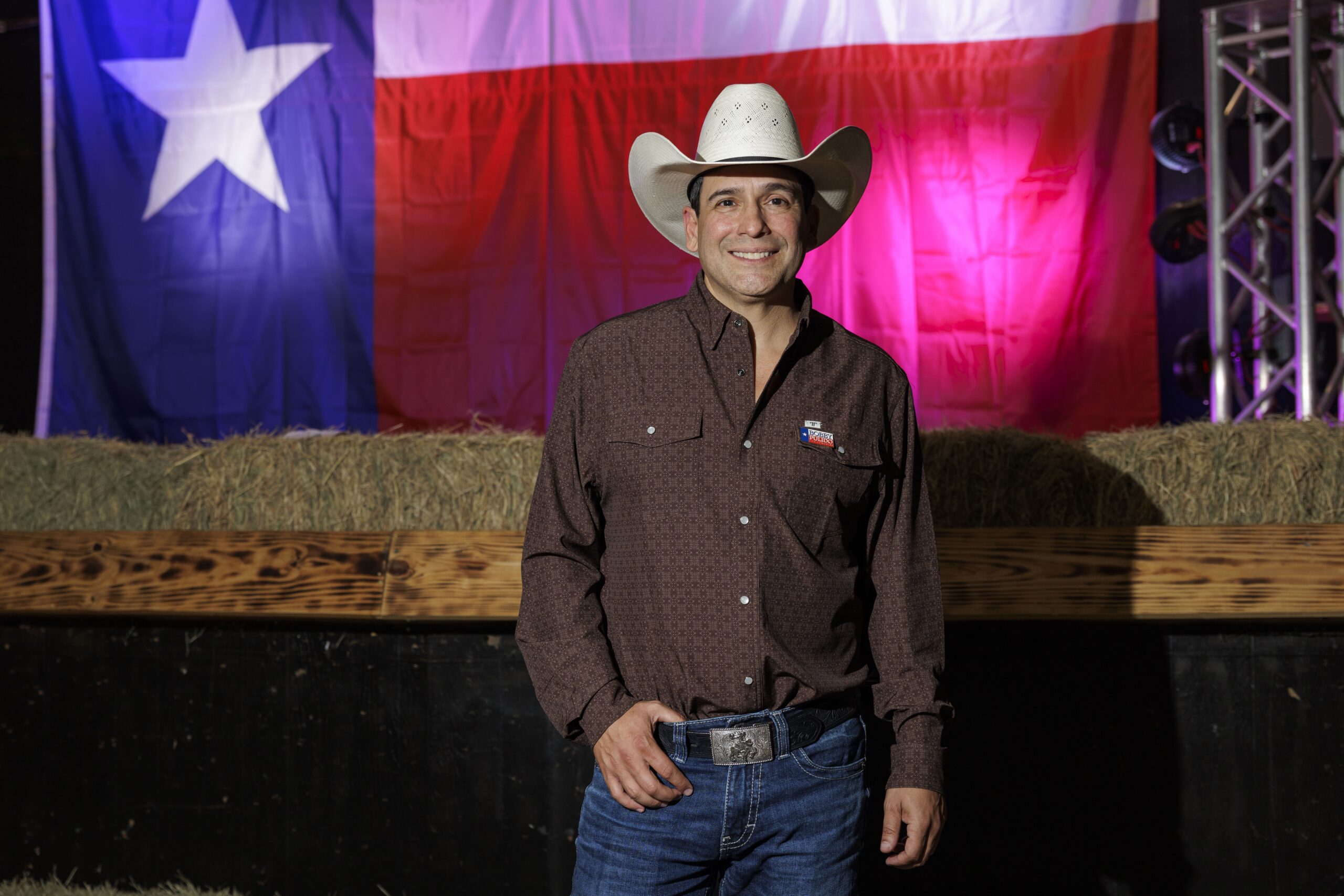
Tejano music star and Democratic candidate Bobby Pulido poses for a portrait following a campaign event in Falfurrias on October 25, 2025. (Photo by Michael Gonzalez)
His uncle, Eloy Pulido, was a county judge. In high school, Bobby Pulido was selected by his teachers to attend Texas Boys State, a prestigious civic leadership program, and later studied political science at St. Mary’s University in San Antonio.
With these deep roots in politics, he assumed he might one day run for office.
But in the mid-1990s, major record labels were searching for the next Selena-type sensation. When Pulido’s father invited him to record a duet, executives heard him and offered a deal he couldn’t resist. He left college a year shy of graduating and became one of Tejano music’s biggest stars, producing 18 albums, winning two Latin Grammy awards, and touring the U.S. and Mexico.
Now, three decades later, the father of four hopes to translate his cultural capital into political momentum.
On the campaign trail, Pulido has hosted what he calls “ranch halls” instead of town halls. He appears in his signature cowboy hat and boots, sometimes breaking into song at the end of his speeches. His campaign ads emphasize that he’s “not team red, not team blue, team you.”
He argues that Latino voters in the Valley defy easy partisan labels.
An in-depth study in 2020 by the Texas Organizing Project Education Fund found that many Latino voters hold weak partisan attachment, even when they regularly vote for one party. Rather than aligning wholesale with a platform, respondents often described weighing issues individually—immigration, healthcare, taxes, education—and basing votes on who is running at any given moment.
Equis Research, a national firm that studies Latino voters, has similarly argued that Latinos should be understood less as a guaranteed Democratic bloc and more as persuadable swing voters.
That pattern is visible in South Texas. In 2024, some Valley voters supported Trump at the top of the ticket while backing Democrats in local and congressional races.
“I hate this narrative that South Texas is red,” Pulido said. “I don’t think the people are red. I think they care about the candidate.”
The four counties that make up the Valley, which has more than 1.3 million mostly Latino residents, had not voted Republican in a presidential race since the late 1800s. That shifted dramatically when Trump made moderate gains in 2020—then markedly larger ones four years later.
In Hidalgo County, where District 15 is anchored, he went from drawing 28 percent of the vote in 2016 to 51 percent in 2024.
Political pundits and the media often oversimplify the Latino electorate, and Pulido rejects the argument that the shift was mostly about the economy and immigration.
He believes cultural conservatism—including debates over gender identity—resonated with many Valley voters deeply rooted in church, family, and a Tejano identity, while shielding them from the overt discrimination that Latinos face in other communities where they are the minority.
“You don’t feel the racism because we’re all Hispanics, predominantly,” he said. “So you just think, ‘It’s conservatism. I go to church, I love God. I want tax cuts, have the government staying out of my business.’”
He added: “You don’t understand how many people down here would tell me stuff about biological men playing in women’s sports, and none of them had ever experienced that, or even known of any situation where it happened.”
In a region where many Mexican American families like Pulido’s go back generations—in some cases to before the land was part of the United States—cultural identity and party affiliation do not always move together.
Democratic candidate Ada Cuellar at a No Kings rally in October. (Courtesy of Ada Cuellar Campaign/Facebook)
Pulido sees himself in that middle space. He’s confident he can bring some Trump supporters back to the political center with a focus on working-class concerns like healthcare access and cost of living.
He said programs that focus solely on people living in poverty create resentment among people who earn just enough to disqualify them, yet still struggle to make ends meet.
“So we have to do something about catering our message more to the middle class and the working class,” he said. “Because they feel like they have to work two jobs just to make it.”
Pulido believes his advantage is his friendships across party lines, including with Border Patrol agents and Trump voters.
“The most important thing for me as a Democrat that did not vote for Donald Trump is I’ve learned how to talk to people that did,” he said. “They feel I don’t disrespect them, and I don’t look down on them. And I don’t think I’m better than they are.”
Pulido’s celebrity status and his ability to code-switch politically are formidable. Yet Cuellar has mounted a serious campaign, self-funding television and radio ads while criticizing his establishment endorsements and old social media posts in which he made sexist remarks and boasted that a family friend who was a judge dismissed a speeding ticket.
She argues that longtime Democratic power brokers in the Valley who are backing Pulido are the same ones who contributed to voter disillusionment that helped Republicans flip the district.
“It’s a mistake to think that he’s the only candidate that can win this district,” she said.
This week’s winner will face Republican U.S. Representative Monica De La Cruz in November. She flipped the district in 2022 after Texas Republicans redrew its boundaries, and won again in 2024 by 14 points.
“It is absolutely winnable,” Pulido said. “But I’m the underdog, I get it.”
The post Why This South Texas District Is a Proving Ground for One of Democrats’ Biggest Questions appeared first on The Texas Observer.
Leave a Reply