
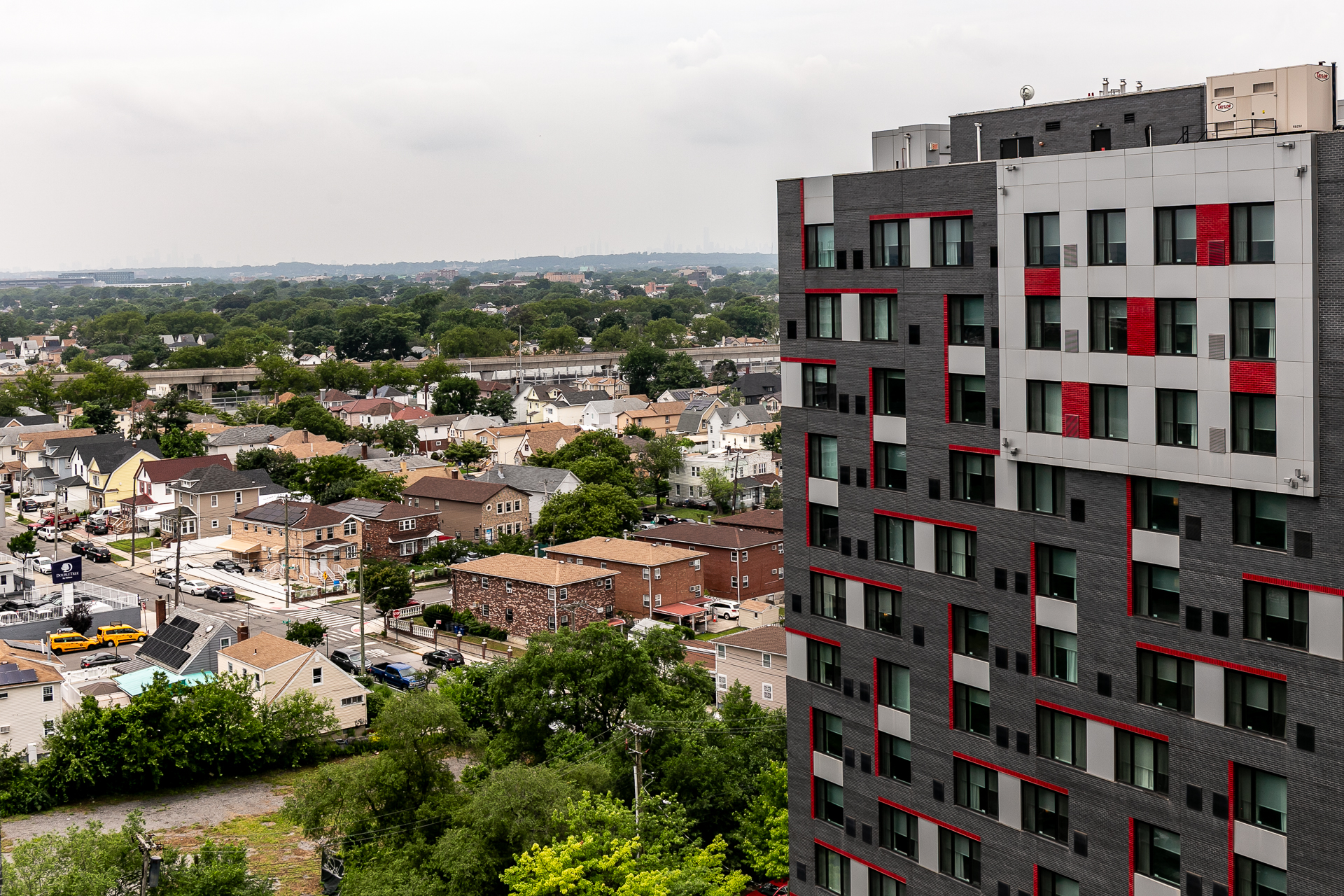
“I was shocked at how vividly the contrast of the city’s low and high density came to life when I visited the new exhibit at the Museum of the City of New York,” the author writes. “Today’s zoning code is for a city that no longer exists.”
Buildings in Jamaica, Queens. (Adi Talwar/City Limits)
I have long understood that New York City lacks available housing. Moreover, I know that approximately 50 percent of the city’s area is zoned only for one and two-family houses. But I was shocked at how vividly the contrast of the city’s low and high density came to life when I visited the new exhibit at the Museum of the City of New York.
Entitled “He Built This City: Joe Macken’s Model,” the work is a 27-by-50 foot model of New York City. It was done at a scale of one millimeter equals 10 feet. It’s so big that all of Staten Island does not fit in the gallery. It shows all the buildings of the city, from The World Trade Center to the houses at Breezy Point in the Rockaways. Mr. Macken spent 21 years making the model out of everyday balsa wood and cardboard. He started with 30 Rockefeller Plaza and then decided to do the buildings around it. Two decades later he had done the whole city. And remarkably, Joe Macken’s Model demonstrates before our eyes why we have a housing crisis.
What the model most powerfully shows is that most of the city is actually a suburb of one and two-story buildings. The New York of our minds, towering structures and vast numbers of people, is really quite limited. The downtown financial district and Midtown east and west are massive in Manhattan, but the rest of that island is much less imposing. Brooklyn at the end of the bridge, Long Island City, recent towers along the East River and, interestingly, public housing developments stand out. Parks are beautifully crafted, but their relative absence in vast stretches of the Bronx, Brooklyn and Queens is painfully clear.
Strikingly, the model is a three-dimensional rendering of the 1961 zoning map.
New York City introduced the country’s first zoning code in 1916. It was designed to regulate urban planning principles that evolved in the 19th century. High density was considered a problem. Separation of classes and uses was promoted. Residences in manufacturing districts were not allowed. Otherwise, homes were, more or less, as of right. The automobile was barely mentioned.
The implementation of the code occurred at the same time that the newly consolidated city committed to vastly expanded subway service. Residents of overcrowded Manhattan could find homes in the new “subway suburbs.” The 1920s witnessed an explosion of housing in Brooklyn, the Bronx and Queens.
Over 400,000 apartments, 100,000 single-family houses and another 100,000 two-family homes were constructed in this decade. The apartments were predominantly in four, five and six story middle-sized buildings. The expanding subway stitched these new neighborhoods together. Unfortunately, it all came to a stop with the Great Depression in 1929.
The financial suffering of the 1930s and the world war during the first half of the 1940s suppressed neighborhood expansion. By 1940, subway extension had ended. However, car use continued to grow, even if slowly. The development of the outer boroughs where the subways had not reached became organized by automobile use.
The post-war era of the GI Bill and the reemergence of the auto industry was the time of the suburbs. The growth of New York City’s population started to slow. The 1960 census was the first to show a reduction of the number of New Yorkers. Thus, Mayor Robert Wagner Jr. oversaw a major revision of the zoning code in 1961.
It was far stricter than the original code. Separation of uses—residential, commercial and manufacturing—was even more exacting. Given the assumption that the city would no longer grow, density was restricted. Half the city was zoned for only one and two-family houses. The middle-sized apartment building became highly restricted. Joe’s model shows it all.
New York continued to shrink through the 1980 census and then turned around. The 2020 census showed 8.8 million New Yorkers, a 20 percent increase from 1980. The 1961 zoning code, however, did not respond to this dramatic change. Under Mayor Michael Bloomberg the code was amended for even lower densities.
Today’s zoning code is for a city that no longer exists. New York needs a new zoning code. The city requires a construction surge at the scale of the 1920s. The current code will not allow it. It also needs its subways extended to make higher densities livable.
Those committed to a single-family house and a garage can have them—somewhere else. For those who want to live in New York, densities have to rise. A new code can make that happen. Joe Macken’s model shows in three dimensions where we need to build.
Charles Lauster is an architect in New York City whose firm does institutional work and public planning.
To reach the editor, contact Jeanmarie@citylimits.org
The post Opinion: What a Model of NYC Reveals About Our Housing Crisis appeared first on City Limits.
Leave a Reply