
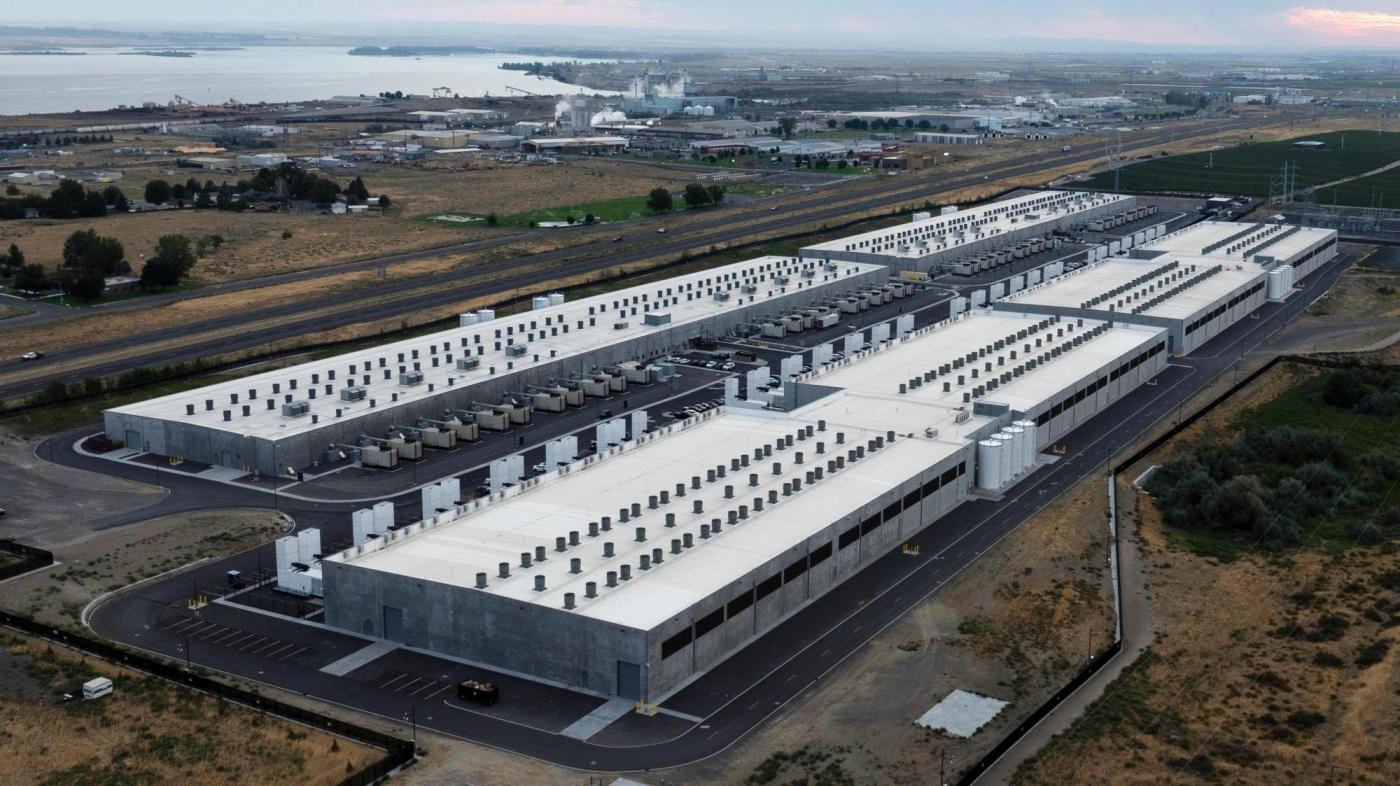
Environmental advocates and residents who live near proposed data centers called for a moratorium on new hyper-scale data centers and other restrictions at a Wednesday rally at the state Capitol in St. Paul.
The call for a pause in construction across the state comes as several projects — including in Becker, North Mankato and Hampton — have halted as developers cite strenuous permitting processes in Minnesota and other states making it easier for new development. On Tuesday, in what’s believed to be a first in Minnesota, the Eagan City Council approved a one-year moratorium on new projects. And in Farmington, the mayor recently resigned following a heated public debate about a proposal there.
Some projects are still on track. A 280-acre development in Rosemount for Meta, Facebook’s parent company, is under construction. Hermantown city officials recently rejected citizens’ requests for further environmental scrutiny of a 200-acre site for a data center proposal, though a lawsuit is ongoing.
As of this fall, at least 13 hyper-scale data centers had been proposed across the state — most not yet under development, and some canceled. Eleanor Dolan with “Stop the Hermantown Data Center Group” estimated that there may be up to 23 now.
“In our community, we have seen how politicians signing non-disclosure agreements, how insufficient environmental reviews and powerful corporations pushing through unwanted projects on our residents causes harm,” she said.
In the 2025 legislative session, lawmakers passed a standalone “data center bill” as part of a budget deal that repealed an electricity tax exemption for data centers. The bill also upgraded existing state tax exemptions on hardware and software to until 2042 or for 35 years, whichever comes “later” — instead of until 2042 or for 20 years, whichever comes earlier.
Republican lawmakers last year tried to push pro-data center legislation, such as permitting reform, but they didn’t make it out of committee.
Sen. Jennifer McEwen, DFL-Duluth, said Wednesday she will be introducing a moratorium on new data center construction that would be in place until a comprehensive study and regulatory framework on data centers is enacted.
“It is alarming to see how these giant corporations are influencing data center-related discussions and legislation in committee, but are not showing up often in person to answer our questions,” she said.
Sen. Erin Maye Quade, DFL-Apple Valley, said she will be introducing legislation to prohibit the use of non-disclosure agreements for data centers. She said she’s also looking to end tax exemptions for big tech.
“The emergence and quick integration of AI against our will into our everyday lives is deeply problematic, and it’s deeply unpopular, and it is why these big tech corporations have to use NDAs to get their data centers, because if people knew they were happening … they would stop them,” she said.
Kathy Johnson, a resident of Farmington, spoke to the lack of transparency her city has seen on data centers.
“These companies see opportunity in small towns. They see limited state regulation. They see local governments without the technical resources to fully evaluate the utility-scale industrial projects,” she said.
Johnson said information about scale, noise, light, fuel storage, water consumption and more only emerged after the permitting process was well underway.
“That is not transparency, that is a predatory strategy at its best,” she said.
Johnson said Farmington residents have turned to legal action because “citizens are ignored, dismissed, overridden, and the democratic process has failed.”
Residents from other areas where data centers have been proposed joined the rally on Wednesday.
Rebecca Gilbertson, of Hermantown, said 17 resident parcels were rezoned as a result of the project there. Aubree Derksen, from Pine Island, said “Project Skyway” is projected to be a 482-acre project with a 3 million-square-foot data center.
Data centers, which support artificial intelligence, social media, online commerce and other digital applications, require large quantities of electricity and water to keep the systems running and cool.
There are few comprehensive studies on the environmental impact, but a 2024 report released by the Department of Energy found that data centers consumed about 4.4% of total U.S. electricity in 2023 and are expected to consume approximately 6.7 to 12% of total U.S. electricity by 2028.
Related Articles
Online seller eBay to buy secondhand fashion marketplace Depop from Etsy for $1.2B in cash
24-hour ‘hackathon’ at St. Thomas asks creators to use AI to fight hunger
Mark Zuckerberg quizzed on kids’ Instagram use in social media trial
EU privacy investigation targets Musk’s Grok chatbot over sexualized deepfake images
What to know about the homeland security shutdown
Leave a Reply