
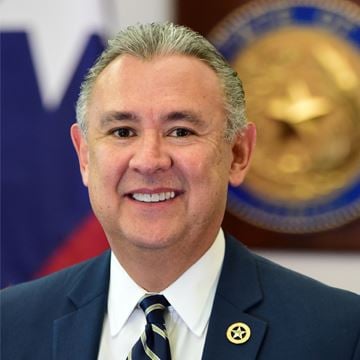
After nearly eight years—two terms—in power as the top prosecutor in Texas’ fourth largest county, Democratic District Attorney Joe Gonzales is not running for reelection in Bexar County. And while there is no clear successor, there is no shortage of contenders on the crowded Democratic primary stage.
Eight candidates are vying to be the Democratic nominee for DA in this solid-blue county. As a debate between those candidates on February 3 emphasized, there are plenty of differences in personality and temperament between the candidates, but not much daylight in their proposals for how to address some of the office’s most pressing issues. (The Democratic nominee will go up against the sole GOP candidate, Ashley Foster, in the November general election).
Without a clear frontrunner or heir apparent, Gonzales told the Texas Observer the race is wide open—“nobody on the ballot has any kind of edge or lead,” he said. That leaves a big impending hole at the top of a prosecutor’s office that handles about 60,000 criminal cases a year.
With higher-profile politicians, such as longtime state Representative Trey Martinez-Fischer and District Court Judge Ron Rangel, opting against running, the Democratic field of candidates includes a motley crew of largely unknown figures—ranging from those on the left-ish who seek to carry on the torch of progressive reformers to past Republican candidates who vow to enforce a more punitive law and order.
So what’s at stake? In many ways, the viability of reform-minded prosecutors in a state that’s becoming increasingly hostile to criminal justice reform. Gonzales, who ousted the controversial incumbent Nico LaHood in the 2018 Democratic primary, was part of a wave of liberal prosecutors who got elected to DA offices in the major counties of Texas and nationwide. These officials, which have included at various points John Creuzot in Dallas County, Jose Garza in Travis, and the now-pariah ex-DA Kim Ogg in Harris, have prioritized keeping people out of the system through diversion programs and prosecutorial discretion.
But these blue-county DAs have increasingly prompted legislative and political backlash in recent years–including with the Republican-held Texas Legislature passing a so-called rogue DA law that allows the state to recall and replace elected local prosecutors for not pursuing charges for certain types of crimes like low-level drug possession, or, in the wake of Roe v. Wade’s overturning in 2022, refusing to prosecute abortion providers.
Even as Attorney General Ken Paxton seeks higher office, his potential GOP successors are all promising to keep would-be rogue DAs at heel—and Republican leaders at the Capitol are likely to keep pressing new ways to micromanage local prosecutors.
“I do think that whoever ends up in the seat is going to continue to see the pushback that I’ve seen from Austin,” Gonzales said.
On the ballot for the March primary are three current prosecutors in the Bexar County DA’s office: Oscar Salinas, Jane Davis, and Angelica “Meli” Carrión Powers. Three former prosecutors, now in private practice, are also gunning for the role: Shannon Locke, Veronica Legarreta, and Meredith Chacon. Former Fourth District Court of Appeals Justice Luz Elena Chapa and James Bethke, director of Bexar County’s Managed Assigned Counsel Office, which helps provide defense attorneys to defendants who can’t pay, are also running.
This choice overload will almost certainly lead to a runoff election in May.
Bexar County District Attorney Joe Gonzales. (Bexar County)
Voters are being asked to choose from a slate of mostly qualified candidates, with varying levels and breadth of law experience. In part, it may come down to whether voters think experience in the DA’s office is important, or if they think a new perspective is needed.
Current prosecutors push for the former. “In order to inspire confidence from within the people that try the cases day to day, they have to think, well, ‘you were just in my spot last week,’” Salinas, who’s been a prosecutor for 12 years, told the Observer.
Jane Davis, 78, has worked in the Bexar County DA’s office for decades and currently leads the Juvenile Division. “I love this office. I’ve been here for 40 years. I don’t want to see it go to pot,” she said in an interview. She clinched an endorsement from the San Antonio Express News shortly before early voting started this week.
Powers, who didn’t respond to the Observer’s request for an interview, was an assistant DA in Bexar County from 2002 to 2017 has run the office’s Family Violence Division since 2019.
Bethke has spent about 30 years building programs to make defense attorneys more accessible to low-income defendants, and has led the Bexar County office for five years. He doesn’t see much of a difference between the goals of a prosecutor and a defense attorney. “At the end of the day, whether you’re defense or prosecution, a guiding light for me is equal justice for all,” he said. “A prosecutor has the ultimate control on determining what cases to bring in, what to charge, whether or not to defer into a different type of program.”
Notably, the Texas Organizing Project PAC, an influential progressive group that advocates for bail reform and previously helped elect reformer DAs in Texas, including Gonzales, has thrown its weight behind Bethke.
Meredith Chacon, who has previously worked as both a victim’s advocate and a prosecutor, stated in the debate that “not all experience is the same.” She’s been a prominent critic of Gonzales, and even tried to challenge him in 2022 as a Republican (she lost the GOP primary to now-state Representative Marc LaHood, brother of Gonzales’ predecessor). Legarreta, who’s also run for office as a Republican before, said during the debate that the DA should have a “balanced” perspective on the system. Chacon and Legarreta did not respond to the Observer’s interview requests.
If there’s a spectrum of progressivism in the Democratic primary race, most candidates sit in the middle, promising to balance reform with being “tough-on-crime.” At the most progressive end of the spectrum is Locke, a defense attorney with an active presence on TikTok, who has consistently called for the DA’s office to investigate ICE officers and promises to use the position to fight back against President Donald Trump’s agenda.
“The District Attorney’s office is the place in local government where you can most effectively resist the Trump administration and what’s happening in Austin,” Locke told the Observer. “When I talked to the people that were going to run [for DA], they didn’t see the office that way.”
On the other end of that spectrum is the former Appeals Court Justice Luz Elena Chapa, who is endorsed by the San Antonio Police Association and Bexar County Deputy Sheriff’s Association and who claims the current DA regime’s purportedly lax prosecution policies has caused a “public safety crisis.”
Chapa, 52, was the clear target of disdain from other candidates during the early February debate, largely because of her lack of prosecutorial experience and her vague plans to “fully fund” the office, despite that decision lying with the County Commissioners Court. “Anyone saying that they’re going to fund or they’re going to do all of these magical things to get money—that’s an uninformed position because it’s not that easy,” Powers said during the debate. “The DA’s office doesn’t control the budget.”
After referring to her opponents as “junior prosecutors,” Chapa also drew an impassioned rebuke from Locke. “If you think you know everything, you’re a big danger to this community, especially when you know nothing,” he said.
The next DA will inherit an office that’s understaffed and struggling to manage caseloads that are growing in step with San Antonio’s population. Many of the candidates have been openly critical of Gonzales’ handling of these problems.
In his six-plus years in office, Gonzales has led the Bexar County DA’s office through the turmoil of the COVID-19 pandemic, which halted grand juries and led to a massive backlog in cases. Winning on a platform of “true criminal justice reform” in Bexar County, his efforts have made him a lightning rod for attacks from the right and his own party.
As political pressure and tough-on-crime rhetoric from the state’s GOP leaders grows, some candidates say that Gonzales has been too outwardly defiant and has put a target on the back of the DA’s office.
“Discretion needs to be used responsibly, and you can’t broadcast that you’re not going to prosecute a certain type of criminal offense,” Salinas told the Observer. During the debate, Davis suggested the office shouldn’t “brag” so much about its progressive moves.
Many of the candidates argue that the DA’s office needs to repair its relationship with local law enforcement. In 2021, Gonzales established a Civil Rights division, tasked with handling cases of excessive force, officer shootings, and custodial deaths—a move that drew the ire of the law enforcement lobby.
“Police associations believe that I created that department in order to go after cops. That’s not what that’s about,” the incumbent said. “That’s about holding everyone accountable, because I’ve said from the very beginning that no one is above the law.”
Still, the candidates do broadly support the incumbent’s less controversial reforms—at least among Democrats—such as the “cite-and-release” program he implemented, which allows officers to choose to issue a fine rather than arresting someone for a low-level crime like minor drug possession. The goal was to reduce the strain on the DA’s office and lessen the penalties for people committing nonviolent crimes. It would also clear up space in the system for violent crime—but detractors argue it lets people stay on the street to commit more crimes. LaHood had tried and failed to implement a similar policy.
Since the program launched, Gonzales said it has kept 13,000 people from being arrested for low-level offenses. All of the Democratic candidates the Observer spoke with approved of the program. Almost all of the Democratic candidates have said the office should focus on violent or “repeat offenders,” which has been a focus of the office strategy for years now.
Staffing and office morale have also been a consistent problem, according to some of the more than 140 people who left the Bexar County DA’s office during Gonzales’ terms. People complained of overwork, low pay, and micromanagement.
Gonzales points to Senate Bill 22, passed in 2023, which gave rural counties more money to fund their prosecutors’ offices. He said this led to a drain of experienced prosecutors from Bexar County, in search of more pay for lighter case loads. It’s unclear whether any of the candidates will be able to solve the staffing problem in the office, although several have argued that training and some workload shuffling may do the trick, in the absence of more money from the county.
No one is running as a self-appointed successor to Gonzales’ regime. And indeed Gonzales has refrained from endorsing anyone in the primary. But he did say that if one of his current division directors—Davis or Powers—makes it into the runoff, they will get his official support.
How much that nod would help remains to be seen.
The post A Motley Crew of Dems Vie to Become New Bexar County DA appeared first on The Texas Observer.
Leave a Reply