
It’s Valentine’s weekend, and while in my opinion this is one of those holidays driven by greeting-card companies, restaurants and flower shops, it’s still a wonderful holiday and fun for lovers, young and old. I have some celestial suggestions to make this year’s Valentine’s weekend special.
How about this? After a wonderful candlelit dinner, may I suggest a great way to top off your celebration is to drive to a dark spot, preferably in the countryside, park the car, turn on some soft music and go outside and gaze at the night sky. Make sure you’ve thought ahead and have an extra winter coat and thick blankets in the car. Really do it right and have some reclining lawn chairs in the trunk so you can relax and snuggle under the celestial theater of love.
The old reliable for lovers is the full moon, but unfortunately, it’s not happening for this year’s Valentine’s Day. Also, the bright planet Venus, named after the Roman goddess of love, is also a no-show, so you’ll have to be a little more creative. Start out with this as a warm-up. The brightest “star” in the early evening is actually the planet Jupiter, beaming away in the southeastern sky. It’s the largest planet of our solar system, more than 88,000 miles in diameter. Look into your sweetie’s eyes and say that your love is vaster than Jupiter. Don’t mention, though, that Jupiter is basically a big ball of gas.
(Mike Lynch)
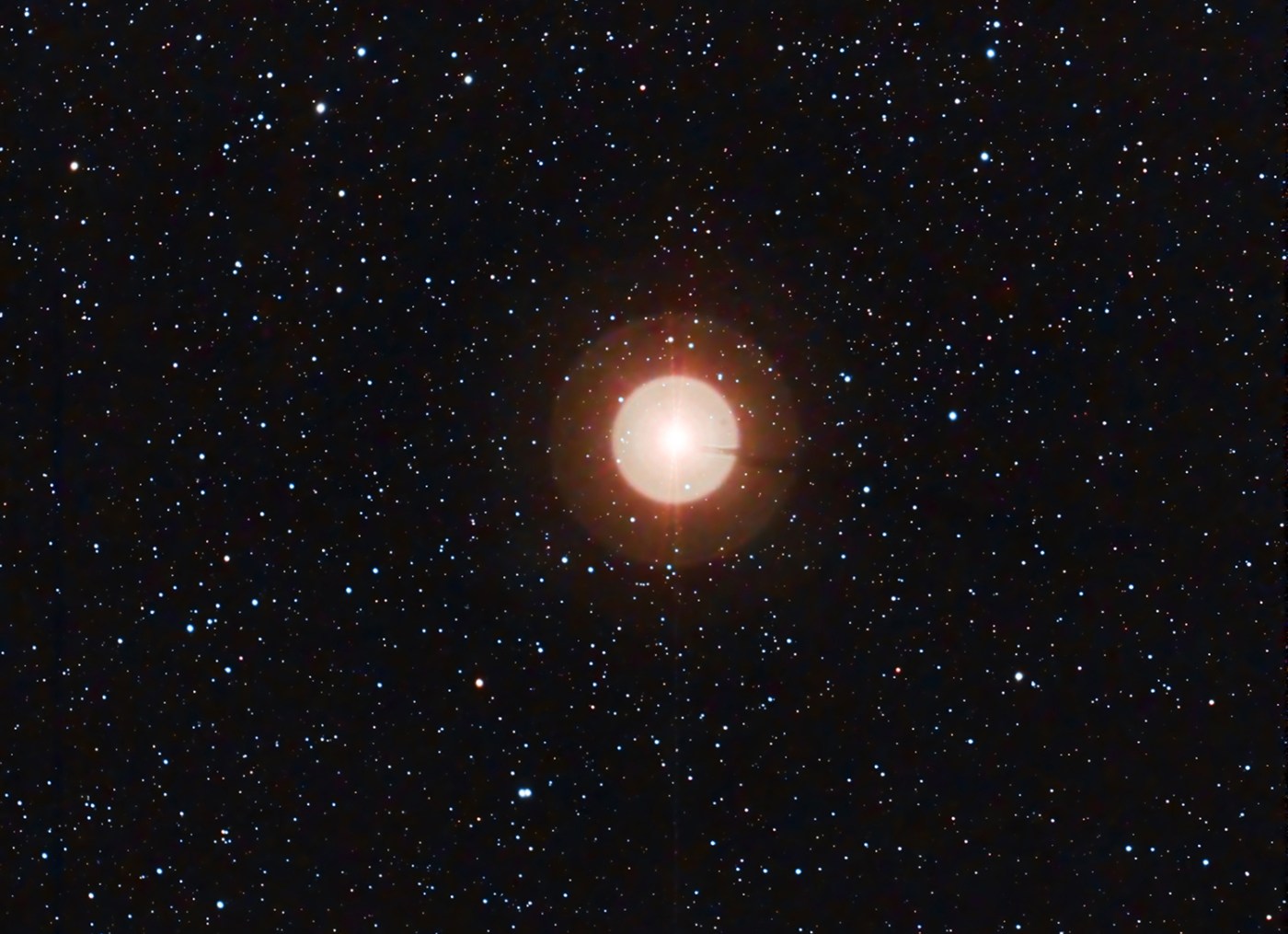
Next, show your significant other the bright star Betelgeuse (pronounced “beetle-juice”), in the mighty constellation Orion the Hunter. It’s not all that far away from Jupiter this year in the southern heavens. Just look for the three bright stars that make up Orion’s belt. Betelgeuse is a bright reddish star to the upper left of the belt. It marks the right armpit of the nocturnal hunter, not exactly in the spirit of Valentine’s!
Betelgeuse (Mike Lynch)
Betelgeuse is still a great Valentine’s star, though, because it’s a super red giant star, about 600 light-years away, with just one light-year equaling nearly 6 trillion miles. Not only is it a red star, but it’s really perfect because it beats like a giant cosmic heart. Every six years it goes from about 500 million miles in diameter to well over 700 billion miles. Even at its smallest, Betelgeuse is way bigger than our sun, which isn’t even a million miles in diameter. In fact, you could fit at least 160 million of our suns inside Betelgeuse. By the way, our Earth is only about 8,000 miles across. Feeling small?
Betelgeuse is so huge that if you were to put it in our solar system in place of our sun, it would swallow the planets Mercury, Venus, Earth and Mars, possibly reaching out to Jupiter! Our Valentine star Betelgeuse is nearing the end of its life. It won’t die of a broken heart, but within a few million years it’ll suddenly and violently explode, what astronomers call a supernova explosion. No one knows for sure exactly when that’ll happen, but when it does Betelgeuse could temporarily be as bright as a full moon.
(Mike Lynch)
One more nice Valentine in the night sky is rising in the east, just above the horizon. It’s a formation of stars that resembles a backward question mark rising on its side. That’s the chest and head of the constellation Leo the Lion. The love angle here is twofold. If you see the constellation as a lion, you can say that it symbolizes that you’re the “king or queen of the beasts” in the jungle of love. If you’re not sure about that one, and I can’t say I blame you, just tell the love of your life that the backward question mark is a sign that there’s no question about your future together. OK, that’s another reach!
After you enjoy the Valentine’s wonders of the night sky that I’ve humbly suggested, the rest is up to you. Make it heavenly!
Mike Lynch is an amateur astronomer and retired broadcast meteorologist for WCCO Radio in Minneapolis/St. Paul. He is the author of “Stars: a Month by Month Tour of the Constellations,” published by Adventure Publications and available at bookstores and adventurepublications.net. Mike is available for private star parties. You can contact him at mikewlynch@comcast.net.
Related Articles
Skywatch: A disgraced charioteer turned goat farmer
Skywatch: Jupiter and the great winter constellations dominate February night skies
Skywatch: Jupiter’s dancing moons
Skywatch: There’s a giant on the rise
Skywatch: Orion, victim of a sting operation
Leave a Reply