
Wa Chi Minh Vang spent nine years in jail in Vietnam, where he ran afoul of government operatives for preaching Christianity within the country’s tight-knit Hmong community. His father, he said, died in jail, but Wa Chi Minh Vang never stopped advocating for greater religious freedom through his “Hmong United for Justice” YouTube channel, which he ran for years from Minnesota in an attempt to rally fellow refugees to the cause.
After seven years in a refugee camp in Thailand, his sister Thi Dua Vang, her husband and five other members of their family were finally able to join him in St. Paul in December 2023, when eight Hmong-Vietnamese families arrived together in the Twin Cities. The area’s Hmong-Vietnamese Christian community had suddenly nearly doubled in size.
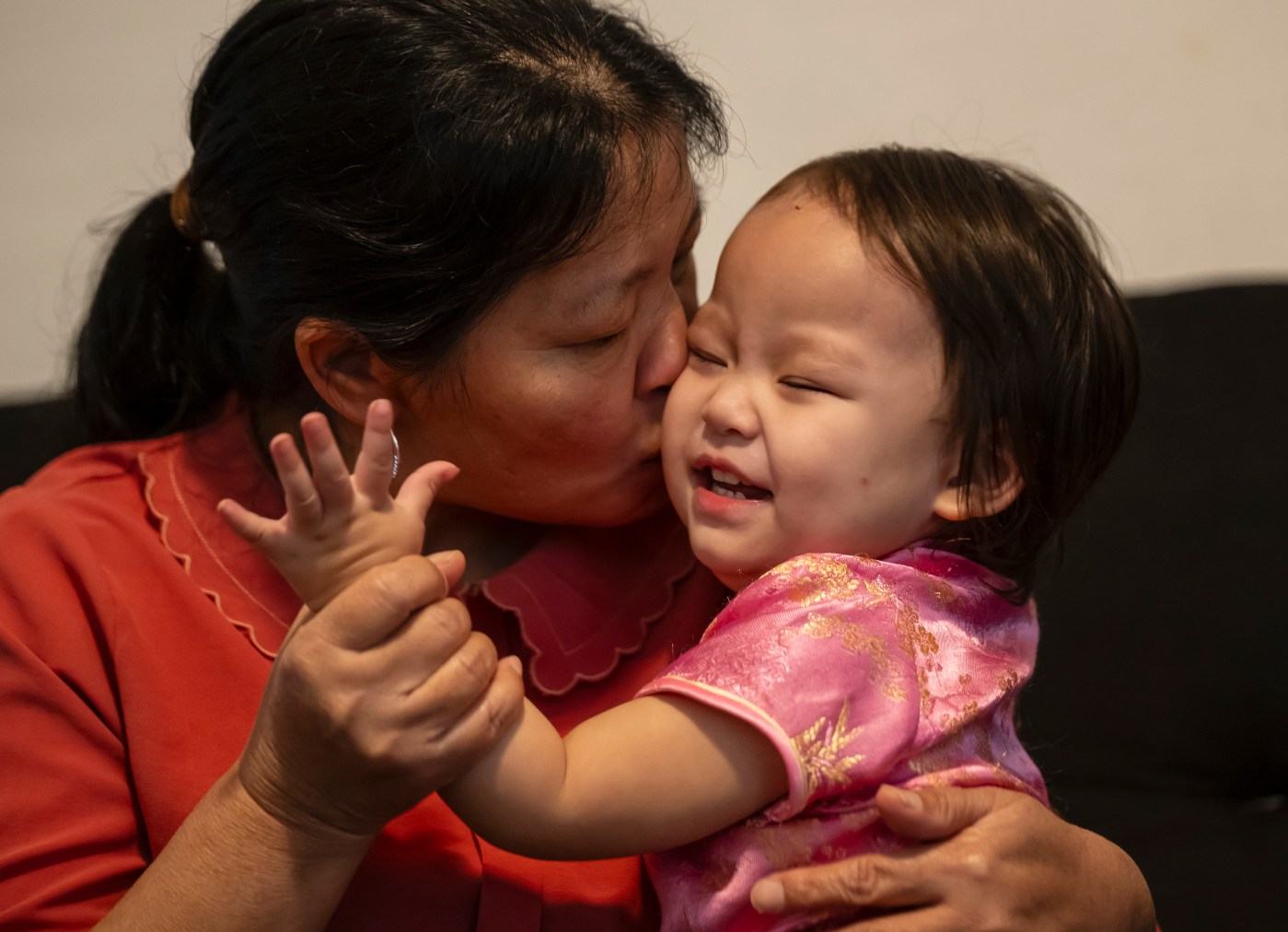
Thi Dua Vang kisses her one-year-old granddaughter, Pang Chia, as she and her husband, A Pao Giang, speak with journalists at an undisclosed location on Tuesday, Feb. 10, 2026. (John Autey / Pioneer Press)
“We’re very, very small,” said Wa Chi Minh Vang, sitting with his sister, her husband and their granddaughter, who remain in hiding together in Minnesota following Thi Dua Vang’s two-week detention last month by federal Immigration and Customs Enforcement agents. “We’re just 20 families.”
Wa Chi Minh Vang talks about his sister, Thi Dua Vang, with journalists at an undisclosed location on Tuesday, Feb. 10, 2026. (John Autey / Pioneer Press)
Thi Dua Vang’s life changed on the morning of Jan. 8, and not for the better. At 7:40 a.m., federal agents knocked on the door of her St. Paul rental home. Thi Dua Vang, a grocery worker, had put in late hours the night before and was still in bed, but her 11-year-old son opened the door.
“Do you know this guy?” they asked him, showing him a name. “Oh, that’s my mom!” her son replied.
“Where’s your mom?” they pressed.
“My mom’s still sleeping,” he said.
Within minutes, the federal agents had roused Thi Dua Vang from bed. Two years after relocating to Minnesota, praying for a better life, the 49-year-old’s next ordeal began. She and her husband are in the U.S. legally and in the process of acquiring green cards.
In the month since, her experience has underscored the scope of both Operation Metro Surge and Operation PARRIS, two federal efforts that claim to focus on detaining “the worst of the worst” while re-interviewing lawful refugees whose permanent residency applications are still in the pipeline. Critics, from civil rights advocates to federal judges, have pointed to detentions like Vang’s as they question why the federal government’s tactics have aggressively detained unwitting, everyday workers who have no criminal history and face no criminal charges.
In a written statement, a media office for the U.S. Department of Homeland Security said of Thi Dua Vang: “This individual was in the United States without legal status and was arrested by ICE. They have been released on bond and will have their day in court.”
A two-week ordeal
Meanwhile, in Thi Dua Vang’s St. Paul home, the federal agents explained they needed to check paperwork related to her application for a permanent residency credential known as a green card.
After spending two weeks in federal detention, Thi Dua Vang, right, tearfully embraces her husband, A Pao Giang, outside a federal facility in Houston, Texas on Jan. 21, 2026. (Courtesy of Wa Chi Minh Vang)
The agents collected all of the papers she showed them, including her personal I.D. and her Social Security card, in a bag. Then they quickly collected her and transported her to the Bishop Henry Whipple Building, a federal office building at Fort Snelling that has doubled as a detention facility during Operation Metro Surge, the Department of Homeland Security’s weeks-long immigration enforcement action.
The next day, she was boarded onto a plane to El Paso, Texas, where she was held for about a week in a chilly, prison-like setting, surrounded by other women, most of them Spanish-speakers. Unable to speak English or Spanish, Thi Dua Vang said she was at a loss to communicate with others around her. On Jan. 12, she was boarded onto yet another plane, where she was the only woman among a large group of Latin men.
From her best understanding of the situation, she recalled, she thought she was headed back to Vietnam alone.
“She has no criminal history,” said Wa Chi Minh Vang, at a loss to understand why the government would attempt to deport her, while translating questions from a reporter to her and her husband during a recent interview. “She has no criminal anything. She works in a grocery store and comes home. She’s been here just two years.”
The airplane taxied out toward the runway, and then taxied back, she said. Her name was called. She was taken off the plane and placed back in detention, with little understanding of why. Within three days, she was transported to another federal facility, this one in Houston, Texas, where she shared another chilly detention cell with 20 other women, most of them Spanish speakers.
During her two weeks in detention, food consisted of a light soup for breakfast, a potato for lunch and another for dinner. She was never offered the opportunity to go outside for fresh air, to stretch her legs or see the sun.
A court appearance on Jan. 20 resulted in an offer: she could get out of detention on a $3,500 bond. Her family, through an attorney, agreed to pay the sum, though it was unclear why she would be considered a flight risk or on what charges she was being held on. Wa Chi Minh Vang and her husband drove for the better part of two days, spending the night in Oklahoma City. At 3 p.m. on Jan. 21, they received an email indicating Thi Dua Vang would be freed within three hours.
Even driving as fast as they could without getting pulled over, they were still at least seven hours away.
Thi Dua Vang with her and husband Apao Yang talk to a reporter at an undisclosed location on Tuesday, Feb. 10, 2026. (John Autey / Pioneer Press)
Released, and then hounded
Released from the federal detention facility in Houston near 8 p.m. with her cell phone but no documents, Thi Dua Vang made a plaintive call to her family. She had nowhere to go but to linger outside the federal buildings, which would not allow her to stay in the lobby.
“Are you guys coming?” she asked. “They released me outside.”
Her husband and brother were still almost four hours away, they said. They asked her to use her phone to take pictures of her whereabouts so they could use the surroundings as landmarks to find her. At 11 p.m., the three were tearfully reunited, having overcome just the first two-week hurdle in what’s become an ongoing immigration nightmare.
Once back in Minnesota, Thi Dua Vang found she had lost her job at the grocery store as someone had already taken her place. She checked in with ICE officials, who told her to make annual visits to their office from now on. Her husband and brother brought her to Driver and Vehicle Services to see about replacing her missing I.D. and other documents confiscated but never returned by ICE.
Then, at 11 a.m. on Jan. 27, came another knock on her door. It was federal agents — again. This time, she knew not to open up for them. They returned on the afternoon of Jan. 31, but again walked away empty-handed, though it did not appear they walked far. Relatives spotted two large Black vehicles parked on either side of her home until 2 a.m. the next morning.
Since then, she’s gone into hiding with her husband, praying that ICE will finally leave her alone.
“She’s very, very scared,” Wa Chi Minh Vang said. Her husband is equally apprehensive but also optimistic. America is supposed to be the land of the free, he said. For two years, for his family, it had been.
“He’s scared of driving,” Wa Chi Minh Vang said. “He says, ‘We’re not angry. We suffered persecution in Vietnam and went to Thailand, and we came to this country. We trust God. We don’t have the power to do anything, but we trust God.’”
As of Wednesday afternoon, an online fundraiser on GoFundMe.com — tinyurl.com/ThiDuaFund — had raised more than $30,000 for Thi Dua Vang’s family from more than 770 donations.
Related Articles
With ICE using Medicaid data, hospitals and states are in a bind over warning immigrant patients
William Robiner: Power combined with anonymity is a recipe for cruelty
Letters: The pillars of my civic faith — the Constitution and voting — are under fire
Immigration crackdown, fraud top issues as Legislature prepares to convene Tuesday
Epstein’s girlfriend married a woman, showing how he gamed immigration
Leave a Reply