
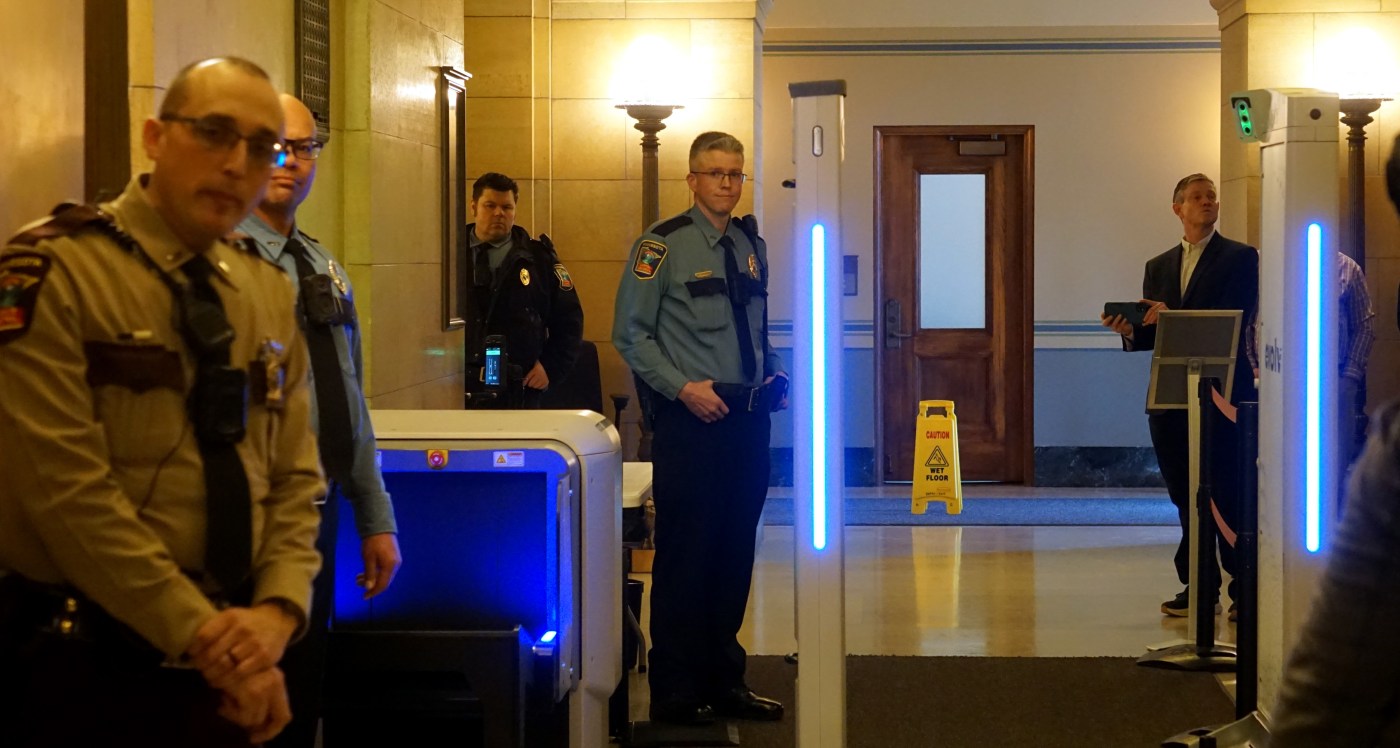
A new weapons screening requirement at the state Capitol will help keep prohibited weapons like knives out of the building when it goes into effect next week, but visitors will still be able to carry handguns if they have the proper permit.
Starting Tuesday, members of the public visiting the Capitol will need to pass through a metal detector and send their bags through an x-ray machine so security officers or State Patrol troopers can screen for banned items.
Banned items will include knives, explosives, and blunt-force objects like batons, as well as event or protest items like balloons, spray paint, chalk, or candles. But anyone with a permit to carry may continue bringing a pistol into the Capitol under state law.
If carrying a pistol, visitors will need to inform staff that they have a weapon and have a State Patrol trooper verify their permit and a government-issued identification. People carrying without a permit could face arrest.
Executive order
Gov. Tim Walz issued an executive order directing weapons screening last month based on the recommendations of an independent security assessment commissioned by state leaders in the wake of last summer’s violence against Minnesota lawmakers.
Minnesota was among a minority of states without security measures like x-ray scanners or metal detectors at its entrances. The June 2025 assassination of former House Speaker Melissa Hortman and her husband, Mark, and the shootings of state Sen. John Hoffman and his wife, Yvette, pushed the state to implement a long-debated security boost.
In July, a nude intruder broke into the Capitol and was discovered sitting in the Senate president’s chair by security officers — after state public safety leaders told news media that they had already boosted security measures. In response public safety leaders reduced the number of unlocked doors, installed new door alarms and boosted security presence at remaining open doors.
The state Capitol was wired to support metal detectors during major renovations completed in 2017, but the new capabilities sat unused for nearly a decade. Now, four entrances have both metal detectors and x-ray scanners. All visitors and staff will have to pass through screening, though state lawmakers, statewide elected officials, members of the state Supreme Court are exempt.
“No single measure eliminates all risk, but this one meaningfully reduces preventable risks and violence in a shared civic space where the public, elected officials and staff gather on a regular basis,” said Minnesota Department of Public Safety Commissioner Bob Jacobson at a Friday news conference.
Security checkpoints
The primary entrance for visitors is on the ground level under the south steps of the state Capitol, according to the Minnesota State Patrol. The other three security checkpoints are at tunnels connecting the Capitol to the Minnesota Senate Building, Minnesota Judicial Center and State Office Building.
Public safety officials did not have an exact estimate of how much the measures will cost the state, though the machinery at the four checkpoints cost around $200,000, a State Patrol spokesperson said. The state also had to bring additional officers to the Capitol, which will add to costs. Security expenses will be covered by the State Patrol’s budget, according to public safety officials.
The Capitol will remain accessible to the public between 8 a.m. and 4:30 p.m. on weekdays. Security will offer expanded hours during extended floor debates during the legislative session, which sometimes extend late into the evening or early morning.
Not a ‘weapons ban’
Col. Christina Bogojevic, chief of the Minnesota State Patrol, said the new weapons screening policy is not a “weapons ban” and does not change existing state law. It doesn’t change the rules on items allowed in the Capitol, but gives security more control over what makes it into the building, she said.
“In the past, we wouldn’t know if someone was carrying an illegal or a prohibited item if they hid it under a jacket,” Bogojevic said. “We wouldn’t know that unless it was used, and so again, this is a layer of security to allow us to see those prohibited items before they make it into the Capitol.”
The state Senate also is boosting security.
Starting on Feb. 17, the Senate will require members of the public to pass through a full-body scanner before entering the Senate Gallery, the observation area above the floor where members gather to vote. It’s also banning members of the public from carrying firearms in the Senate Gallery.
The 2026 Minnesota Legislature starts on Tuesday.
Related Articles
After one month, how is Minnesota paid leave holding up?
Burnsville takes new approach to implement affordable housing programs
Audit: Changing procedures may safeguard $1 billion in MN Medicaid programs
Greater Minnesota cities ask lawmakers to invest in ‘the basics’ as hot-button issues loom
MN governor hopeful Lisa Demuth focuses on fraud while visiting Moorhead
Leave a Reply