
By JENNIFER McDERMOTT and BRITTANY PETERSON
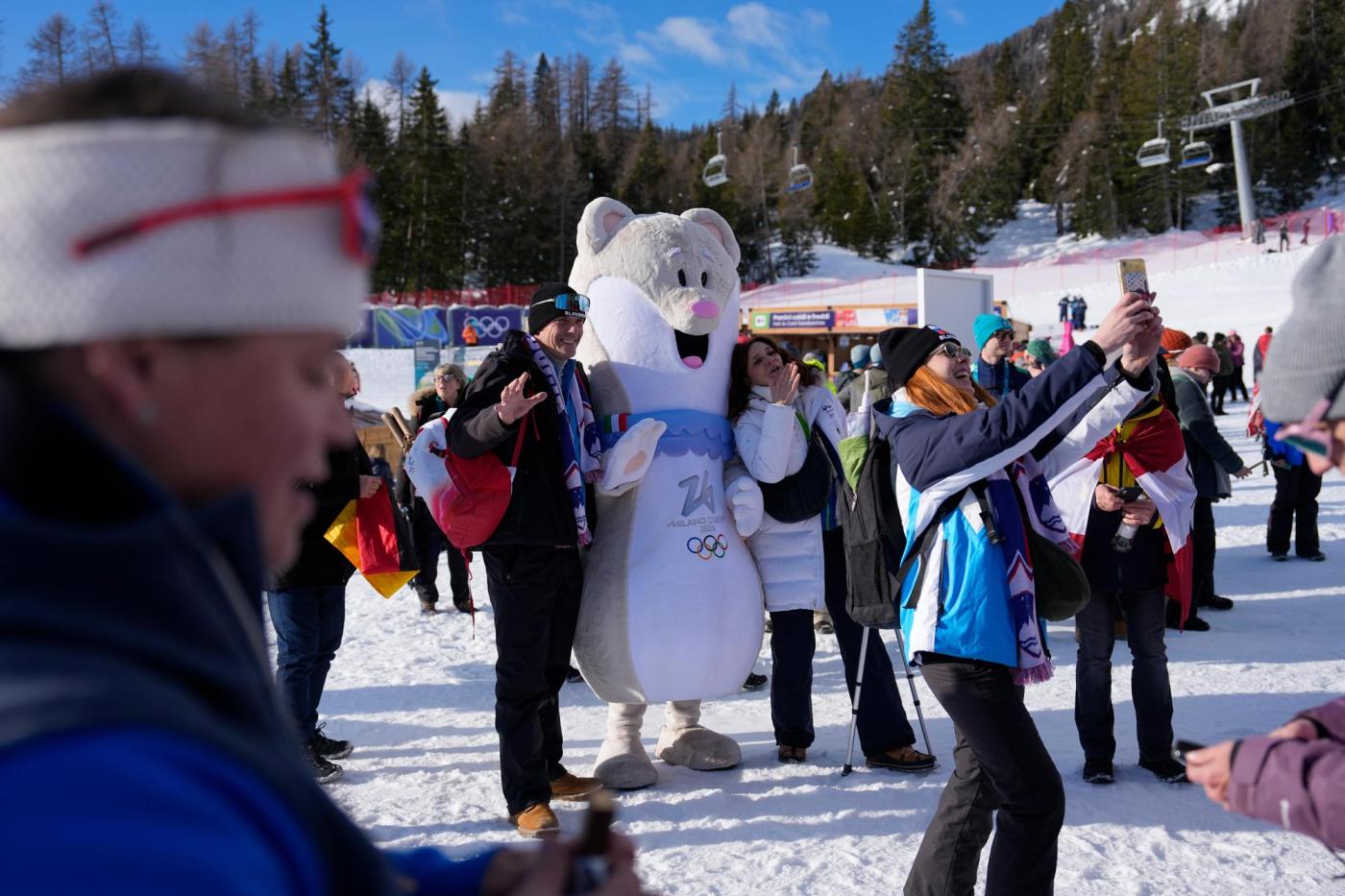
CORTINA D’AMPEZZO, Italy (AP) — The pair of animals chosen as mascots of the Olympic and Paralympic Winter Games are stoats — weasel-like creatures that are at risk because of climate change. One of them is brown and the other is white, because in cold climates, the tiny animals’ fur changes from brown to white for winter, to blend in with the landscape.
Related Articles
Olympic pin mania has collectors running between landmarks and swarming a trading center
His helmet honors Ukrainian athletes killed in war. The IOC barred him from competing
Jessie Diggins adds another medal to Olympics haul
Will American ‘Quad God’ Ilia Malinin try hardest quad of all in his last skate at the Olympics?
Ukraine’s Vladyslav Heraskevych out of Winter Olympics over banned helmet honoring war dead
However, stoats are increasingly turning white before there is any snow on the ground, leaving them vulnerable to predators — their snow-white coats amid dirt and rocks is like a target on their backs for sharp-eyed raptors.
Olympic organizers haven’t talked about that, at least not so far.
They say the mascots are meant to welcome people and communicate that these Games are infused with Italian spirit.
The white stoat mascot is Tina — short for Cortina, after Cortina d’Ampezzo, one of the two cities hosting the Winter Olympics. Her younger, darker-furred brother, Milo — after the city of Milan — was born without one paw and is the mascot for the Paralympics in March.
Their images are on magnets, bags and pins. But since stores sold out in the Games’ first days, it’s been nearly impossible to find a plush toy of the stoat siblings in Milan and Cortina d’Ampezzo.
Still, every medalist receives a toy on the podium, though, which means they stay in the public eye. And a costumed Tina is a regular at competition venues, spreading joy, greeting giddy spectators and posing for photos.
Embodying the ‘dynamic Italian spirit’
Marco Granata, a doctoral student who researches stoats at the University of Turin in Italy, thinks the organizers are missing out on an opportunity to educate people a bit more and help this animal.
“It’s ironic because everyone now is talking about stoats, looking for stoats, but no one knows about real stoats, mostly because the Olympic committee didn’t inform the population about it,” he told The Associated Press.
When asked by the AP in Milan on Thursday why no one is talking about the stoat and climate change, Olympic Games Executive Director Christophe Dubi said: “I’m glad you raised it and we should include that in our narrative.”
If the mascot speaks to the changing environment, and that message can be conveyed to the younger generation, “let’s use it,” Dubi also said.
An Olympic mascot dances near the finish line of an alpine ski women’s downhill training, at the 2026 Winter Olympics, in Cortina d’Ampezzo, Italy, Saturday, Feb. 7, 2026. (AP Photo/Robert F. Bukaty)
The Olympics’ website describes stoats as naturally curious — animals that “love sports and the outdoor life but they also want to have fun. They represent the contemporary, vibrant and dynamic Italian spirit.”
Raffaella Paniè leads the branding for the 2026 Milan Cortina Games and oversaw the mascot’s creation, crowd-sourced from young Italian students.
She told the AP she doesn’t think talking about the implications of climate change is within the scope of the organizing committee. There were so many options for messaging, and the committee needed a focus, she added.
They put a lot of effort into making the mascots very friendly. “That’s how the mascot comes to life really, makes it very special, more than what it is as an animal,” she said.
“We are organizing a sport event so we need to promote the culture of the country,” she added.
Needing ‘the right wardrobe’ to avoid predators
As climate change shortens winters globally, the stoat and about 20 other color-changing species are more frequently mismatched, said L. Scott Mills, an emeritus professor at the University of Montana.
Their seasonal molting is triggered by shortening day length — a cue that the seasons are changing — so it happens around the same time each year, even when there’s no snow, Mills added.
In this photo provided by Eduoardo Pelazza, a white stoat, known as an ermine, holds prey on Dec. 10, 2011, in Ormea, Italy. (Eduoardo Pelazza via AP)
“Most of their survival depends on avoiding predation and that depends on camouflage — having the right wardrobe when it’s snowing and when it’s not,” Mills said.
While stoats are not endangered, studies have shown that predators attack mismatched decoy weasels more than matching ones, Mills said.
Owls, hawks, coyotes and foxes all hunt for stoats.
Mills connected the camouflage mismatch phenomenon to climate change while studying snowshoe hares some 13 years ago. That was a “eureka moment,” he said.
Doctoral student Marco Granata reviews footage he captured of stoats, Wednesday, Feb. 11, 2026, in Turin, Italy. (AP Photo/Brittany Peterson)
Hope for the stoat
Granata, the doctoral student, tracks stoat populations in the Italian Alps, where they live at high altitudes. They were once hunted for their fur, for coats, but that is now prohibited in Italy.
He says the stoat faces a much more important threat, just like sports that rely on snow. Researchers say the list of places that could host Winter Games will shrink substantially in the coming years.
“I think that the Olympic committee came up with the perfect mascot for these Winter Games,” Granata said. “Both the stoat and the Winter Games share the same destiny. They look fine now, but they are increasingly impacted by climate change.”
A woman poses next to Milo, the mascot of the Paralympic Winter games in Cortina d’Ampezzo, Italy, Wednesday, Feb. 11, 2026. (AP Photo/Robert F. Bukaty)
Mills said stoats, which live across the Northern Hemisphere, may eventually be able to evolve to stay brown year-round if there is no snow. Conservation efforts help, along with steps to reduce emissions and slow warming, so stoat populations don’t decrease too much, he added.
Projections show that if stoats don’t adapt, the color-changing species will decline in numbers over the next couple of decades as the snow is reduced, Mills added.
“This is an example of the challenges of climate change, but also the potential for hope,” he said. “We have a way to prevent them from being lost.”
Peterson reported from Turin, Italy.
AP Winter Olympics coverage: https://apnews.com/hub/milan-cortina-2026-winter-olympics
The Associated Press’ climate and environmental coverage receives financial support from multiple private foundations. AP is solely responsible for all content. Find AP’s standards for working with philanthropies, a list of supporters and funded coverage areas at AP.org.
Leave a Reply