
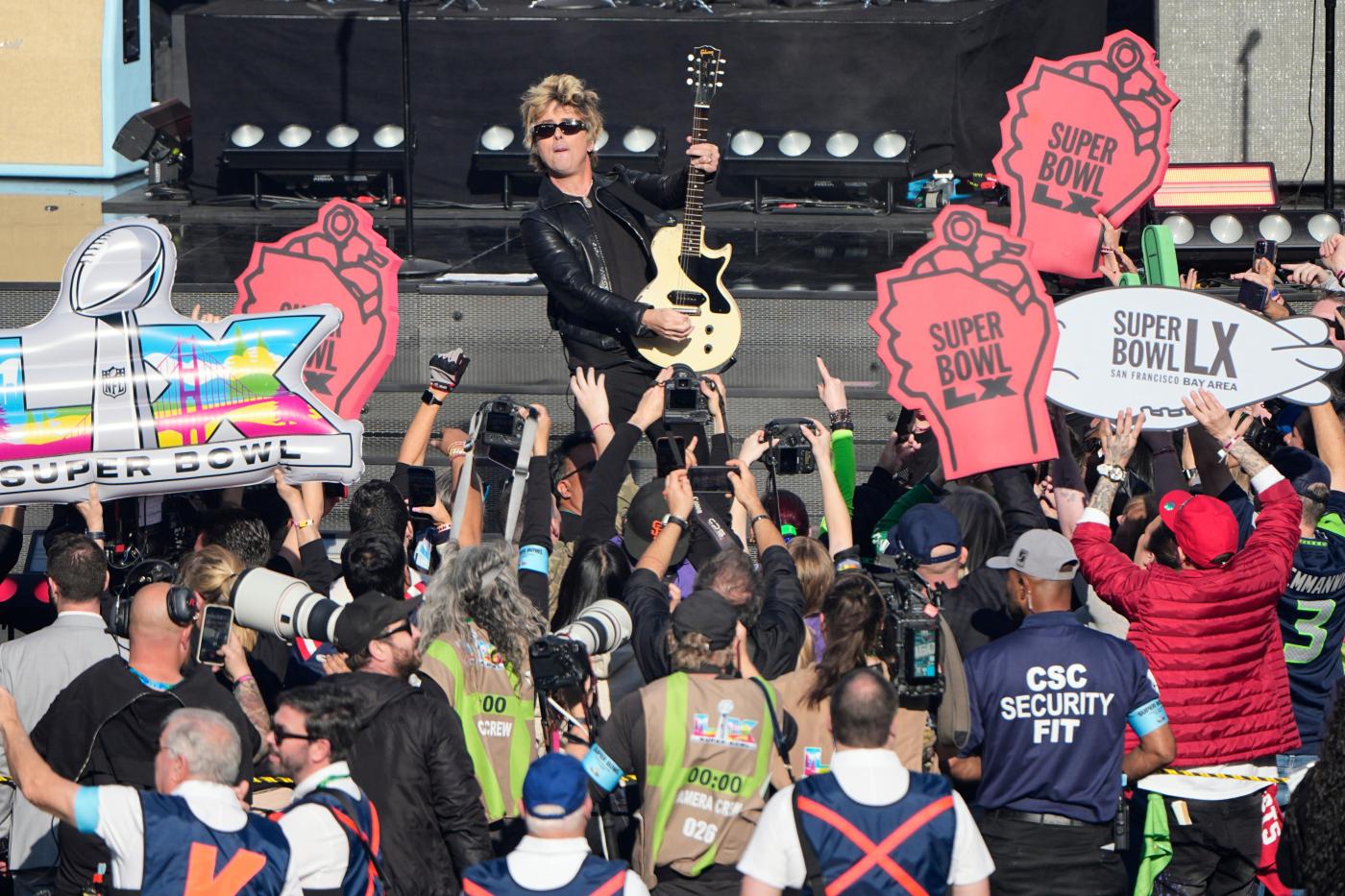
The pop-punk band Green Day performed a relatively uncontroversial medley of its hits at the opening ceremony before Super Bowl LX in Santa Clara, California, on Sunday.
But two days before that performance, during another Super Bowl weekend event, Green Day’s frontman, Billie Joe Armstrong, took to the microphone to call on Immigration and Customs Enforcement agents to quit their jobs.
“This goes out to all the ICE agents out, wherever you are,” Armstrong said from the stage of the FanDuel Party in San Francisco on Friday, before using expletives while telling agents to quit their jobs.
Sooner or later, he added, referring to top administration officials, “Kristi Noem, Stephen Miller, JD Vance, Donald Trump, they’re going to drop you like” a bad habit, again punctuating his remarks with expletives. “Come on this side of the line.”
The White House did not immediately respond to a request for comment Sunday.
Green Day has long been a sharp critic of President Donald Trump and his policies.
In 2016, the band led a “No Trump, no KKK, no fascist USA” chant while performing at the American Music Awards in Los Angeles. During concerts, Armstrong and bandmates have frequently changed the lyrics of their hit song “American Idiot” from “I’m not a part of a redneck agenda” to “I’m not a part of the MAGA agenda.” In 2023, the band released the protest song “The American Dream is Killing Me.”
Last month, Trump bashed Green Day as a musical selection for the Super Bowl’s festivities. “I’m anti-them,” he told The New York Post. “I think it’s a terrible choice. All it does is sow hatred. Terrible.” (The president has likewise disparaged Bad Bunny, the Puerto Rican artist who will headline the Super Bowl’s halftime show. He said recently that he would not attend the game, saying of Bad Bunny’s selection, “All it does is sow hatred.”)
Green Day is hardly the only act to use a Super Bowl appearance to make a political statement. Brandi Carlile, the gay singer-songwriter who performed “America the Beautiful” before the game, told Variety on Saturday that queer representation mattered in the current political moment.
“The through line to being queer and being a representative of a marginalized community, and being put on the largest stage in America to acknowledge the fraught and tender hope that this country is based on,” she said, “it’s something you don’t say no to. You do it.”
This article originally appeared in The New York Times.
Related Articles
‘I can’t tell you’: Attorneys, relatives struggle to find hospitalized ICE detainees
Letters: Don’t mistake TIF subsidies for real growth in St. Paul
A Hmong child bride who killed her husband years ago dreads her next ICE check-in
Stephen Mihm: ICE enforcement is echoing the Fugitive Slave Act
A month of learning, advocacy, frustration for St. Paul Mayor Kaohly Her
Leave a Reply