
If she could go back in time, she never would have married him.
Nou was 15 and living in a refugee camp in Thailand when she was wed to a much older man. She didn’t want to and, with decades of hindsight and regret, she wishes she had pushed back.
Now, she’s 50 and living in St. Paul. She is disabled from what she describes as years of abuse at her husband’s hands and from a suicide attempt in 2003. Her husband died the same day, in what she says was an act of self-defense, and she pleaded no contest to voluntary manslaughter.
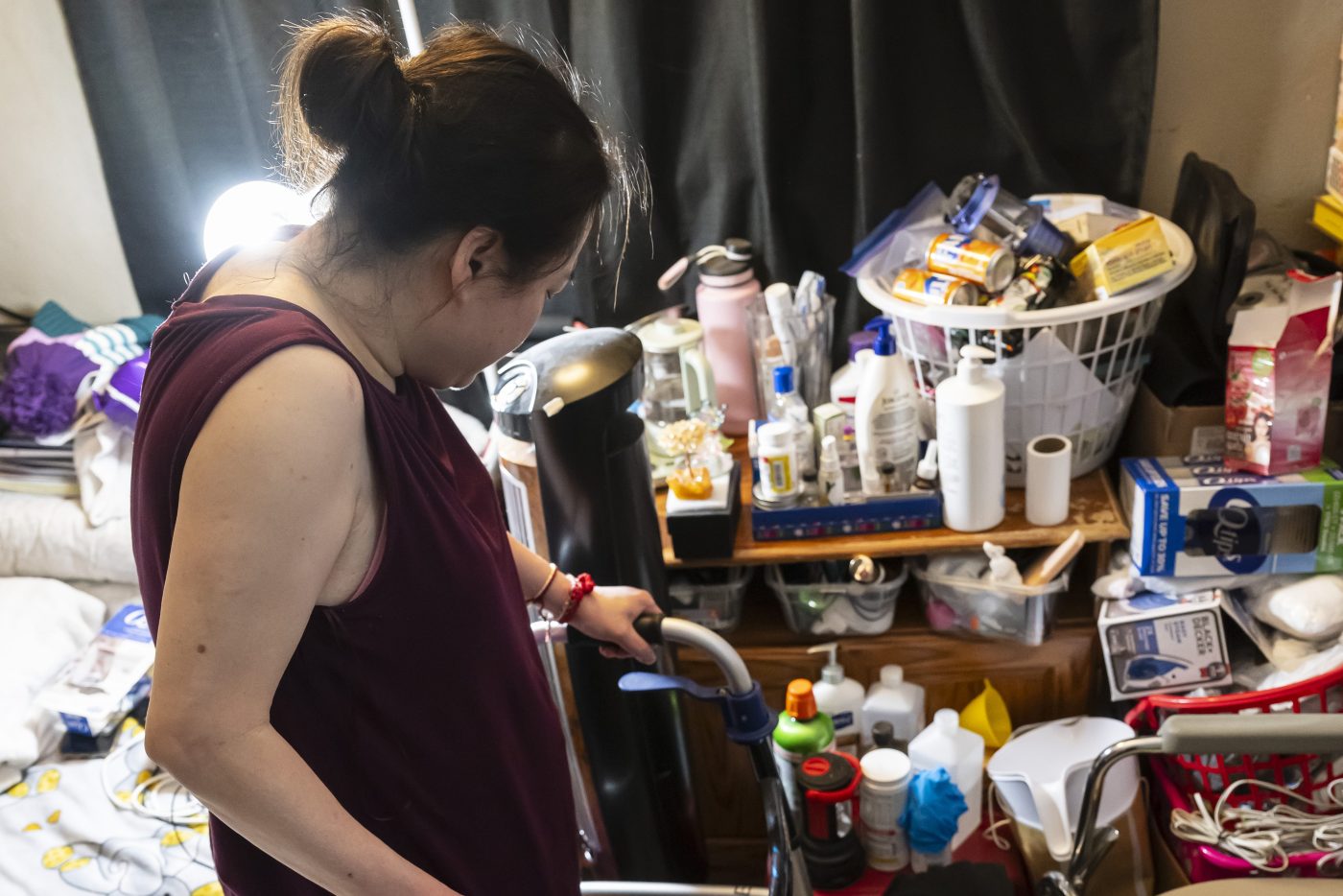
Nou uses a walker at her house and a wheelchair when she goes anywhere else, and her family cares for her everyday needs. She believes she wouldn’t survive detention or being deported to the country where she was born, Laos. (John Autey / Pioneer Press)
She served nearly seven years in prison and her green card was taken. U.S. Immigrations and Customs Enforcement issued a removal order to Nou, who asked to be referred to by only her first name due to safety concerns. The order was not carried out and she has to regularly check in with ICE.
Her next appointment with ICE is Tuesday and, given the current surge in immigration enforcement in Minnesota, she fears she will be taken into custody.
Nou cannot get around without a walker or wheelchair, and her family cares for her everyday needs. She believes she wouldn’t survive detention or being deported to the country where she was born, Laos. Due to the persecution of the Hmong people there, she and her family escaped to a refugee camp in Thailand when she was 2 years old.
As the Trump administration touts the “Worst of the Worst” they’ve arrested, Nou’s name and picture could wind up on their list: They’ve included people who’ve been convicted of manslaughter and who have removal orders.
The U.S. Department of Homeland Security said as of Wednesday that it had arrested more than “4,000 illegal aliens, including violent criminal illegal aliens, since Operation Metro Surge began in Minnesota” in December.
“We will not back down from our mission to remove criminal illegal aliens from American neighborhoods,” DHS Assistant Secretary Tricia McLaughlin said in a statement.
Amid the harsh stance from the federal government, Nou feels she has to talk about her life, so people can understand the circumstances as she pleads to stay with her relatives in St. Paul, though she doesn’t want to offend her deceased husband’s family.
She’s contacted organizations, looking for legal help, but hadn’t been able to find any as of Friday. Former St. Paul City Council member Dai Thao started a GoFundMe (gofund.me/fd04d955f) for Nou’s legal and medical needs.
“Nou has already survived more than most people should in one lifetime,” Thao wrote on the fundraising page.
Promised a good life in America
The man Nou married was around 40 years old when he visited Thailand from the U.S. He was Hmong and had become a U.S. citizen.
“He told me I was the most beautiful girl,” she said. He promised her a good life, saying she could go to school or they could open a business, she recounted recently. “He begged my mom and dad to allow him to marry me.”
But “I didn’t want to marry him because I was afraid that if I came to the U.S. and my parents were still in Thailand, if he doesn’t love me, I’d have nobody to love and protect me,” she said.
FROM THE ARCHIVES: ‘Open secret’ of child brides roils Twin Cities Hmong community
She said the man paid her mother $2,000 and promised to send $20 a month back to hire someone to do the chores she’d been responsible for, though he ultimately didn’t.
They were culturally married in 1992. She left Thailand in 1993 and moved to California to live with him. Her uncle, who was already in the U.S., sponsored her as a refugee and she obtained a green card in America, according to Nou.
Physical abuse, control over her life
The abuse started in 1994, Nou says, with her husband pulling her hair, pinching her and pouring cold water on her as she tried to sleep.
He would point a gun at her head and order her to have sex with his relatives or truckers parked nearby; she never did, she says, and would cry and beg for him to stop. He often accused her of infidelity, though she said she was faithful to him.
When he visited Laos, Nou said he would have his friends track her movements and record her phone calls. When he returned home, there were many times he’d point his gun at her and threaten her.
“He wanted to murder me so that nobody would know how I died, that it would be a mystery,” Nou said.
Nou said her husband controlled most aspects of her life: She worked, providing in-home support to people who were elderly or disabled, and he took the money from her paychecks. He didn’t allow her to drive for her first seven years in America, and would later take away the car keys after he beat her so she couldn’t escape or get help. And he blocked her from seeking citizenship, including ripping up her paperwork.
“He knew that once I got my citizenship, I would have more rights,” she said.
She briefly took a class to learn English, and the teacher mentioned they could get their pictures taken for free for citizenship documents.
“I sat all day, waiting for that picture. I was able to start the process,” she said, speaking through a Hmong interpreter.
But her husband didn’t want to get legally married and sponsor her to become a citizen because he talked about doing so for another of his wives, Nou said.
He told her to never contact police
On a day Nou returned home late from running errands, she said her husband beat her head so hard that he broke his own knuckle.
Related Articles
Appeals court affirms Trump policy of jailing immigrants without bond
Protesters arrested outside Whipple federal building on 1-month anniversary of Renee Good’s death
Prosecutors began investigating Renee Good’s killing. Washington told them to stop.
Large-scale fire and small explosion at UMN steam plant late Friday night
Immigrant whose skull was broken in 8 places during ICE arrest in St. Paul says beating was unprovoked
At work, a supervisor and another woman saw bruises on her face and asked if they wanted her to call the police; she said no.
“My husband had always warned me that if I don’t want to make headline news, I should just let our problem be our problem,” Nou said. He told her if she ever called the police, “he was going to kill every cop that came.”
She said she sustained other head injuries from separate incidents, including a time he beat her so badly that she fell and hit her head on a coffee table, causing her to black out.
She can’t hear as well in her left ear as her right one, she said, adding, “I’m not sure how much of it was impacted from the beatings.”
Homicide, attempted suicide
She told him she didn’t want to be married anymore.
“He always mentioned that the reason I can’t leave him was … no matter where I go, he’ll find me,” she said. “If I left quietly, he said he would hire people to kill me.”
She confided in her sister, who lived nearby, about the abuse. But she said her sister told her she couldn’t stay with her because said she and her husband were also afraid of him. Nou went to her uncle, who told her it was the first he knew about it and she should go back home and try to make it work.
When Nou’s husband brought back another wife from Laos, she thought he would leave her alone. But Nou said her husband became more abusive and isolated her more.
In August 2003, “he said he was going to cut me up and flush my flesh down the toilet and then hide my bones,” so no one could find her remains, Nou said. “I was protecting myself. … He was going to kill me that night.”
Police said Nou fatally stabbed her husband at their home and then stabbed herself, according to an article in the Sacramento Bee. Nou was hospitalized in critical condition.
Nou shows her malformed feet at her St. Paul home. (John Autey / Pioneer Press)
She was in a coma for more than two months. She said her husband previously stepped on her back, which damaged the nerves to her legs, and her feet stiffened up when she was in the coma. Her toes remain gnarled and she has a condition called a foot drop.
When she was in the county jail, she developed an infection and her small toe needed to be amputated.
‘Battered women’s syndrome’
At a hearing in 2004, Nou’s public defender told a judge a jury might acquit her as a victim of “battered women’s syndrome,” said a Sacramento Bee article about health care at the county jail.
Nou said recently that she wishes people would have stepped in and called law enforcement when she was being abused.
“If you’re ever in a situation like mine … seek help,” she said.
Nou felt like she had no choice but to enter a plea of no contest because she needed medical attention she wasn’t getting in jail.
She also said she didn’t fully understand the court process — including that she would lose her green card — because she had never been through the legal system and was in so much pain. She thought she would serve her sentence, get out of prison, find a job and try to rebuild her life.
Immigration enforcement was waiting for her when she was released from prison. She was given information about regularly checking in with ICE, and she said she’s done everything that’s been asked of her.
‘I’m scared’
After Nou’s time on parole was over, she moved to Minnesota to live with family.
“My husband has taught me a very hard lesson, and I don’t want to make any more mistakes,” she said, adding that she remains traumatized and it’s difficult for her to sleep without nightmares.
She said she’s no danger to anyone.
Related Articles
Amid immigration enforcement escalation, St. Paul artists respond with surge of creativity
Valeng Cha: When Federal ICE meets Minnesota Nice: an immigrant’s perspective
Appeals court affirms Trump policy of jailing immigrants without bond
Protesters arrested outside Whipple federal building on 1-month anniversary of Renee Good’s death
Prosecutors began investigating Renee Good’s killing. Washington told them to stop.
“I can’t even walk,” she said. She stays in bed all day and night because she’s in constant pain and it’s too difficult for her to move around. She has various medications in her room for her arthritis, diabetes and kidney stones, among other conditions. She said she started receiving a small amount of disability benefits relatively recently.
She previously had surgery on her feet and is scheduled for another surgery later in February.
If she’s taken into ICE custody and isn’t able to seek a legal recourse, “for someone like me, if I don’t get that second chance, I would just be dead,” she said.
She has no relatives left in Laos and, if she’s deported, doesn’t know how she would get care.
“I’m scared,” she said. “I can’t sleep, can’t eat.”
For help
Domestic violence help is available in Ramsey County and St. Paul 24 hours a day, seven days a week through the St. Paul & Ramsey County Domestic Abuse Intervention Project by calling 651-645-2824. Throughout Minnesota, the Day One crisis line can be reached around the clock by calling 866-223-1111 or texting 612-399-9995.
The 988 Suicide & Crisis Lifeline can be reached by calling or texting 988 for free 24/7 support.
Leave a Reply