
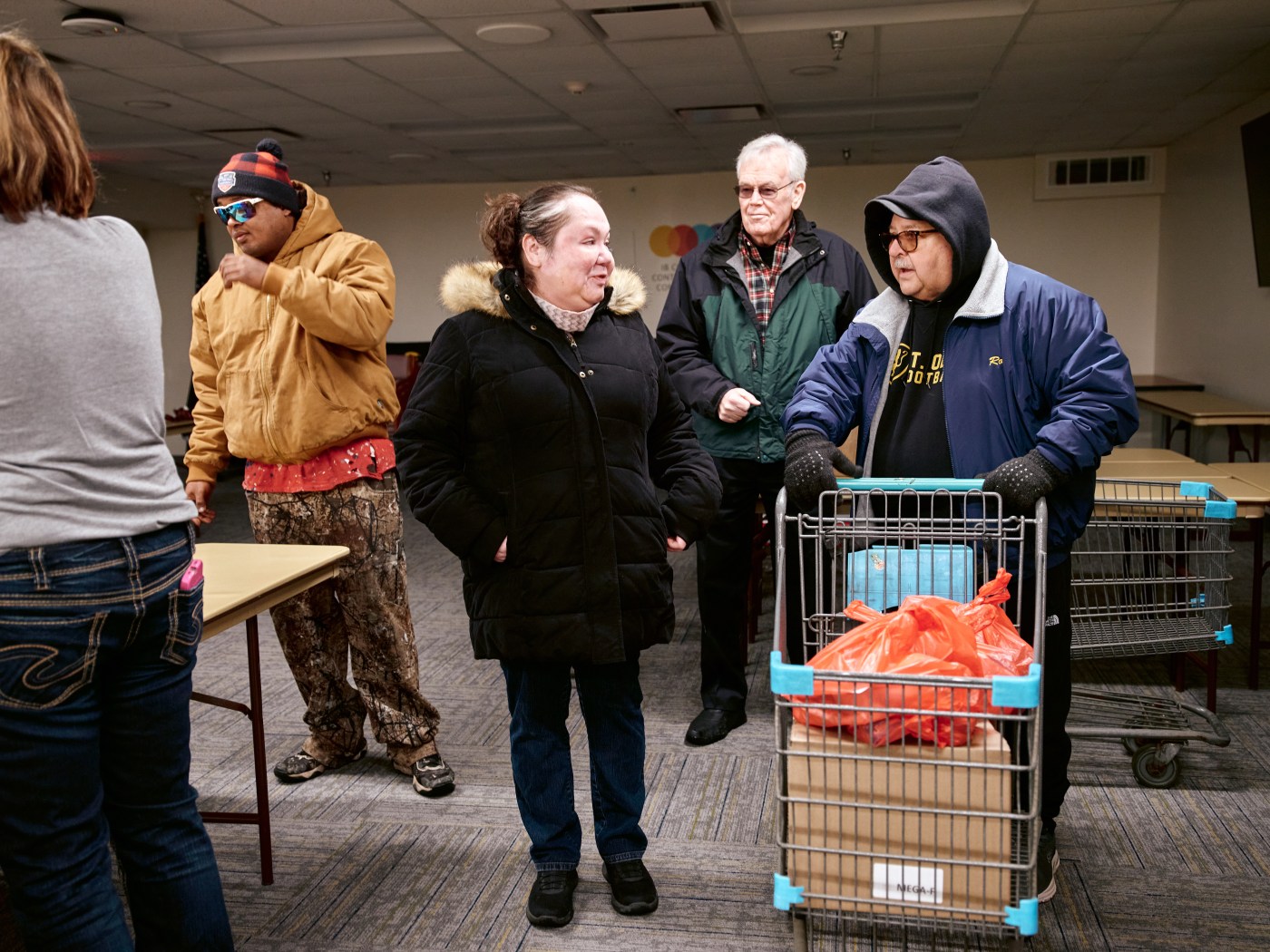
Fare For All, an affordable pop-up grocery store, is ending service to the metro after its February stops.
The program, which includes monthly stops in St. Paul, Eagan, White Bear Lake and six other locations in the Twin Cities, will continue serving nine sites in Greater Minnesota, The Food Group announced to shoppers on Monday.
The nonprofit’s traveling grocery store is open to everyone, selling packs of fresh produce and frozen meat at up to 40 percent off retail prices — especially helpful in recent times, with rising grocery prices.
Another program, Twin Cities Mobile Market — a grocery store bus that visits neighborhoods mostly in St. Paul and Minneapolis — will continue service, the Food Group said.
An email to shoppers who use Fare For All was sent on Monday explaining the change.
“With food prices remaining high, we need to invest our resources in communities that lack grocery store access,” the email stated. “We know this news may be disappointing, and we want to acknowledge the real impact this change may have for you and your household.”
The grocery landscape
The grocery landscape has changed since Fare For All began in 2002; it has operated under its current model (including no pre-registration required) since 2008.
“Having more affordable grocery options can really mean that we see fewer participating at Fare for All,” said Sophia Lenarz-Coy, executive director of The Food Group.
Aldi, the popular discount grocery chain, opened its first location in the Twin Cities in 2003. Consumers in the metro can also find grocery deals at Sam’s Club and Costco, in addition to other grocery stores and options such as Walmart and even Dollar chains. In the growing season, affordable produce can be found at farmers’ markets.
Recent events may have also played a role, Lenarz-Coy says.
“We’ve seen at several of our metro locations much less participation than a few years ago,” she says. “It was an interesting dynamic where, when COVID hit, there were obviously major disruptions, and many of our sites never got back to those pre-COVID levels in the metro.”
Before the pandemic, in 2018, Fare For All served 53,317 households. In 2025, it was 34,343, or a decrease of about 36%, according to the Food Group.
Food sourcing is also more challenging, she says, due to retail competition and inventory changes.
“Back in 2008, there were more ways we could find really good deals on things, especially frozen meat,” says Lenarz-Coy. “Our sourcing team has to work harder and harder.”
For all these reasons, in addition to rising costs, the nonprofit reassessed where this program is most needed.
“We started to think about, as an organization, how do we best invest our resources?” Lenarz-Coy says.
Early reaction
Reaction to the news was mixed on Fare For All’s Facebook page. They include:
Related Articles
Man wielding butcher knife at Cottage Grove Elementary arrested
Pets featured in our newsletter in January
‘Frozen water out?’ White Bear Lake Ice-Out Contest organizer contemplates name change, sticks with original
After ‘ICE out’ messages were destroyed, snow sculptors recreate their works in Minneapolis
MnDOT: Rethinking I-94 public comment is open through March 9
“I live on social security and this makes me very sad as it really helped me.”
“I’m so very saddened by this, as I’ve frequented the White Bear location for over 15 years! Thank you guys for all you’ve done!”
“The assumption that those using fare for all are all low income isn’t true.”
“Bad bad timing! I am positive that inner city folks could sure benefit from Fare for All services during this time! I think they should have thought this out better.”
“Thx for all the meals you made possible. I will miss you in the metro.”
Looking forward
The Food Group is larger than a couple of grocery store programs: The nonprofit partners with food shelves, community organizations and farmers across Minnesota, working toward food justice and equity.
As for the Fare For All program, metro shoppers can still stock up on the meat and produce deals for now.
“We will still have all our sites in February, so we’ll be sending staff to chat with people in person, answer questions and include a flier of other local resources at each of our sites, too,” says Lenarz-Coy.
The February schedule includes a stop at the West Seventh Community Center at 265 Oneida St. in St. Paul from 10 a.m. to noon on Friday, Feb. 13.
As of March, though, Fare For All will no longer make its nine metro stops in St. Paul, White Bear Lake, Eagan, South St. Paul, Burnsville, Fridley, Bloomington, Richfield and New Hope.
Stops will continue beyond the metro at nine sites in North Branch, Mankato, Hutchinson, Red Wing, Rush City, Buffalo, St. Cloud (two locations) and St. Joseph.
Related Articles
‘Frozen water out?’ White Bear Lake Ice-Out Contest organizer contemplates name change, sticks with original
Medicaid fraud: MN officials will push for increase in unannounced visits
Ramsey County to open treatment homes for youth in juvenile justice system
Stillwater chamber officials apologize for response regarding snow sculpture’s removal
Resignations in U.S. Attorney’s Office could slow MN fraud cases
We asked if participation is also down at these “rural” sites.
“It is slightly lower at our rural FFA (Fare For All) sites today than in the metro,” said Emily Eddy White, director of advancement and culture, in an email to the Pioneer Press. “However, the main driver of the decision to continue the program in Greater Minnesota is about equitable grocery access. We are also differentiating our two affordable grocery programs geographically with Twin Cities Mobile Market remaining in the metro.”
For the complete schedule and more info on Fare For All, visit thefoodgroupmn.org/groceries/fare-for-all/schedule/.
Message to Fare For All shoppers
Here is the email sent to shoppers on Monday for the St. Paul stop with the subject line of “Important Update: Fare For All Services in the Metro Area”:
Dear West 7th FFA customer,
We hope you’re doing okay during these challenging and heavy times in our community. We are writing to share an important and difficult update about Fare For All services in the metro area. After thoughtful consideration, The Food Group has made the difficult decision to close metro Fare For All sites. With this change the Fare For All program will be focused on rural communities. We will continue to operate and invest in Twin Cities Mobile Market as our metro affordable grocery solution. Fare For All services at metro sites will close after February 2026.
We know this news may be disappointing, and we want to acknowledge the real impact this change may have for you and your household. We also want to acknowledge the difficulty of this news while we navigate such a challenging and heavy time in our community. Please know that this decision was not made lightly. We know that this directly impacts families who rely on Fare For All at West 7th to put food on the table each month. For many years, it has been our privilege to serve metro communities by providing access to affordable, nutritious food. We are deeply grateful for the trust you have placed in us and for the relationships built through Fare For All.
Both Fare For All and Twin Cities Mobile Market have the mission to make foods more accessible and affordable. We are needing to focus on program efficiency, differentiating geographically, and setting these programs up for long term success. With food prices remaining high, we need to invest our resources in communities that lack grocery store access. While Fare For All will no longer operate at metro sites, during these challenging times we remain committed to food access and to serving communities in meaningful ways. We will continue to support communities through our mission and programs which include rapidly responding to ensure fear is not a barrier to immigrant communities accessing food.
2/13/2026 will be the final distribution at the West 7th Fare for All location.
Thank you for being part of the Fare For All community. We truly appreciate the opportunity to have served you.
Leave a Reply