
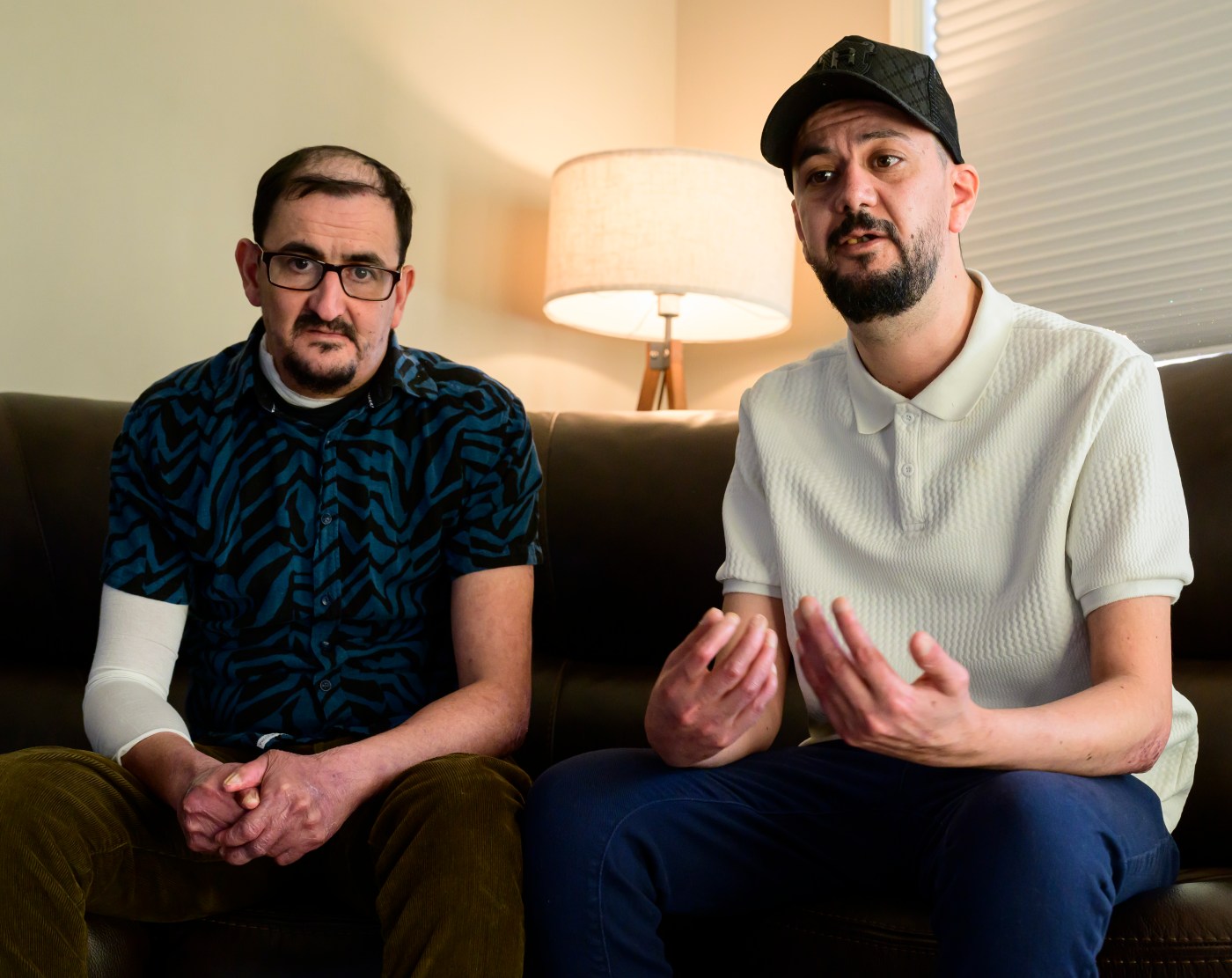
Brothers Mohamed Duklef, 36, and Hani Duglof, 32, came to the U.S. from their home country, Libya, in 2014, looking for a solution to a health issue the two have lived with since birth. Their skin is as fragile as a ripe peach, Duklef said. One light scratch and it peels and blisters instantly.
“It impacts my life from when I wake up in the morning until I sleep,” Duglof said. “It’s hard for me to live my daily life.”
For Duglof, not only is the skin on the outside of his body fragile, but so is the skin inside. This means that eating is no simple task, and doctor’s visits are frequent.
Duglof said he was arrested by ICE agents on Jan. 10 in New Richmond, Wis., while working for a grocery pickup service. He was detained and taken to Minneapolis, where he stayed in a cell for one day before being transferred to a hospital due to his rare health condition. Duglof was then taken back to the detention center, where he stayed for four days in a cell with no access to care for his condition and little food before being released, he said.
He said he was detained after two vehicles parked in front of and behind his car, boxing him in. ICE agents exited the vehicles and asked what Duglof’s immigration status was. When he shared that his asylum case was pending, the agents arrested him and, with handcuffs on his arms and legs, brought him to the Whipple Federal Building at Fort Snelling.
“What’s happening now is the government is just unplugging pending asylum cases by grabbing people, haphazardly, without thinking whether it makes sense,” Duglof’s attorney, David L. Wilson of Wilson Law Group, said.
Wilson, who’s worked with Duglof and his brother since 2014, said the way the government is currently handling immigration and asylum cases is haphazard and often lacks a clear purpose, which he said was evident during Duglof’s detainment.
“In 2026, nothing surprises me anymore,” Wilson said.
Immigration and Customs Enforcement did not immediately respond to the Pioneer Press for comment. A federal judge in Minneapolis granted a temporary restraining order Wednesday intended to prevent federal officers from arresting and detaining lawful refugees in Minnesota who have yet to receive their proof of permanent residency.
Extremely sensitive skin
Hani Duglof speaks Thursday at his brother’s home in Blaine. (John Autey / Pioneer Press)
Duglof’s skin condition, epidermolysis bullosa, affects about one in 20,000 births, according to Stanford Medicine. It makes him prone to significant blistering from ordinary friction. For example, Duglof said, if he wears shoes and stands on his feet for a day, the skin on his feet will peel raw.
The genetic condition is uncomfortable, and the wounds can range from minor to severe enough to require a visit to a hospital. If the wounds are at their worst, they can become infected, which takes months to heal and requires medical attention, Duglof said.
The condition also impacts Duglof’s ability to eat. He can only tolerate soft foods like pasta, mashed potatoes and soup; harder foods can puncture his esophagus and irritate his digestion, he said.
Managing the condition requires a consistent routine, Duglof said. He visits doctors regularly for treatment, and he and his brother came to America because of the health care opportunities.
“Even though I know people still complain here, there are rights for people with disabilities,” Duklef said.
For Duklef, the difference between living in Libya and Minnesota as someone with a chronic condition is like night and day. Duklef said there was little access to research or understanding of the condition in Libya, and people often had negative associations of people with chronic health conditions.
Duklef said that since living in the U.S., he and his brother have been part of many clinical trials to help find a solution to their condition. One treatment recently received FDA approval, he said.
“Maybe people say, ‘Who pays for this?’ We actually paid from our bodies to researchers to try these therapies,” Duklef said.
Pending asylum
Mohamed Duklef talks about his brother, Hani Duglof. (John Autey / Pioneer Press)
The brothers initially came to the U.S. on visitor visas, Duklef said. Around 2014, a civil war was ongoing in Libya, and the country became less safe for them to return to, he said. Duklef said he consulted a lawyer to find out what his options were for living in the U.S., and he was told that the two could apply for asylum.
The brothers’ last names are spelled differently as a result of different interpretations of the pronunciation by separate customs agents back in Libya, they said.
Duklef is now a naturalized U.S. citizen through marriage, but his brother’s asylum case is still pending. Duglof has a work permit and an ID, all of which he said he gave to the agents when he was stopped.
“When your asylum is not decided yet, you are authorized to stay, work, live, and they give you a work permit that’s renewable,” Duklef said. “That wasn’t new to us, but they said he’s out of status and they just took him out.”
Related Articles
How is St. Paul’s Victoria Crossing mall on Grand Ave. eligible for TIF funding?
Judge orders 5-year-old Liam Conejo Ramos and his dad released from ICE detention
Hudson Hot Air Affair set to return Feb. 6-8
Judge says she won’t halt the immigration enforcement surge in Minnesota as a lawsuit proceeds
ICE claim that a man shattered his skull running into wall triggers tension at a Minneapolis hospital
When the ICE agents put handcuffs on Duglof, he said his skin immediately reacted.
When Duglof was detained, he tried to explain his condition to the agents, he said, but few seemed to care. Duglof said he was in a cell with close to 20 others. The space was crowded, Duglof’s skin was wounded and he needed medical attention.
“I kind of sacrificed my privacy, showing them my knees in hopes that they’ll understand my condition.”
Duglof described the experience as extremely vulnerable. He said he never shows people his wounds, and instead tries to cover them, but he knew that in order to try to get the agents to understand his situation, he had to.
To the hospital and back
Eventually, near 11 p.m. on Jan. 10, one agent saw the severity of Duglof’s wounds and had him transferred to a hospital. Duglof stayed in the hospital until 2 p.m. on Jan. 13. A few agents were with Duglof while he was in the hospital, and his brother Duklef was called. Duklef tried explaining to the agents that Duglof can only eat specific kinds of foods; otherwise, his health is at risk.
Duglof said he remembers seeing a nurse with tears in her eyes when hospital staff told him they couldn’t keep him and that he would have to be taken back into ICE custody. The nurses gave agents a bag of food safe for Duglof to consume, including protein milk and pudding.
Hani Duglof shows bandages on his knees from wounds following his detention. (John Autey / Pioneer Press)
Duglof was returned to ICE custody, but did not receive the care needed for his condition, he said. Agents who started new shifts did not understand that Duglof could not eat the same kinds of food that others could, he said.
One agent who gave Duglof a sandwich said, “This isn’t a five-star hotel.”
While Duglof was in ICE custody, Duklef was working to get his brother released on bond. Duklef said the situation was dire, and he knew that his brother would not be cared for if he wasn’t released.
“After reading stories of people dying in detention centers, especially with medical conditions, now I understand why,” Duklef said. “If people try to advocate for themselves, but nobody listens to them, then this is what happens.”
Duglof said that over the course of four days after he was transferred from the hospital, he ate very little, as most agents would not feed him the food he brought back from the hospital.
“Imagine having one meal a day, not even a meal a day. Sometimes it was 8 ounces of chocolate shake, sometimes it was 4 ounces of rice pudding, that’s it.”
Still living in fear
Duklef’s call for his brother to be released was successful, and Duglof was released on Jan. 15.
“If he wasn’t released quickly … I don’t know what would have happened to him,” Duklef said. “They were about to send him to El Paso.”
The worst part of the entire experience was knowing that Duglof is not a criminal, he said.
“It pains me to see on the news and everywhere that they say they’re arresting criminals and rapists and all these lies,” Duklef said.
Minnesota Judicial Court records show that Duglof had a speeding ticket in 2019, but the case has been dismissed as the fine was paid.
“When I came here, I tried to follow every single rule,” Duglof said. “I did everything step by step with the lawyers to make sure that I do everything right, and even then, I was treated like an illegal immigrant. I was treated like a criminal.”
Duklef said he believes the Trump administration is targeting immigrants with pending asylum cases because it’s easier to find them than someone who’s undocumented and has “no traces in the systems,” he said.
“I find it very unfair to go after those people who try so hard and have paid thousands of dollars to lawyers to make sure what they do is the right and correct way,” Duklef said.
Wilson said in years past, and even so little as one year ago, the government would typically see someone like Duglof, who has a pending asylum application, and “no criminal history that would bring him to the government’s attention,” and that person would be left alone.
Though Duglof’s followed the legal procedures correctly in seeking asylum, what he cannot control is the pace at which his immigration status is decided, Wilson said, which puts Duglof at risk of losing the opportunity to have his case reviewed.
“The government gets impatient with its own failings,” Wilson said. “Maybe the government should improve its own process.”
Related Articles
5-year-old Liam Conejo Ramos and father return to Minnesota from Texas detention facility
How Alex Pretti’s death became a national tipping point
Protesters rally across the U.S. in solidarity with Minneapolis
Trump says feds won’t intervene during protests in Democratic-led cities unless asked to do so
Judge orders 5-year-old Liam Conejo Ramos and his dad released from ICE detention
Duglof said he still has wounds in his esophagus and on his legs where he was handcuffed. He said swallowing is very painful and that some of the wounds have become infected.
According to Wilson, Duglof is expecting a court hearing soon, when Duglof may be required to refile his asylum application, which would restart the entire process. Wilson expects it to be an ongoing process.
Duglof said that though he should not have to fear detainment again, he can’t fully trust the system.
“I hopefully won’t go through this again,” Duglof said. “Even though I’ve been released, I’m still scared to go out. I can’t live my normal life anymore.”
Leave a Reply