
A month ago, widespread fraud in Minnesota government programs made national headlines, with Gov. Tim Walz eventually ending his campaign for a third term in office as he faced scrutiny over his handling of the scandal.
Federal officials initially cited fraud as a part of the reason for their immigration crackdown in the state this past month. But the recent surge in enforcement and resulting clashes between the federal government and Minnesota officials may have triggered a series of events that could hurt efforts to deal with fraud.
Federal prosecutors have delivered most of the accountability in recent high-profile cases of fraud in state government programs. Former Assistant U.S. Attorney Joe Thompson, who had led the prosecutions, estimated that the theft could run into the billions.
So far, more than 90 individuals have been charged in schemes tied to housing, autism and meal programs, and more than 50 have been convicted.
On Dec. 18, the U.S. Attorney’s Office in Minnesota announced yet another round of charges, with Thompson calling the state’s fraud problem “industrial-scale.” It appeared that 2026 would deliver only more staggering examples.
Now there’s a chance those prosecutions could grind to a crawl, former heads of the office say.
At least six resign
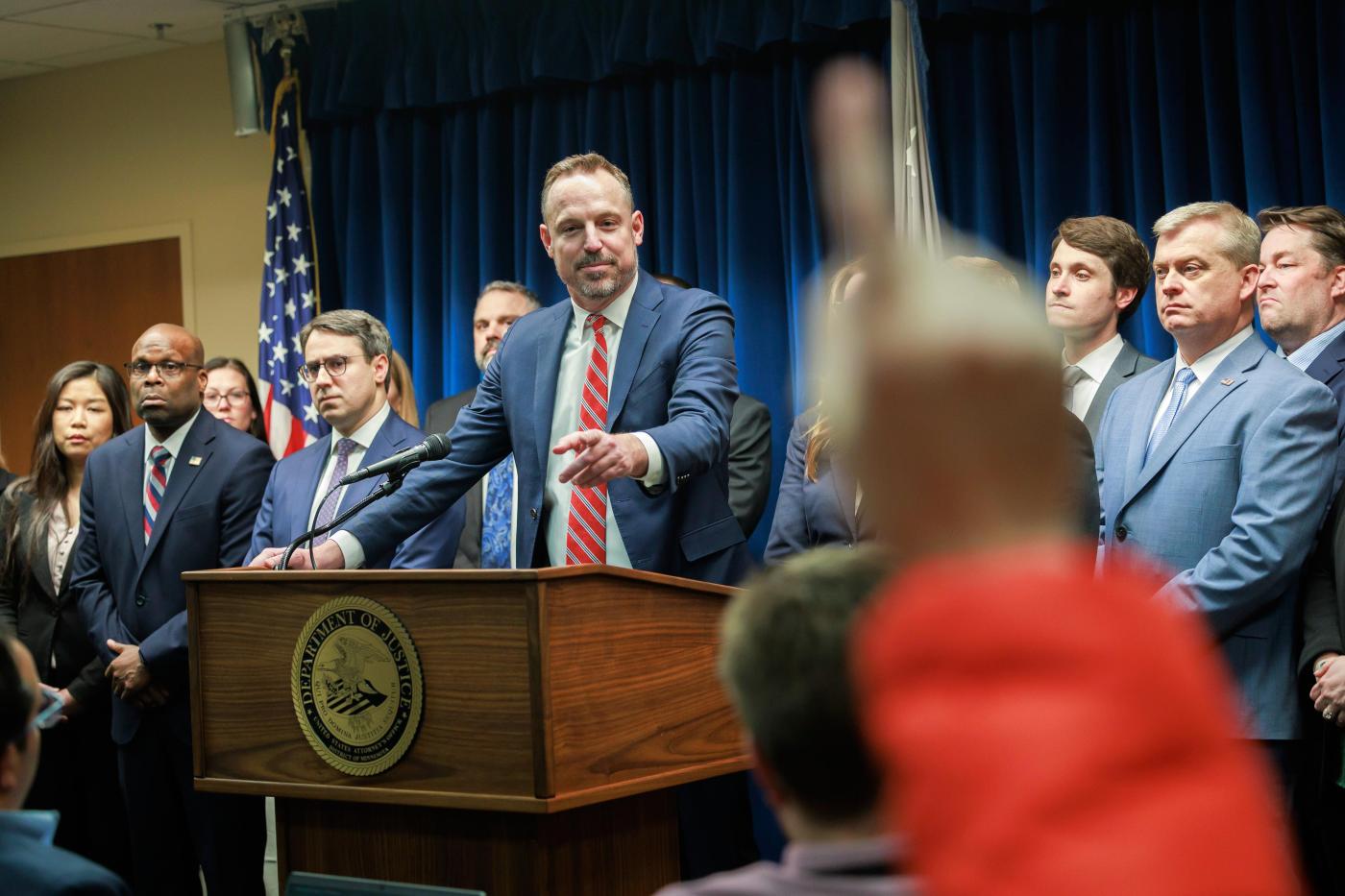
Thompson was among at least six Minnesota prosecutors who reportedly resigned after Justice Department pressure to investigate the widow of 37-year-old Renee Good, who was killed by an Immigration and Customs Enforcement agent on Jan. 7. Some familiar with the office expect more resignations to follow.
Accountability and further investigation into government fraud could face significant disruptions as a result of those high-profile departures on top of existing staffing issues, according to an ex-federal prosecutor and former heads of the U.S. Attorney’s Office for Minnesota.
B. Todd Jones. (AP Photo/Jacquelyn Martin)
In typical times, the district might be able to pass complex fraud cases along to another prosecutor, but with recent attrition, that may prove to be more challenging, said B. Todd Jones, who served as Minnesota’s U.S. attorney under Presidents Bill Clinton and Barack Obama.
Jones said it will be difficult to replace the expertise of attorneys with decades of experience.
“The investigations will slow down,” he said. “You’ve had a drip, drip, drip of people that worked on those cases that have left during the last year because of the dynamics at the Department of Justice, and there’s more that’s happening as we speak.”
U.S. Department of Justice also hit with resignations
In the past, the DOJ might step in to assist a district with staffing shortages, Jones said, but the department has faced a wave of resignations and staffing issues of its own in the first year of Donald Trump’s second presidency.
Already, the U.S. Department of War had sent dozens of military lawyers, known as judge advocates, to assist with the case load in Minnesota during the immigration enforcement surge, according to multiple national news reports.
Former Minnesota U.S. Attorney David Lillehaug, who also served under Clinton, told Politico this week that attorneys from the Eastern District of Michigan had been called in to assist in Minnesota.
Lillehaug told the news outlet there were only around 17 prosecutors in Minnesota of the 50 that the office is normally supposed to have, basing that number off his ongoing familiarity with people who work there.
The former U.S. attorney didn’t respond to requests for an interview from the Pioneer Press, and the DOJ declined to confirm information about personnel.
“We have charged dozens of defendants from Minnesota who’ve defrauded the American people, and our whole of government approach to combatting these issues will continue until all fraudsters and violent criminals are brought to justice,” a department spokesperson said in a statement.
Minnesota U.S. Attorney Daniel Rosen and his office did not respond to requests for comment on this report. Rosen was appointed by Trump and confirmed to the post in October.
Related Articles
Trump says feds won’t intervene during protests in Democratic-led cities unless asked to do so
Judge orders 5-year-old Liam Conejo Ramos and his dad released from ICE detention
Huge cache of Epstein documents includes emails financier exchanged with wealthy and powerful
Trump administration approves new arms sales to Israel worth $6.67 billion
Judge calls Justice Department’s statements on slavery exhibit display ‘dangerous’ and ‘horrifying’
Loss of seasoned, experienced prosecutors
The Minnesota U.S. Attorney’s Office does not currently have a public information officer. Until a few weeks ago, Assistant U.S. Attorney Melinda Williams served in that role, but she resigned along with Thompson. Williams and Thompson couldn’t be reached for this report.
Anders Folk, who served as acting U.S. attorney in 2021 under President Joe Biden and is currently running for Hennepin County attorney, described the current number of prosecutors at the U.S. Attorney’s Office as being “as small as it’s been in modern history” and noted the loss of what he described as “extraordinarily seasoned, experienced prosecutors.”
“The office is going to have a much more difficult time … doing the amount of work that we’re used to seeing it do, and doing the sophisticated types of cases that we’re used to seeing it do,” he said.
Mark Osler, a University of St. Thomas School of Law professor who once worked as a federal prosecutor in Michigan, echoed what Todd and Folk said and questioned new leadership in Minnesota.
“It is unprecedented to have this kind of a loss,” he said. “It reflects very poorly on the U.S. attorney that he is losing his best people when they are most needed. That’s just bad management.”
Building and prosecuting cases won’t be the only functions that could be affected, Osler said. The complex process of retrieving stolen funds also could be more difficult. In December, Thompson told reporters that the federal government had recovered up to $70 million, about $30 million of which is in bank accounts.
Feeding Our Future case
Attorney Kenneth Udoibok, who represented Aimee Bock, the alleged “ringleader” in the $250 million Feeding Our Future fraud scheme, said he didn’t expect the resignations to have a significant impact on sentencing in that case or any other fraud matters.
Bock was convicted last year and awaits sentencing. Udoibok has said she plans to appeal.
“It should be a healthy presumption that there is no entity in the United States that can withstand challenges as much as the federal government,” said Udoibok.
He added that he was mostly concerned about any potential changes in the “temperament” of the prosecution team rather than delays in the process.
Aimee Bock, founder and executive director of the nonprofit organization Feeding Our Future, arrives at the Minneapolis federal courthouse with her attorney, Ken Udoibok, right, on Wednesday, March 19, 2025, in Minneapolis, Minn. (Kerem Yücel/Minnesota Public Radio via AP)
Where do fraud cases stand?
Until 2025, the Feeding Our Future scheme dominated fraud coverage in Minnesota. In that case, prosecutors allege fraudsters claimed reimbursement from the state education department for millions of meals they never served as part of a federal pandemic meal aid program for children.
Last year, a new front opened — a federal investigation into Medicaid fraud became public.
The FBI raided businesses suspected of defrauding a Medicaid-funded state housing program for people with disabilities and addiction in July, and by September seven had been formally charged for stealing at least $10 million.
That same month, another was charged in a $14 million children’s autism services scheme, which Thompson at the time described as the “first in an ongoing investigation.” Federal prosecutors have said these investigations grew out of the Feeding Our Future case.
In response to the fraud cases, Minnesota’s Department of Human Services ended the Housing Stabilization Services program and ordered a third-party audit of 14 “high-risk” Medicaid programs.
Then, in December, federal prosecutors announced a new round of charges. Thompson told reporters he believed more than half of the $18 billion distributed in Medicaid funding through the 14 high-risk programs since 2018 could have been stolen.
State officials disputed that figure, calling it speculative. Walz said Thompson “would have been let go by any other administration” for “speculating” about fraud, but later praised him as a “principled public servant” when he resigned.
Days after Thompson said he believed Medicaid fraud alone could top $9 billion, Nick Shirley, a conservative YouTuber, posted a 43-minute video claiming rampant day care fraud by Somalis could have cost Minnesota more than $100 million.
The video, which garnered millions of views online, was based on existing allegations about fraud in Minnesota’s child care program, which until recently was run by the state’s Department of Human Services and is now under the authority of the Department of Children, Youth and Families, a spin-off agency.
As early as 2018, rumors circulated of fraud in Somali-run day cares receiving state money, including that theft topped $100 million, though the Shirley video did not give proof of theft at the scale alleged.
Homeland Security begins ‘massive investigation’
Following Thompson’s $9 billion allegation and the Shirley video, the Department of Homeland Security began conducting what it called “a massive investigation on childcare and other rampant fraud.” A social media post in late December showed federal law enforcement agents visiting a business in the Twin Cities area.
By early January, Homeland Security Secretary Kristi Noem announced that her agency, which oversees ICE, would send thousands of agents to Minnesota for “Operation Metro Surge,” an immigration enforcement crackdown in part tied to allegations of widespread fraud committed by Somalis in Minnesota.
Jones, Minnesota’s former U.S. attorney, said big fraud estimates from federal prosecutors ahead of any final charges or indictments were a departure from typical procedure.
“I was surprised how candid the U.S. Attorney’s Office was. One, about talking about the case in real time with cases pending, and two, the estimate of the damages or the losses,” he said. “In the end, all it did was provide a pretext for this administration to say we’ve got to do something about all these illegal immigrants who are committing billions of dollars in fraud.”
Related Articles
Judge says she won’t halt the immigration enforcement surge in Minnesota as a lawsuit proceeds
Journalists Georgia Fort, Don Lemon among 4 more arrested in St. Paul church protest
‘You wore the badge,’ federal judge tells ex-Customs officer from Minnetonka sentenced for distributing child pornography
Federal lawsuit: People detained at Whipple Building without attorney access
Ramsey County prosecutor to public: Come forward if feds commit felony against you
Leave a Reply