
“The ASAP Act can deliver two things New Yorkers urgently need: lower bills for households and more clean electrons on an increasingly strained power grid.”
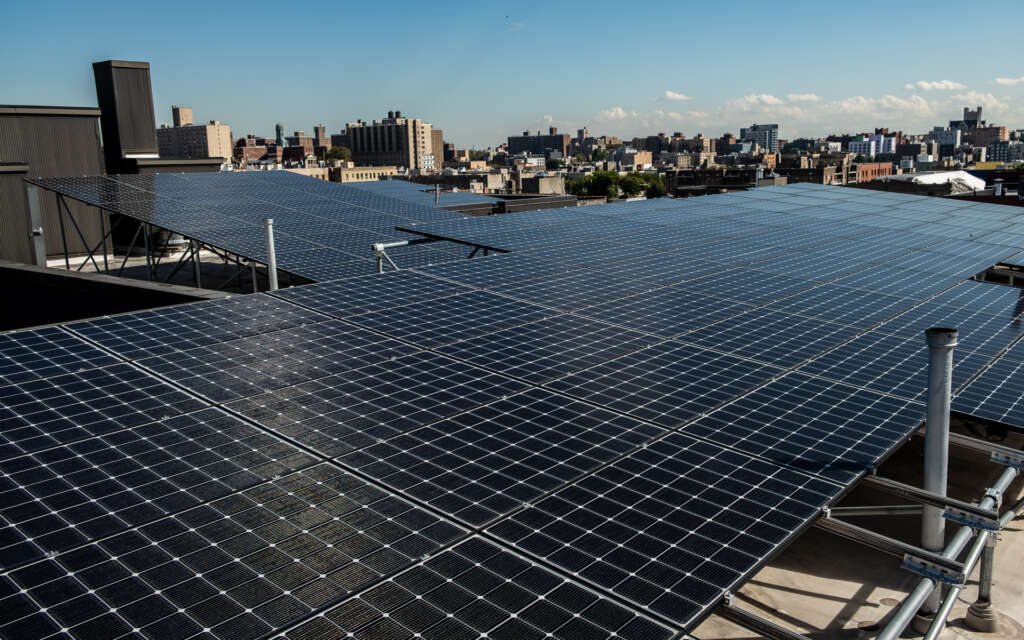
Solar power panels at the Sherman Terrace co-op in the South Bronx. The panels were installed in 2020.
As the federal administration continues to brazenly pull the country into yet another shortsighted bid for oil dominance that enriches only the fossil fuel industry, the stakes are obvious: American energy independence and affordability are being sacrificed.
We can keep tethering ourselves to volatile geopolitics, to fossil fuel prices we’ll never control, and to an energy system built on instability and extraction—or we can choose the alternative that’s right in front of us: harnessing the sun here at home on our own rooftops. By rapidly accelerating local solar in New York, we can build power right here in our communities, beyond the reach of coups, cartels, and commodity shocks.
This legislative session offers New York a chance to do just that: pass the Accelerate Solar for Affordable Power Act (ASAP Act), S6570 and A8758. The ASAP Act would double New York’s rooftop and community solar goal, and cut red tape to lower the costs of getting community solar connected to the grid. In short, the ASAP Act can deliver two things New Yorkers urgently need: lower bills for households and more clean electrons on an increasingly strained power grid.
Why waste time and taxpayer dollars on chasing foreign oil or greenlighting new and expensive gas pipelines—like the recently approved NESE (Northeast Supply Enhancement) pipeline project in New York City, which had previously been rejected three times for projected environmental harms—when we already have a thriving industry built around the cheapest, most abundant power source on Earth: the sun.
Distributed solar, meaning rooftop systems and smaller community-scale projects, is delivering real results. So much so that New York is already on track to meet the Climate Act target of 10 gigawatts of statewide distributed solar ahead of schedule. To date, we’ve already built 7.6 gigawatts, which is enough energy to power roughly 1.3 million homes. These projects have the power—literally and economically—to directly benefit people’s daily lives. They show up as lower electricity bills, cleaner air, more resilient local grids, good-paying clean energy jobs, and real investments in local communities.
Take, for example, the rooftop solar project recently completed by GreenSpark Energy at Rochester’s Foodlink Center, a nonprofit that tackles food insecurity across the region. This 679 kilowatt solar array cuts energy costs for the organization and frees up resources to serve more local families.
In New York City, Solar One is working with nonprofit and industry partners – including Green City Force, Solar Uptown Now Services, PowerMarket and Accord Power– to build solar on 142 NYCHA buildings in Brooklyn and Queens. In addition to producing seven megawatts of community solar that will generate bill discounts for thousands of low- and moderate-income neighbors, project partners are training NYCHA residents in solar installation, and providing STEM internships to high school students, pairing installations with resident engagement and workforce development. These projects grow local renewable energy for low-income New Yorkers while advancing energy justice where it matters most: in people’s homes and communities.
These projects also bring clean energy jobs to our state. NYSERDA’s recent Clean Energy Industry Report shows that New York’s solar and storage industry currently supports 18,688 jobs. The ASAP Act would create another 15,000 jobs, adding to a growing ecosystem of good-paying clean energy jobs across the state.
But political headwinds are making it harder to get more projects like these online. The federal government recently gutted our country’s longstanding clean energy program (the Investment Tax Credit), increasing costs of projects by at least 30 percent. While at the state level, expensive, outdated, and time-intensive processes to connect new projects to the grid are forcing companies to take their business, jobs, and investment elsewhere.
The ASAP Act will change that: it doubles the state goal, creating a mandate for state agencies and the Public Service Commission to invest in local renewables, and enacts common-sense “interconnection” reforms to lower grid connection costs and maximize existing infrastructure while reducing costly upgrades.
A recent study spells out the benefits in no uncertain terms. Scaling up distributed solar and storage to the levels envisioned in the ASAP Act would save New Yorkers roughly $1 billion a year in energy costs. That translates to real money: about $87 a year for the average upstate ratepayer and $46 a year downstate—and the savings reach everyone, whether they directly participate in solar or not.
As the affordability and climate crises collide, we have no time to lose. New York lawmakers have the chance this year to unlock gigawatts of local clean energy and deliver real bill relief by passing a law that adds nothing to our state budget. With the ASAP Act, we can choose a healthier, more resilient, more affordable future that puts clean energy—not volatile fossil fuels—in the hands, and on the rooftops, of New Yorkers.
Kate Selden works at Solar One, an environmental nonprofit whose mission is to design and deliver innovative education, workforce training, and technical assistance that fosters sustainability and resiliency in diverse urban environments.
The post Opinion: For Affordable Clean Energy at Home, New York Needs Solar ASAP appeared first on City Limits.
Leave a Reply