
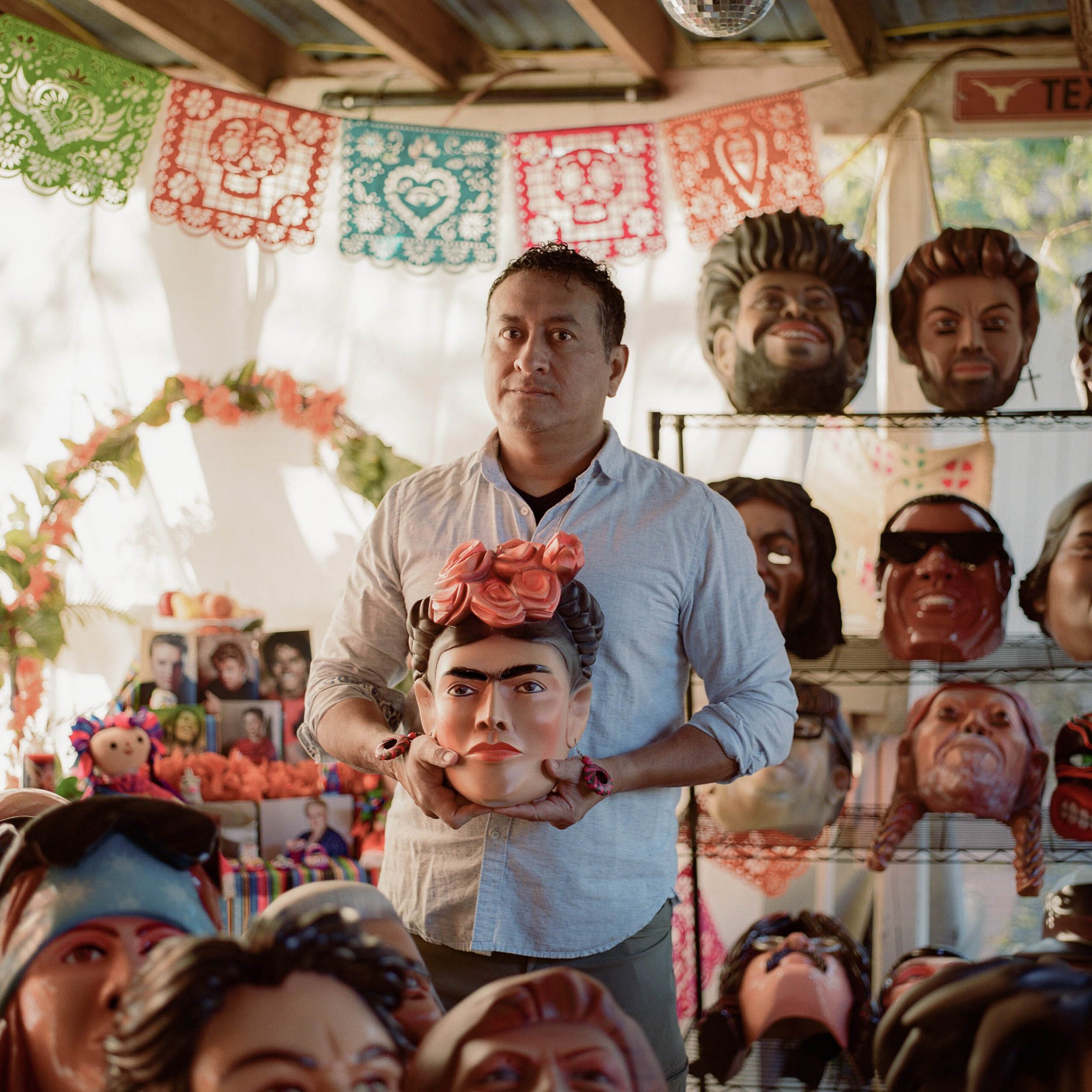
On the back porch of his Southeast Austin home, Willy Baltazar displays a vibrant Día de los Muertos-style altar that honors more than just ancestors.
Lined up are portraits of legends who have shaped Mexican culture and beyond: Vicente Fernández, Paquita la del Barrio, Frida Kahlo, Bob Marley, and Michael Jackson. Each icon is paired with a matching hand-carved wooden mask laid nearby—a living extension of Xantolo, a centuries-old spiritual festival from Veracruz’s La Huasteca region in coastal Mexico.
This pop culture mash-up serves as a bridge between his Austin life and the native custom that still defines him.
Baltazar was raised in Tantoyuca, Veracruz, known as the Pearl of the Huastecas, an area famous for preserving Nahua heritage and a main keeper of Xantolo. The three-day sacred festivity—with the liveliness of a carnival—starts in late October and blends Huastec rituals with Catholic practices to honor the dead. During what’s widely regarded as the region’s own version of Día de los Muertos, every home sets up an altar adorned with cempasúchil [marigold flowers], veladoras de santos [saint-etched candles], and ofrendas [food offerings]. The streets fill with the smell of incense and the sounds of string instruments. Dancers in ceremonial masks parade through Tantoyuca to guide lost loved ones back to the world of the living.
“It’s not something you miss,” Baltazar proudly recounts. “It completely transforms the town and runs through our blood.”
Baltazar vividly remembers cuadrillas [dancing troupes] parading in brightly colored costumes with masks looming large as they moved rhythmically through every neighborhood. He was always captivated by la embarazada [the pregnant woman], el diablo [the devil], and el vaquero [the cowboy]. The three symbolic figures represent the fundamental cycle of human existence: birth, mortality, and the enduring human spirit. Troupe members embody this essence while maintaining a vow of anonymity. “You must never know who is behind the mask,” Baltazar warns.
“IT’S A SACRIFICE, BUT THIS IS PART OF THE PRESERVATION.”
At the festival’s close, the entire town makes its way to the cemetery, where dancers honor those who have performed before them and undergo the destape,a public unmasking that reveals their identity.
Children are encouraged to join the cuadrillas as early as age 3. Baltazar dreamed of participating, or at least owning a mask, but the elaborate costume regalia was beyond what his family could afford. Instead, he watched from the sidelines and promised himself that one day he’d be a part of it. When Baltazar moved to Texas more than 20 years ago, his priority shifted to starting a family and finding his footing in a city where he didn’t yet speak the language.
Meanwhile, in Veracruz, rehearsals start as soon as the festival ends and continue year-round. Joining a cuadrilla comes with a seven-year cycle of mandatory dancing during Xantolo—otherwise attracting bad luck. Unable to commit to that rhythm from afar, he returned each October as an observer. “I felt like I was looking in from the outside,” he recalls.
That outsider’s view transformed in 2021. Determined to weave his Mexican customs with Austin’s cultural scene, he placed his first order of masks with an artisan in Veracruz. The two figures were not conventional subjects: Freddie Mercury and John Lennon, his two musical icons and the ultimate bridge to his heritage.
“We live in the Live Musical Capital of the World,” he explains, “and this is how I connect my roots to life in America.”
A mask can be made in a day, but high demand delayed the process for weeks. Baltazar drove 13 hours to his hometown to pick them up once they were ready—a 700-mile journey that was a turning point in his life.
Holding the finished creations, he realized he could keep expanding his collection beyond traditional designs. For a long time, he wasn’t sure if they would become an exhibition, a personal display, or something else entirely. Regardless, he collected them. Since, he’s picked them up in batches of five to 10—now holding more than 70 pieces depicting Prince, Marilyn Monroe, Ray Charles, and Elvis Presley.
Between trips, Baltazar calls his car a “mobile gallery.” As a full-time Uber driver, he keeps a few masks displayed. “It always starts a conversation,” he says. “People get curious, and I tell them about Xantolo.”
Riders often take photos with the pieces, impressed by the lifelike detail, and have started requesting personalized ones of their loved ones who’ve passed away. “It’s like the tradition is adapting. Maybe they don’t know much about Xantolo, but honoring our ancestors is universal,” he says.
The constant travel eventually led to investing in a dedicated van for his three to four annual trips. “Flying out would be easier, but they’re too fragile and I can’t risk them getting damaged in cargo,” he notes. “It’s a sacrifice, but this is part of the preservation.”
Baltazar (Harmon Li for the Texas Observer)
The woodwork behind his masks begins with master artisan Jesús Alejandres Ponce, who cultivates the trees, carves the figures, and hand-paints them. Ponce explains that carefully selecting pemuche wood is essential. “The quality shapes every facial gesture,” he says. “Each deliberate strike brings out the character’s expression with the subtle tension of a frown or the gentle curve of a serene gaze.”
Ponce faces occasional skepticism from people outside the culture about the handmade nature of the art. “Sometimes people ask if these were made by a machine or mass-produced in a factory,” he sighs, “but it’s amazing they think so.”
Baltazar’s most recent Xantolo trip carried a decisive purpose beyond picking up a new set of Willie Nelson and Lionel Richie masks. This time, the journey finalized a deal with Cuadrilla Reforma—a massive troupe who travels across Mexico performing Xantolo’s signature dances. Thirty-five members who already hold visas for the United States plan to come to Austin for the next Viva La Vida Festival, the city’s largest Día de los Muertos parade, held a week before Xantolo.
The performers intend to free-dance through downtown, a spontaneous cultural exchange separate from the parade. Baltazar plans to host as many members of the troupe as possible, making the property where he began his pop culture collection the home base for core performers. “For decades, it was only a distant fantasy,” he says. “Now, I am finally inside the circle.”
The post Austin’s Willy Baltazar Is a Man of Many Masks appeared first on The Texas Observer.
Leave a Reply