
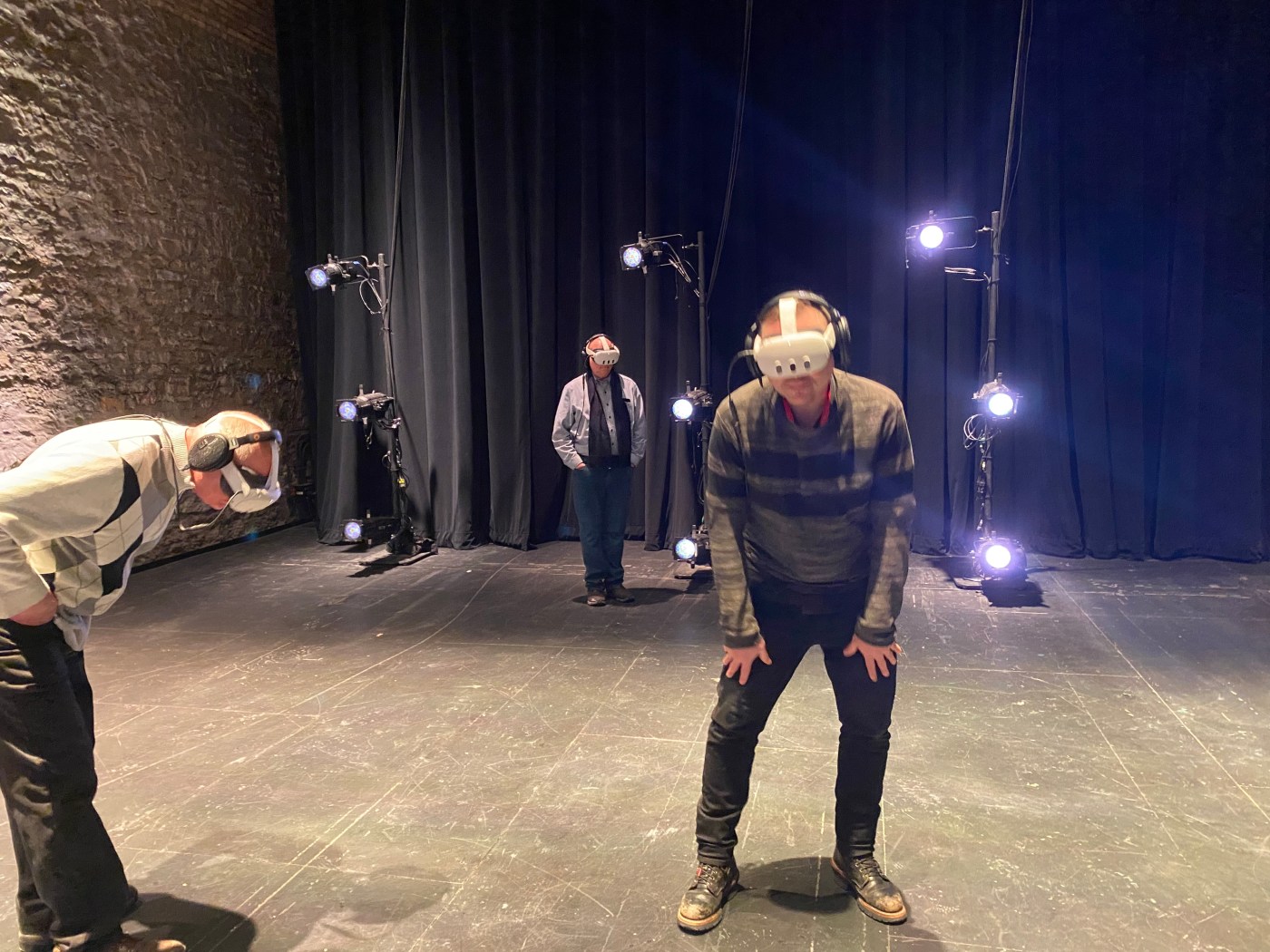
This week, audiences have had a chance to hear the Berlin-based Mahler Chamber Orchestra — virtually.
As part of an engagement presented by Schubert Club Mix at the Luminary Arts Center, six audience members at a time don headsets and walk around the Luminary stage, “seeing” musicians perform and hearing their music through headphones.
Designed by Henrik Oppermann of the company Schallgeber, in collaboration with MCO, the virtual program uses spatial audio to create a sense of moving through the musicians as they play. Get up close to the virtual version of violinist Timothy Summers and you can hear each bow stroke in sharp detail. Step further back, and you hear more of a blended sound of the different instruments playing together.
If you’ve ever wondered what a string bass sounds like up close, this is your chance. The instrument’s notes are so low, it’s often not easy to distinguish them from the brighter, higher-note instruments like a flute or a violin when it is not playing solo. Like a bay leaf in a savory sauce, the bass provides essential tone and depth, even if its flavor isn’t distinguishable at first. Only in its absence does its essential role become clear. MCO’s virtual concert allows you to lean in close and take a good listen.
With object-based audio and distance modeling, the mix of hardware and software technology creates a way to hear the music in three dimensions. “I’m basically having all musicians miked up, and then also the room, and then I recreate it in 3-D space,” Oppermann said on the event’s opening day on Thursday.
The program features three pieces of music, beginning with Wolfgang Amadeus Mozart’s Quintet in G minor, followed by the Overture from “A Midsummer Night’s Dream” by Felix Mendelssohn and lastly “Siegfried Idyll” by Richard Wagner. Because each work features a different number of musicians and varies slightly in the way it was designed, each has a different feeling.
Mozart’s quintet in some ways provides the most visceral experience. Fewer instruments make every one all the more distinctive. Standing between a cello and a violin, you can hear both instruments in different ears.
The Mendelssohn work features almost five times as many instruments, and uses 99 microphones as opposed to 12 for the Mozart recording. As a result, it has a very full and nuanced sound, and there’s more space to walk through as you virtually experience the piece. The last piece by Wagner features 13 musicians, with the trumpet only performing at the very end.
Normally, audience members aren’t allowed to get so close to real musicians playing, so in a way it’s a way of listening to music that’s altogether different than a regular concert. It also doesn’t quite compare physically with hearing live music, which has the added allure of the physical resonances of the music, not just the sound coming through headphones.
According to Oppermann, the idea is to ultimately supplement, not replace, live music concerts. Much like orchestra, opera or theater events that are both performed live and simultaneous screened to multiple locations, he said MCO hopes to eventually offer live virtual experiences for audiences at home.
In the meantime, MCO’s virtual concert is enough of a novelty to explore, even if it’s not quite as fulfilling as the real thing.
IF YOU GO
Who: The Schubert Club
What: The Mahler Chamber Orchestra — In Virtual Reality
When: 10 a.m.-6 p.m. Jan. 24 & Jan. 25
Where: Luminary Arts Center, 700 N. First St., Minneapolis
Tickets: $25 at schubert.org.
Capsule: Walk amid virtual musicians in this virtual experience.
Leave a Reply