
Zohran Mamdani promised to expand eligibility for the CityFHEPS rental voucher program to people with slightly higher incomes and households at risk of eviction, but a larger than expected fiscal deficit and accelerating program costs may complicate his budget plans.
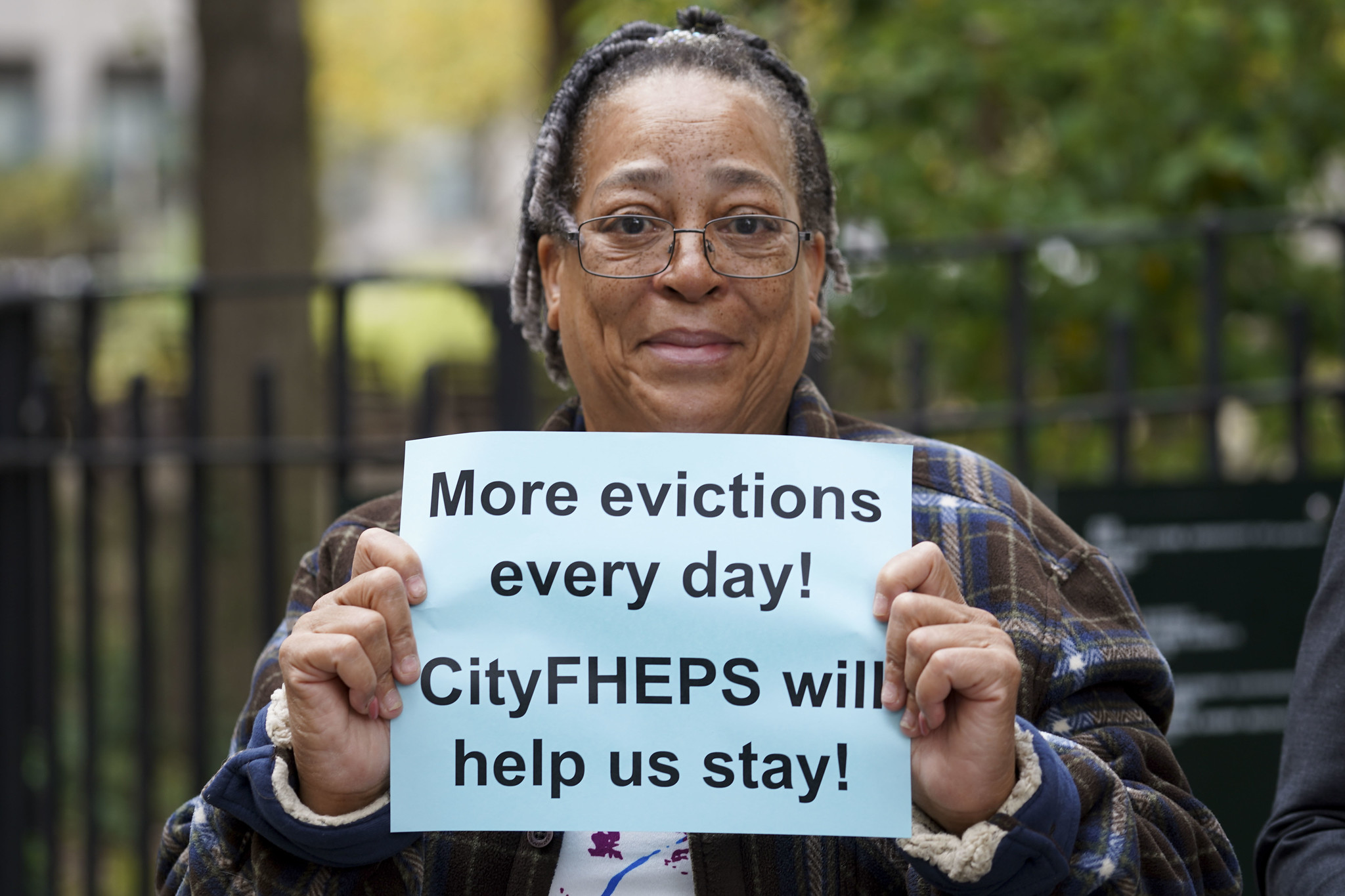
Housing advocates at a rally outside City Hall in 2023, to call for expanding CityFHEPS. (Gerardo Romo / NYC Council Media Unit)
Mayor Zohran Mamdani’s first city budget faces a big shortfall. One reason? Keeping up with the fast-accellerating demand for housing vouchers.
The City Fighting Homelessness and Eviction Prevention Supplement (CityFHEPS) budget soared to $1.25 billion last fiscal year, a five-fold increase since 2021. The comptroller estimates it may break $2 billion when the next fiscal year ends in June.
The rising cost of the program, “is a further indication that we have a homelessness crisis,” said Christine Quinn, CEO of Women In Need (WIN) an organization that provides services to the homeless.
CityFHEPS serves over 65,000 households—making it the second largest voucher program in the country—and is leasing up new voucher holders at record rates. But its large price tag challenges a Mamdani administration seeking to balance its first budget with an ambitious housing agenda.
Advocates say that housing New Yorkers with vouchers will actually save the city money compared to pricey shelter stays.
“You can house people in shelters, which cost astronomically more than using vouchers to house the homeless, or you can help people get permanent homes where they and their children are likely to thrive for far less money housing someone with a voucher,” said Quinn.
But some budget groups are concerned that costs are running too high.
“It’s clear that the city can’t afford to expand it at the scale of potential need,” said Sean Campion, director of housing and economic development studies at the Citizens Budget Commission.
The Adams administration underbudgeted the CityFHEPS program by nearly $800 million this fiscal year—the biggest single contributor to a $2.2 billion shortfall, Comptroller Mark Levine said.
The program is growing at 4 percent a month, according to the comptroller, meaning it would double in size every two years if it keeps up that pace.
“We are raising the alarm now about the scale of these gaps,” said Levine in a budget presentation last week.
Comptroller Mark Levine presenting on the budget shortfall on Jan. 6, 2026. (Flickr/NYC Comptroller’s Office)
That rapid growth doesn’t take into account the cost of expanding eligibility for the program, which Mamdani pledged to do in his campaign.
Legislation passed by the City Council in 2023 would enable people with slightly higher incomes and households at risk of eviction to get CityFHEPS vouchers. But, as City Limits first reported, the Adams administration refused to expand the program, citing its costs. The Council sued and the bills have been held up in court ever since.
The expansion could explode the cost of the program, according to Levine.
“Our office estimates that if this measure, again currently tied up in court, were to be implemented it would add between $6 billion and $20 billion more to the costs of this program in the first five years,” said Levine.
While running for office, Mamdani pledged to drop the lawsuits preventing implementation and expand the program as dictated by the Council. The administration did not immediately respond to questions this week about whether they still plan to do so.
With housing as the largest expense in most New York households’ budgets, tackling those costs seems like a natural fit in a political climate where affordability is the number one issue.
But the program’s spiraling costs may make a city voucher expansion difficult for the Mamdani administration to stomach, despite support from advocates and the City Council.
Councilmember Sandy Nurse, who supported the expansion bills, said they would wait for a budget proposal from City Hall before weighing different priorities.
“It costs money to keep people housed in the current environment we’re in, just like it costs a lot of money to build housing… we thought this was a good package of bills, and we stand by it,” said Nurse.
The city also isn’t getting much help from the state. A $50 million statewide rental assistance pilot program included in last year’s state budget looks small compared to CityFHEPS’ billion dollar price tag.
Vouchers from that pilot, the Housing Access Voucher Program or HAVP, have yet to be disbursed, but will become available through the city’s Department of Housing Preservation and Development on March 1, sources say.
Lawmakers in Albany have been calling for a $250 million commitment for HAVP this year to meet statewide need. “For too long, we have relied heavily on shelters and hotels, short-term subsidies, and federal programs with long waitlists, leaving too many households without a path to stability,” said Senate Housing Committee Chair Brian Kavanagh, in a joint statement with Assembly Housing Chair Linda Rosenthal.
“Last year’s investment of $50 million for the newly created pilot program was a great first step, but does not meet the urgent need to reduce homelessness and housing instability in our state,” added Rosenthal.
Nevertheless, the outlook for rental assistance got a little less bleak this week, as lawmakers in Washington seem likely to pass a federal appropriations bill that would maintain the status quo for Section 8 housing vouchers. The president’s earlier budget had threatened deeper cuts that the city and state would have had to scramble to fill.
With a housing affordability crisis accelerating, and few resources from the federal and state government, CityFHEPS has become all the more important.
“CityFHEPS has played an increasingly integral role in [the Department of Social Services]’s efforts to help vulnerable New Yorkers find and maintain affordable housing,” Nicholas Jacobelli, a DSS spokesperson, said in a statement to City Limits. More than 15,000 households moved into housing with a voucher in the fiscal year 2025, according to the agency.
Tenant organizers at a rally in Albany in 2024. (Chris Janaro/City Limits)
One way to solve for big deficits is to raise more revenue. To do that, the mayor needs help from Albany. And Gov. Kathy Hochul’s state budget proposal, announced earlier this week, did not include tax hikes for the rich and corporations, as Mamdani and his allies have called for.
Quinn said that getting to a system that prioritizes vouchers over shelter will save money in the long term, even if the transition creates thorny budget questions: “You might have a period of time where you know tax is going up and shelter costs are remaining stable. Eventually we will see the savings on the DSS shelter side,” said Quinn.
The Adams administration tried to rein in the cost of CityFHEPS, even as they leased up more voucher holders than ever last year. They cut an incentive for landlords who hold apartments for voucher holders in June, only to backtrack and send the rule change for review after Legal Aid sued. They also proposed increasing the income contribution for longer term CityFHEPS renters, until the City Council passed a bill to block the change, overriding the former mayor’s veto.
Budget groups and the state comptroller have suggested other ways to cut program costs. State Comptroller Thomas DiNapoli said that poor apartment conditions, which require multiple inspections and incentive payments to landlords, helped drive up CityFHEPS’ spending. So did the city paying higher-than-necessary rents in some of the cases audited, the report said.
DSS disputed the findings of the comptroller’s report, saying it “does not capture the full scope of Agency’s oversight and review processes, and fails to highlight the successes of the program against the backdrop of an historic housing crisis and limited support from other levels of government with regard to the provision of housing subsidies.”
Campion said the city needs to both improve administration and costs for the program, but also pursue other solutions to the affordability crisis that complement vouchers. “Whether they expand it or not, they still need to figure out some level of spending that they can afford,” said Campion.
Mamdani’s other housing plans—to build 200,000 affordable apartments in the city in the next 10 years—may also depend on increased revenue.
“The Mamdani Administration will face tough policy decisions with a budget deficit and competing priorities of expanding CityFHEPS, increasing affordable housing supply, and tackling significant preservation needs,” said Rachel Fee, executive director of the New York Housing Conference.
Mamdani has signaled that he believes housing is the solution to homelessness. Last month, he pledged to stop sweeping homeless encampments.
“We’ve never had a mayor who sought to end the homelessness crisis. All we ever had is mayors who sought to manage the crisis,” said Quinn, who negotiated city budgets herself as City Council speaker from 2006-2013.
“Every position that Mayor Mamdani has taken has shown that he wants to be that mayor,” she added.
To reach the reporter behind this story, contact Patrick@citylimits.org. To reach the editor, contact Jeanmarie@citylimits.org
Want to republish this story? Find City Limits’ reprint policy here.
The post Can Mamdani Afford to Expand the CityFHEPS Voucher Program? appeared first on City Limits.
Leave a Reply