
“A voluntary public option for jobs, offering living wages, benefits, health care and union protections, would raise the wage floor and stabilize the economy during downturns.”
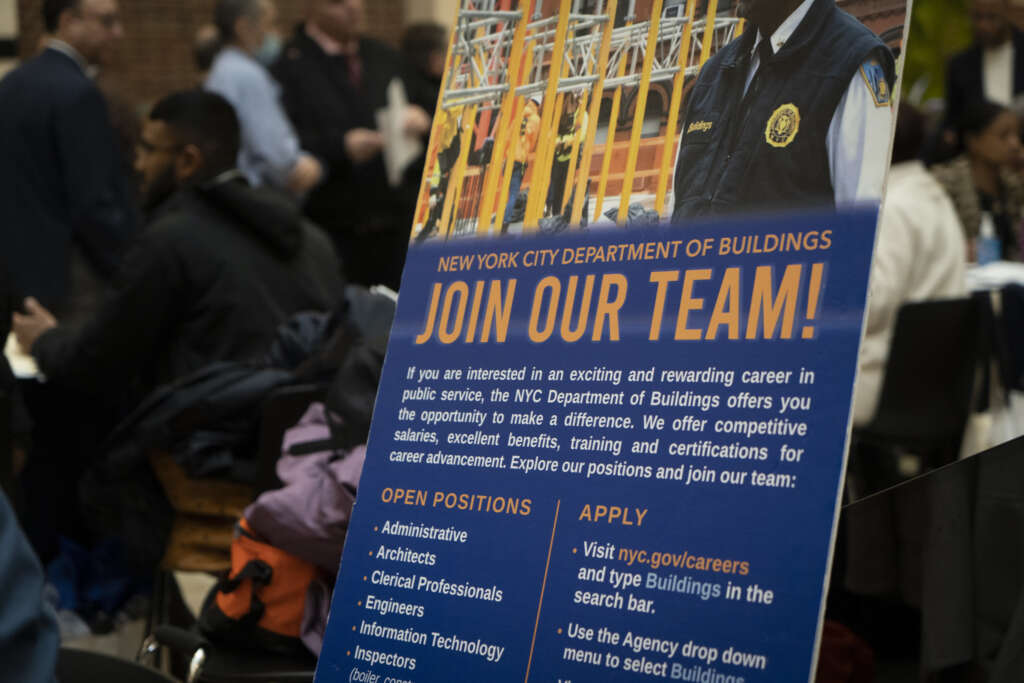
A jobs fair for city agencies in 2023. (NYC Mayor’s Office/Caroline Willis)
Mayor Zohran Mamdani was sworn in this month after a historic campaign that galvanized New York City voters with a bold, inclusive vision: housing for all, childcare for all, public transit for all. It was a vision rooted in universality—one that treated dignity and access not as privileges, but as rights.
Yet one essential “For All” remains absent from the mayor’s agenda list: good jobs for all.
During his stirring inaugural address, Mayor Mamdani spoke at length about working people, aptly referencing “wages that do not rise” and about government’s responsibility to work for those who work hardest. But raising wages only helps people who have work in the first place, and without access to dignified work at a living wage, the promise of affordability and inclusion rests on unstable ground.
Housing, childcare, and transit make participation possible—but work is essential to economic security. If Mayor Mamdani truly seeks to build a New York “For All,” access to publicly funded, socially useful jobs must be a pillar of that vision, not an afterthought.
The question is not new. In 1944, President Franklin D. Roosevelt—who rose to national leadership from New York’s governorship—declared that political freedom cannot exist without economic security. In his historic proposal of an Economic Bill of Rights, the right to a “useful and remunerative job” was the central, fundamental guarantee, and, he would later assert, the guarantee made other economic rights achievable. Employment, Roosevelt insisted, was not merely a market outcome but a public responsibility, essential to dignity and democracy.
Today, policy has drifted far from that principle. The prevailing narrative places the burden of joblessness on individuals rather than institutions. Workers—especially those stigmatized by race, gender, disability, or incarceration—are told that better credentials or stronger networks will deliver opportunity. But credentials only matter if jobs actually exist, and networks themselves reflect entrenched discrimination. The result is a labor market that systematically excludes, even when people do everything “right.”
The outgoing Adams administration leaned into this logic, emphasizing job training while outsourcing job creation to the private sector. Mayor Mamdani’s platform rightly breaks from that approach by prioritizing union protections, collective bargaining, and a $30 minimum wage. These are essential reforms—but they do not reach people who are unemployed, underemployed, or locked out of work altogether. A higher wage floor does little for those who cannot access a job in the first place.
The urgency is visible in the data. More than 210,000 New Yorkers are officially unemployed, with significantly higher rates for Black, Latinx, and Asian workers. Nearly one in four Black youth is out of work. And these figures understate the crisis, excluding discouraged and involuntarily part-time workers who want jobs but cannot find them.
Unemployment is not inevitable. As economist Pavlina Tcherneva argues, it is a policy choice. Governments already intervene aggressively to stabilize markets and subsidize private enterprise. Why not intervene to assure decent work? Refusing to guarantee employment is not neutrality—it is abdication. A voluntary public option for jobs, offering living wages, benefits, health care and union protections, would raise the wage floor and stabilize the economy during downturns.
New York already has a foundation in the Summer Youth Employment Program (SYEP), which has long demonstrated the benefits of public employment. But SYEP is limited by design: seasonal, lottery-based, and often tied to low-wage private work. It is not the ceiling of public employment—but the floor.
A year-round, citywide Jobs-for-All program could build on that foundation, directing labor to urgent public needs: climate justice and resilience, child and elder care, youth programming, public health, and the arts. It would complement the mayor’s affordability agenda by supplying the missing economic anchor those policies require.
Indeed, a recent Urban Institute study found that if implemented in 2018, a national work-based policy package modeled on a New Deal Works Progress Administration (WPA) type program, and a much higher federal minimum wage would have reduced the poverty level dramatically, increased employment and offered more economic security.
An inclusive city cannot be built on an exclusionary labor market. Jobs are the connective tissue binding housing, child care, transit, and education into a coherent vision of shared prosperity. If New York is serious about being a city “For All,” it must be willing to guarantee the most basic economic right of all: the right to dignified work at a living wage.
Cortney Sanders is the director of the National Jobs for All Network at The Institute on Race, Power and Political Economy at The New School. Alan A. Aja is a professor and chair of the Department of Puerto Rican & Latino Studies and co-director of the Mellon Transfer Student Research Program at CUNY’s Brooklyn College. Gertrude Schaffner Goldberg is professor emerita at Adelphi University and former chair of its doctoral program in social work.
The post Opinion: The Missing ‘For All’ Program? A New York City Jobs For All appeared first on City Limits.
Leave a Reply