
Students from the Pratt Institute are teaming up with local community group Mothers on the Move to explore how hemp—a building material rarely used in housing—could help retrofit New York’s oldest buildings, improving indoor air quality and lowering heating and cooling emissions.
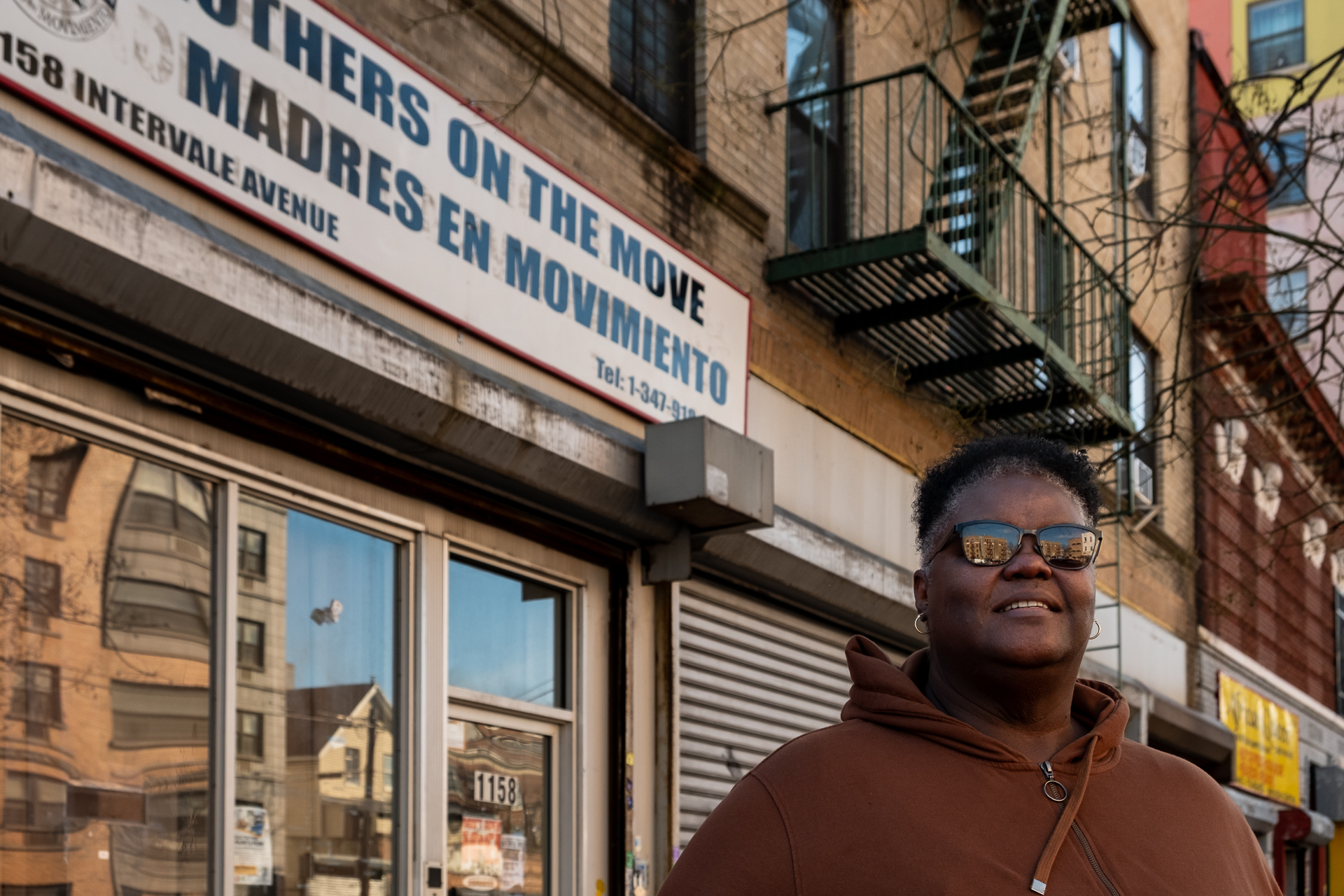
Wanda Salaman, of Mothers on the Move, standing in front of her office in the Bronx. The group has been working with students at Pratt Institute to explore how hemp could improve local housing conditions. (Adi Talwar/City Limits)
This story was produced as part of a capstone reporting project at NYU’s Arthur L. Carter Journalism Institute, with editing by Professor Donna Borak.
On a recent Thursday in the South Bronx, the front door of a shabby aluminum storefront swung open and a group of architecture students slipped inside, notebooks in hand. The room—dim, cramped, and lined with water-stained walls—typically serves as the meeting space for Mothers on the Move, a community group that has spent decades pressing for better housing conditions in the neighborhood. This afternoon, it doubled as a makeshift classroom.
Twelve students from Pratt Institute fanned out across the space, crouching to examine cracks in the plaster and tracing the outlines of a floor plan spread across a folding table. Their assignment was to imagine how one of the city’s most environmentally-burdened neighborhoods might benefit from a building material almost never used in New York City housing: hemp.
The partnership is the latest chapter in Mothers on the Move’s nearly 30-year fight against the environmental and housing conditions that have long made the South Bronx a national symbol of urban health disparities. Bronx residents have the highest adult asthma rate in the city—21 percent, compared to 14 percent citywide—driven by proximity to highways, industry, and aging, poorly ventilated buildings.
“We get sick,” said Wanda Salaman, the group’s executive director. “But some of our apartments that we live in are sicker than us.”
For families like hers, the numbers are not abstract. A 2013 study showed that nearly half of South Bronx households reported having mold and pests, and more than 60 percent lacked basic kitchen and bathroom ventilation. The consequences were predictable: residents experienced more than a week’s worth of asthma symptoms each month. When some families relocated to healthier buildings with proper ventilation, emergency room visits dropped to zero within 18 months, the study found.
Now, students and faculty from Pratt believe hemp—a lightweight, carbon-storing plant fiber—could help retrofit New York’s oldest housing stock while improving indoor air quality and lowering heating and cooling emissions.
For three months, Pratt students reimagined an apartment building near Mothers on the Move and developed retrofit proposals that span from individual units to the entire building. This spring, they’ll get the chance to pitch their ideas to community residents, local politicians, and some of the top city housing agencies, including representatives from the New York City Housing Authority and the city’s Department of Housing Preservation & Development.
Funded in part by the class’s $12,000 budget, the exhibition aims to secure approval to retrofit an office space at Mothers on the Move. If the students’ ideas gain traction, they say the project would mark the first hemp-based renovation of a multifamily apartment in the United States.
A neighborhood’s past shapes its experiments with the future
Salaman has lived through the neighborhood’s cycle of disinvestment and reinvention. After arriving from Puerto Rico at 8 years old, she moved eight times across the South Bronx from 1975 to 1989, navigating mold outbreaks, apartment fires, lead-tainted water, and air thick with highway exhaust. For her, the conditions in many buildings today look painfully familiar.
That history is part of why she has embraced unconventional collaborations. In 2022, following New York’s push to relax cannabis criminalization laws, Salaman worked with Pratt planning students to study the economic impact of legalization. When the team discovered industrial hemp—non-psychoactive, fast-growing, and increasingly used in sustainable construction—the idea clicked.
If hemp could be used to build houses elsewhere, why not here? “It has more than 50,000 uses,” Salaman said. “Why are we not using this in our communities?”
New York City’s climate legislation added urgency. Buildings account for more than two-thirds of citywide greenhouse gas emissions, and Local Law 97 requires owners to reduce emissions by 40 percent in five years or face steep penalties.
Much of that pollution comes from heating systems—old boilers fueled by gas or oil that leak methane and waste energy. Nearly half of the energy used in buildings is dedicated to heating and cooling systems, and the larger part of that comes from the combustion of chemical products made of petroleum, natural gas, and other fossil fuels.
Bhavini Kapur, a sustainable architect who graduated from Pratt last May, was one of the planning students working with Salaman on industrial hemp. She ended up dedicating her thesis to the idea that hemp could be integrated into apartment buildings, and now she’s working closely with the students to help their projects come to life.
During her research, Kapur discovered how hemp could transform from a tiny seed to an insulating material in buildings. Inside the cannabis plant lies a woody center that harvesters cut up into small pieces, also known as hemp hurd. That mixed with lime creates hempcrete, which resembles a mud-like substance that can be made on site.
Hempcrete is light, insulating, easier to transport than concrete, and serves as both structure and insulation. Replacing traditional fiberglass or foam with hemp could cut energy use and eliminate some materials linked to respiratory issues.
While it’s been traditionally marketed as a material for single-home, residential construction, hemp offers a more affordable option for architects using concrete or other carbon-heavy materials. For a conventional wood-frame wall, there are several layers—studs, drywall, sheathing, vapor barrier, and siding. But a hempcrete wall is just made up of studs, hempcrete, and lime coats inside and out.
Pratt students mixed hemp hurd and lime in a patio outside of the architecture building during a workshop class on Nov. 22, 2025. (Photo by Mariapaula Gonzalez)
“It’s simpler and uses fewer materials,” said Ali Memari, chair of residential construction at Penn State University. “Hempcrete can serve as the filler and insulation. So, it’s economical because it replaces multiple layers with one.”
Even with hemp’s criminalized past, Kapur believes the material could spark up some curiosity in communities around the city. “It’s been such a politically charged subject for such a long time with the war on drugs,” she said. “But hemp is a great way to catch attention because of its relation with cannabis, and it’s also a great prototype of how a lot of other bio materials can become part of this discussion, too.”
Hemp has already found its way into multifamily retrofits overseas. In 2012, architects in Paris completed a hemp-insulated renovation in 2012, while using mass timber as structure. In the U.S., researchers are catching up: Rensselaer Polytechnic Institute received a $1.5 million three-year federal grant this March to develop low cost hemp-based insulation panels in single-family homes.
Still, no one has attempted a New York City apartment retrofit—until, potentially, now.
Students take on a 1925 Bronx tenement building
In December, Pratt students presented their midterm proposals for 1149 Tiffany St., a five-story, 1925 tenement owned by the Banana Kelly Housing Association. The building sits directly above Mother on the Move’s storefront office.
For some, the project is personal. Crystar Lopez, 22, grew up in a pre-war, rent-stabilized apartment near the Foxhurst neighborhood and says the area isn’t as walkable since it’s close to the industrial district. “Since people don’t really go out, home has to be a place where they feel comfortable,” Lopez said.
After speaking with Salaman in September to brainstorm project ideas, Lopez and her partner Alexsa Ortiz-Reyes clung to one issue she raised: many families live in apartments with rigid layouts. So, her team focused on creating flexible spaces for families. Their proposal uses temporary, non-destructive walls—finished in hemp lime plaster or compressed hemp blocks—to create modular layouts that comply with city building codes for light and ventilation.
The problem with creating subdivided rooms in the city is that most rarely adhere to the New York City Housing Maintenance Code, which requires that all bedrooms have a window, be at least 80 square feet in area, and that living rooms have natural light. To combat this, Lopez and Ortiz-Reyes designed plans for five different layouts that follow these regulations.
“Before residents move in, they would say, ‘Okay, I need this type of layout,’” Lopez said. “It’s like building your own IKEA apartment.”
The environmentally-friendly flex walls would allow families to create an additional bedroom or living space while still being up to code. Residents could request kits that would include modular curtain rods, storage walls, and a raised floor and pick them up at the Mothers on the Move office. They would also receive a pamphlet showing assembly instructions and different layouts they could create based on their needs.
Lopez and Ortiz-Reyes created 3D models of their modular layouts, featuring textured hempcrete walls designed for kitchens and bathrooms to improve ventilation. (Photo by Alexsa Ortiz-Reyes)
Another student, Julia Orsini, zeroed in on ventilation. After touring 1149 Tiffany, she learned the building had narrow, dark hallways and little natural air circulation—conditions that can trap mold and airborne contaminants inside apartments.
Most buildings built in the early 1900s, according to Salaman, were poorly laid out and resembled mass manufactured housing with simple, repetitive floor plans, prioritizing efficiency over comfort. If air isn’t getting circulated through the building, mold growing that tenants can’t see or asbestos leaking in can’t be flushed out, Orsini said.
Her design would carve vertical shafts from the basement to the roof, framed in timber and lined with rotating hemp panels. Tenants could open or close the panels to control airflow in their apartments. The redesign also includes a roof garden and a double-layer facade that creates shared balconies and channels fresh air into the building.
“The idea behind my project is thinking how we can renovate these existing buildings that have these issues in a way that’s very direct but intentful,” she said. “Carving out these atriums—not looking at changing floor plans or moving around walls—but just doing one direct cut through the building would hopefully be able to alleviate a lot of issues.”
Natural materials bump heads with city regulations
Since U.S. farmers weren’t allowed to grow hemp until 2018, it’s still a relatively new product for architects and developers. In New York City, hemp has not yet been approved for apartment retrofits, according to the Department of Buildings. If a property owner or their registered design professional wants to work with a new material that doesn’t exist in the building code, they must file an application to the DOB’s Office of Technical Certification and Research for approval.
A major challenge for architects is ensuring these new building materials provide adequate fire resistance and insulation. Different materials must meet specific fire ratings, like being able to withstand fire for 30 minutes or an hour. While drywall can be bought to meet these regulations, hemp-lime walls naturally provide a one-hour rating. Building codes today also require walls and roofs to meet minimum insulation levels, called R-values, which measure thermal resistance. Thick hemp-based walls can meet those requirements.
But there’s a cost tied to these types of innovative projects. Even when natural materials are similarly priced—or cheaper—to their carbon-heavy counterparts, architects and developers sometimes hesitate before using them because they require new skills and specialized labor, said Heather Clark, former senior director for building sector climate policy under the Biden administration.
“It’s not just with natural materials, but across the board, we don’t see the adoption of good ideas, good materials, and good techniques,” she said. “It doesn’t happen as fast as we’d like it to happen.”
What helps architects in these early-phase projects are incentives, like subsidies. “If there is some kind of subsidy on the supply side where the government says, ‘We’re going to use hemp insulation in our NYCHA developments or affordable housing projects,’ that creates a supply chain,” Kapur said.
This has been the case for other materials. Since 2022, developers have been able to use engineered wood products like cross laminated timber in building construction designs.
Former Mayor Eric Adams in May, announcing plans for 500 apartments on Staten Island constructed with sustainable mass timber. (Michael Appleton/Mayoral Photography office)
The NYC Mass Timber Studio, launched a year later by New York City Economic Development Corporation with the mayor’s office, offers grant help, technical support, and regulatory guidance to teams working with this material on early-phase projects. In May, former Mayor Eric Adams approved construction for over 500 new mixed-income housing units on Staten Island, with a quarter reserved for affordable housing, making it the city’s largest mass timber residential project. Mass timber, composed of engineered wood materials, is a healthier and lighter alternative to steel or concrete that can also speed up construction through offsite production.
But building code regulations haven’t discouraged the Pratt group. For Kapur, the Pratt studio is a perfect place for early career architects, like the students, to normalize using these natural materials in their work while staying connected to the local community.
“You can very easily incorporate it into your designs,” she said. “”t’s intervention where we can intervene at this point, and the studio is a good example of that.”
The first hemp test in the Bronx
During the first week of December, the Pratt students shared their polished proposals to a room full of professors and Salaman. The crowd buzzed with excitement and erupted in applause after each student spoke. For the group, this is just the beginning.
Before tackling a full apartment retrofit, they wants to start with something smaller. Knowing that it will be difficult to introduce sustainable materials into a community without proper education, Salaman and the students plan to create a hemp demonstration room in one of the offices in the Mothers on the Move building using their semester-long project ideas. If a pilot project is approved after the spring exhibition, the group hopes to transform the office space with natural materials for people to see and touch.
The showroom would act as a learning center for community residents, where they could pick up pamphlets detailing the uses of hemp and its benefits. That would set them up to also participate in the innovation process.
Pratt students created models for a hemp demonstration room at the Mothers on the Move office, where local residents can experience a fully insulated hemp space and learn about the building material. (Photo by Mariapaula Gonzalez)
“What’s so lovely about hemp is that it requires training,” said Jeremias Emestica, a Bronx native and Kapur’s former classmate at Pratt, who mentored some of the students this semester. “There’s a big opportunity to get a good craft skill regarding hemp here in the Bronx. That’s part of this green vision in the borough that many people have.”
In their final project, Lopez and Alexsa-Ortiz Reyes proposed that residents come to Mothers on the Move to build their own hemp blocks for wall insulation. They would measure their walls, make the materials on site, and take them home to assemble using the provided instruction pamphlet.
While the hemp that the students have worked with comes from Coexist Farms in Lancaster, Pennsylvania, the goal is to eventually source locally.
That would allow the Bronx to build a supply chain between upstate New York, where materials like hemp, mass timber and straw will be harvested and sourced, and downstate New York, where the hemp will be manufactured and sold. Working with upstate farmers, the material could be shipped down the Hudson River in barges and delivered to the Bronx marine terminal in Hunts Point. With over 800 farmers registered to grow hemp in recent years, according to Kapur, they have a combined capacity of around 30,000 acres.
If more South Bronx residents learn how to work with hemp, they could secure sustainable jobs in manufacturing, construction, and installation—helping to significantly reduce the borough’s 10.1 percent unemployment rate, the highest in the city, according to Kapur. These climate-friendly positions would also support the city’s goal of creating 400,000 green jobs by 2040.
What’s unfolding in Salaman’s storefront is part-design studio, part-environmental justice experiment. If the students’ ideas prove feasible, the Bronx could become the first test case in New York City for using hemp to improve housing quality, reduce emissions, and address longstanding health disparties—simulanteously.
For Salaman, that possibility alone makes the collaboration worth pursuing.
“Before we had a paper, but now we’re going to have more than just a paper—we’re going to have a model,” Salaman said. “Every time I talk to people, they want to see more.”
After nearly 50 years, a simple farm-grown material could help bring her vision of a revitalized South Bronx to life, she says.
“We could use hemp to insulate apartments and we could free ourselves by creating jobs,” Salaman said. “We could really do generational wealth.”
To reach the editor, contact Jeanmarie@citylimits.org
Want to republish this story? Find City Limits’ reprint policy here.
The post Could This South Bronx Tenement Become NYC’s First Hemp-Retrofitted Apartment Building? appeared first on City Limits.
Leave a Reply