
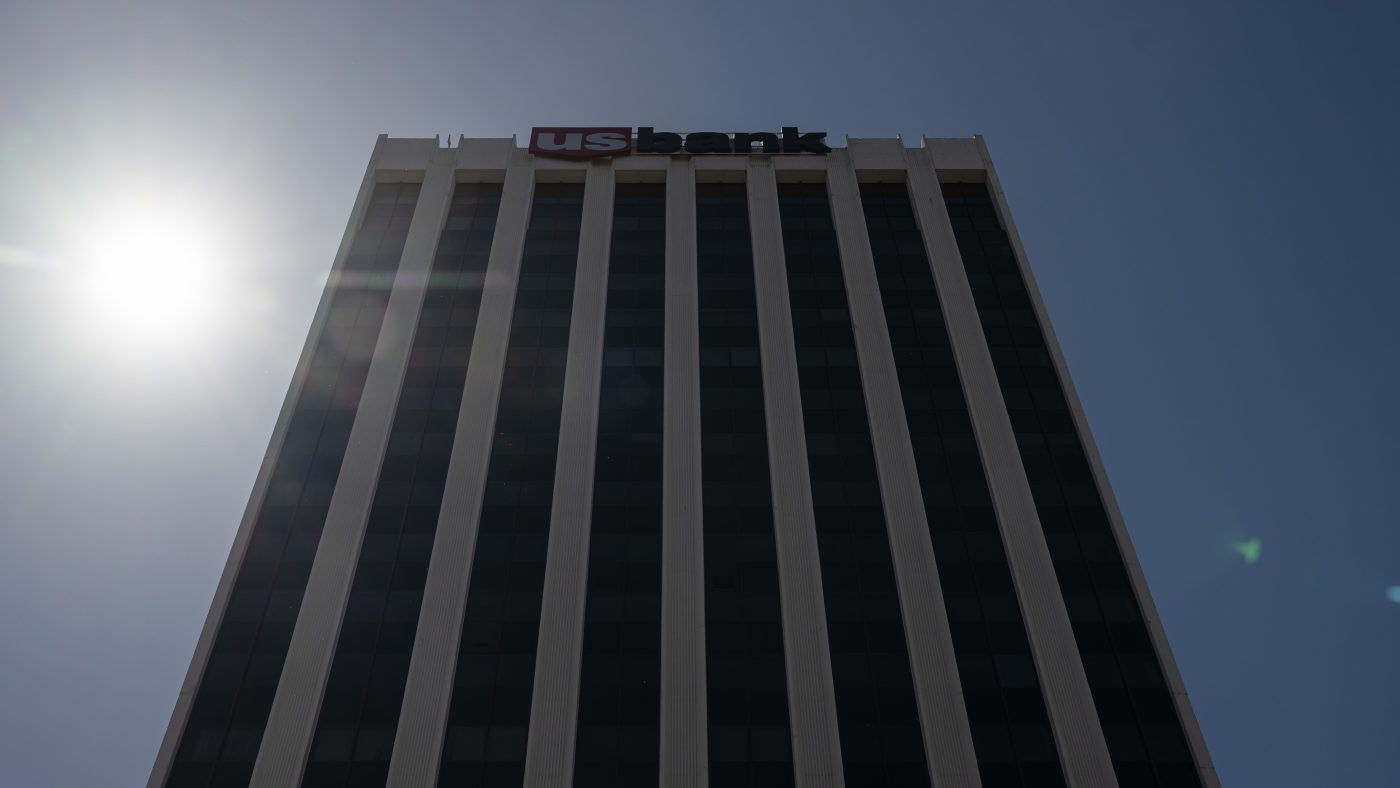
Days before a scheduled foreclosure auction, the nonprofit St. Paul Downtown Development Corporation announced earlier this month it had bought the U.S. Bank Center’s distressed mortgage from First Interstate Bank of Omaha, Neb. While troubled property owner Madison Equities continues to hold title to the 25-story office tower, the downtown development corporation is now the lender, giving it a path forward to steer the fate of the 25-story tower, which is about 26% occupied.
Dave Higgins. (Courtesy of the St. Paul Downtown Alliance)
This isn’t the first acquisition for the year-old nonprofit.
In the past few months, the St. Paul Downtown Development Corporation has acquired the Alliance Bank Center, the Capital City Plaza parking ramp, the Empire Building and the adjoining Endicott Arcade, all of them vacant properties previously owned by Madison Equities, with the stated goal of someday reactivating stagnant corners of downtown.
The Pioneer Press recently interviewed Dave Higgins, the development corporation’s president. A real estate attorney by training, he worked for the Boston Redevelopment Authority and the real estate group of the global law firm DLA Piper before spending most of the past 10 years as a vice president of development with the Minnesota companies Roers and McGough.
The following transcript of the interview has been edited for length and clarity.
Q: How long do you plan to hold onto the U.S. Bank Center? Are you going to serve as the mortgage lender indefinitely?
A: I don’t have a specific timeframe for you. We have some study and analysis to do. During that timeframe, we’ll be the lender, and Madison will be the owner.
Q: Still, your overall goal isn’t to make the nonprofit a major longtime property owner downtown, is it?
A: It really depends on the asset. We certainly have the ability to be a developer/redeveloper of any of these assets. We’re actually doing it on the Capital City Plaza to the extent it needs restoration work. We’re expecting to start and complete that in 2026.
We’re expecting to get work done on the Endicott Arcade in 2026. If we can identify a worthy tenant or a worthy couple of tenants, we’ll do that. We’d like to activate that on street level. In terms of Alliance Bank Center, it might be possible we do a joint venture with somebody else, depending upon what materializes. It’s also possible an investor might come along and say ‘I’d love to take it over.’ If it’s someone who has the experience and capability we can have faith in, it’s possible we might pass the baton and let someone else develop it.
We’re not trying to get in the way of the market. We only exist because we’ve sort of reached a state downtown where the conventional players aren’t taking on some of these assets, and we need momentum to continue. If we create enough momentum where folks come forward odds are good, if they’re capable, that we would step out of the way and hand it off to let the market do what the market should be doing in a normal, healthy environment.
Q: The St. Paul Downtown Alliance has raised the possibility that some buildings may never be successfully repurposed and may just have to come down. With the U.S. Bank Center, could you ever foresee demolishing it?
A: It’s one outcome that’s possible. I think it’s one of the best candidates downtown for a conversion to residences, at least from a spatial standpoint. There’s a lot of structural analysis that needs to be worked out. There’s a lot of cost in terms of plumbing and those challenges, but it works pretty well from a space standpoint. The north half of the block is underdeveloped with a drive-through and an empty bar. The entire block is subject to the debt. If somebody came along and replaced Madison Equities as the owner, they would get the whole block.
Q: So you’re actively pursuing a conversion of U.S. Bank Center to apartments?
A: It’s something that will be studied. If it doesn’t work from a spatial standpoint, it doesn’t make sense to do all the other evaluation. But it does work from a spatial standpoint. Gensler (a global architecture, planning and design firm) got hired to look at 20 buildings downtown, and 10 scored pretty well for potential residential conversion. U.S. Bank Center scored, if not the top, than among the top candidates for residential.
The U.S. Bank Center building in downtown St. Paul on Thursday, Oct. 24, 2024. (John Autey / Pioneer Press)
Q: The Downtown Alliance, which launched your nonprofit, is a public-private partnership between City Hall and major downtown employers like Securian and Ecolab. You’ve said no public funds went into this mortgage acquisition. Then who funded it?
A: We’re not public at the present time with who our investors are.
Q: You’re now a nonprofit lender to Madison Equities, which is a private business. Is U.S. Bank Center still on the tax rolls, and will you pay the $2.6 million in delinquent property taxes?
A: We are a nonprofit. The building is owned by a for-profit. So it’s still on the tax rolls. That tax obligation remains a current obligation of the current property owner, not the lender. It remains to be seen what the future obligations will be.
Q: For the properties that are now owned outright by SPDDC — Alliance Bank, Capital City Plaza, Empire Building, Endicott Arcade — are these now off the tax rolls completely, given that SPDDC is a nonprofit?
A: Alliance has been granted tax-exempt status starting with the 2026 tax year. We do not yet have that status for CCP, so that is to be determined, and Empire Building was acquired too recently to have that status. Alliance is a precedent, so to be determined. The county has an application.
Q: If U.S. Bank Center becomes a tax-forfeit property for failing to pay back taxes, would SPDDC, as the lender, be first in line to acquire it outright?
A: It depends. The county would need to make a decision that it was in the best interest of the county to proceed with a tax forfeiture process. Invariably, because we’re another party involved, they would undoubtedly consult with us whether there’s anything we’d be interested in doing to avoid that. That could take years. It’s a process that has a period of years of delinquency required before the county would exercise that step.
Q: Is Madison Equities paying you, as the lender? If Madison Equities defaults on its mortgage, does the deed transfer to SPDDC?
A: It’s not paying the lender. (But a deed transfer is) not automatic. A lender would still need to follow a foreclosure process, and technically there’s a few different avenues for foreclosing through the court process. There’s an alternate process we used at Alliance Bank Center, called a deed in lieu of foreclosure, where an owner hands over the deed to the property in exchange for the lender agreeing to avoid a foreclosure process. There might be some monetary component to it, like a judgment they agree to pay, but it’s basically a lender agreeing to move on.
Q: It seems pretty clear eventually you’ll end up with this property.
A: There’s potential for that.
Q: You’ve said you don’t want to compete with the market. There was a foreclosure auction scheduled for Jan. 12. Now the private sector won’t get a chance to bid on U.S. Bank Center’s mortgage, and we’re told at least five or six potential bidders had registered. Isn’t that competing with the private sector?
A: It’s hard to know how many of those were actually going to bid or had signed up and were simply tracking it. It’s hard to say. We’ve been having conversations with the lender over 2025, and it made the most sense for them to continue with us. Almost two years ago now, CBRE (the real estate services provider) put out a marketing book with 10 Madison Equities properties, and nobody acquired the property. Saying we locked out competition is not really accurate. (An expedited online auction) is sort of a move of last resort, short of a group like ours stepping in.
We clearly had resources. We’re present. We’re local. We have a singular mission that is downtown-focused. I think the bank did some reasonable math about that. There’s plenty of instances around the country where someone buys a property online, sight unseen, and the property sits and languishes.
Q: With U.S. Bank Center, you now own or largely control five buildings downtown through acquisition?
A: Yes. Initially, with the Alliance Bank Center, we bought the debt in early June. It was about 60 days later that we then got the deed. It was a deed in lieu of foreclosure. The Capital City Plaza Parking ramp I think technically would be considered a short sale, which is just a sale of a property where its value is less than the mortgage. It triggers the requirement of the lender to approve the sale price.
Q: Do you plan to acquire more properties downtown?
Related Articles
U.S. Bank Center mortgage acquired by St. Paul Downtown Development Corporation
St. Paul: Downtown Development Corp. buys Capital City Plaza parking ramp
St. Paul Downtown Development Corp. seeks to acquire Alliance Bank Center
Downtown developers, advocates weigh in on Madison Equities selling St. Paul properties
How could the sale of the Madison Equities portfolio impact downtown St. Paul?
A: I don’t have plans to at the present time. It’s neither a plan to, nor beyond the possibility of happening. But we don’t plan to at the present time.
Q: You’ve said your goal is to reactivate stagnant corners of downtown. You’ve launched a public engagement process to solicit feedback. How can the public weigh in?
A: The “Reimagine Downtown St. Paul: Transforming the Core” outreach began last month. If you go to downtownstpaul.com/reimagine, there’s a map where over 400 people have left comments, and other people have given thumbs-up or thumbs-down to those comments. We have a public survey, pop-ups and small group conversations planned. The website describes it pretty well.
Leave a Reply