
Much like how a sailor, lost and withering at sea, at least gets the chance to see the world, Texas’ ailing Democrats will get the chance this year to recreate some of the magic of the 2018 midterms.
You know the drill: Donald Trump’s in the second year of a presidential stint, and his megalomaniacal unsuitability for public service is catching up with him. Off-year elections in Virginia and New Jersey have given Dems new reason to believe. Congressional Republicans are heading for the exits in telling numbers, while the possibility of a weak GOP candidate in Texas for U.S. Senate looms. This go-round, there’s no real chance of the suite of downballot flips that occurred eight years ago, when that decade’s electoral maps had overripened; still, it’s time now to take out your color wheel and start studying the liminal shades of what constitutes “blue,” plus your lidar scanner (what do you mean you don’t have one?) to start distinguishing calm waters, ripples, and waves.
Paying casual attention, you might not feel Texas Democrats are fielding the A-team that this moment calls for. By this time in that long-lost cycle when Senator Ted Cruz was so nearly ousted, El Paso Congressman Beto O’Rourke had already been running without real primary competition for the better part of a year. In contrast, this year’s marquee Dem nomination process has been slow and fitful. That fact, however, belies the comparative strength of the slate that’s likely to solidify in the coming months.
At least on paper, the 2026 Democratic nominees for the top four races (senator, governor, lieutenant governor, and attorney general) are almost sure to be the most formidable class in recent memory. In 2018, only two of the four already held elected office, one at the county level. From 2020 through 2024, the only top-level nominee who did so was Colin Allred in ’24, then a congressman dragging a low-energy campaign against Cruz to a 9-point defeat. In lieu of seasoned politicians, Texans during these years were invited to put their faith in: a mild-mannered accountant, a self-assessed “ass-kicking, motorcycle-riding, tattooed Democrat,” a burned-out presidential hopeful, and a mild-mannered accountant yet again, among a couple others.
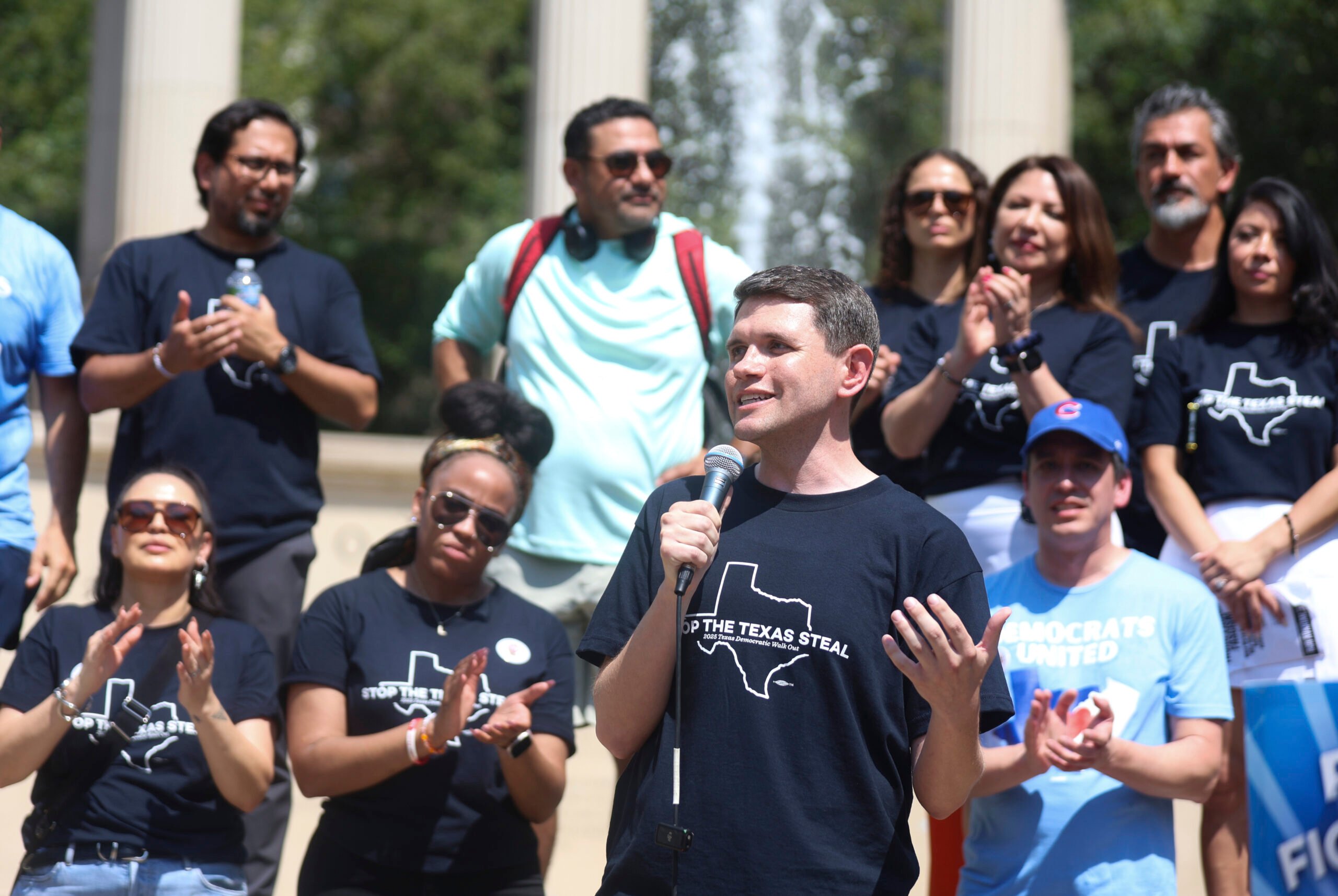
State Representative James Talarico, now running for U.S. Senate, speaks at a rally in August. (AP Photo/Talia Sprague)
This November, Democrats may well put sitting legislators on the ballot in all four of the top slots. By this simple but meaningful metric, the slate should be stronger even than 2014’s relatively heralded lineup (which featured two state senators, Wendy Davis and Leticia Van de Putte, and a guy named Sam Houston). Of course, that ’14 team ended in ashes and grief; holding elected office is no guarantee against getting walloped. But it’s encouraging to see people who’ve won something before, and have something to lose, taking the plunge.
All that praise given, the process has still left plenty to be desired. Way back in May, Allred and O’Rourke met with Congressman Joaquin Castro and state Representative James Talarico to sort out who should take on incumbent U.S. Senator John Cornyn (or one of his primary challengers—Dems are hoping for the scandal-scarred Attorney General Ken Paxton) and to possibly divide their firepower among the races. This boys’ club managed to settle on approximately nothing. Allred jumped in the Senate race first, then Talarico did too; O’Rourke stayed out altogether, as did Castro, who months later gave a head-scratching series of comments about how he would have run for AG if only the other men could have sorted themselves out.
Poor coordination could lead to some odd outcomes. It’s possible that three of the four top nominees will be Austin state reps, a stark homogeneity that no one would intentionally plan. It’s also possible the slots will be split equally between Austin and Dallas politicians—still odd in a sprawling state whose largest city is neither of those two. And it’s further possible that three of the four will be Anglo, in a majority-nonwhite state headed toward majority-Latino status.
Then there’s the down-to-the-wire-ness of it all. North Texas Congresswoman Jasmine Crockett, in particular, waited until the afternoon of the final possible day to officially declare for the Senate, a looming decision that sent Allred scurrying instead into a competitive U.S. House primary that very morning. A firebrand who can earn all the media she needs and stack up cash, Crockett as a candidate means a zero-sum showdown with Talarico, who’d spent months receiving a rising-star treatment and building a lead over Allred.
To this point, I’ve written this column with an assumption that primary voters will tend toward sitting elected officials in March (and May, as needed) and with some indifference to Dem primary beefing in a state where the general election belongs to Republicans until proven otherwise. But voters will indeed have to make choices at the polls before any 2026 slate actually forms, so I’ll offer at least a few notes.
Talarico is a Democrat, a politician, and a Christian. This is a normal combination, though national media has treated it as exotic. The distinction is that, as a graduate student of liberal Presbyterianism, Talarico’s breadth and consistency of religious reference is greater than usual. And his serene delivery and boyish clean-cut looks are, as the kids would perhaps still say, giving pastor.
But Talarico’s campaign refrain that it’s “time to start flipping tables” begs a question: Can you picture him actually flipping a table? With Crockett, you can—or at least the verbal equivalent. With O’Rourke, the closest thing to a success story Texas Dems have, tables were in constant physical danger as the six-foot-something El Pasoan was wont to leap atop them before addressing a crowd. Both Crockett and O’Rourke are the type of politician who can say “fuck” and make it sound right.
Talarico has developed an effective religious-political rhetorical mode, but Crockett (again like O’Rourke) can go viral by breaking out of the politician mode entirely.
Before Crockett’s entrance, Talarico was in the catbird seat. He could be the left candidate and the center candidate at will, the head and the heart of the party alike. Now, even as he responds to his competitor with grace, the high road is obstructed. The lanes of progressive vs. moderate can’t be entirely avoided, and claims about electability and divisiveness will be inflected with race and gender.
Talarico has a large following on TikTok and Instagram; Crockett’s is larger. Talarico can raise money, and so can she. She holds a higher elected office, and she comes from a much more populous metro area. So why not her? Talarico doesn’t want to answer that, but the question isn’t going away.
Crockett at the 2024 Democratic National Convention (Shutterstock)
A step down the ballot, five-term Austin state Representative Gina Hinojosa has nobly given up her seat to challenge the governor, who is likely untouchable but deserves a serious critic of his cronyism and creeping authoritarianism. In the absence of any serious South Texas candidate, Hinojosa will have to play the part—something she can credibly do as a Brownsville native with a last name that screams Valley to anyone who knows the region.
Rounding out the electeds running for the next two rungs, a third Austin state House member, Vikki Goodwin, is taking a shot at the lieutenant governor, and Dallas state Senator Nathan Johnson is aiming for the AG seat vacated by Paxton.
Apart from these, there’s a competing slate of already-rans (until the former congressman from Dallas switched races, I was going to call these Allred-y-rans—alas!). This includes Andrew White, an ex-governor’s son, himself running for guv for the second time [Editor’s Note: White dropped his bid on January 5, after this story published in print]; long-ago-congressman and once-gubernatorial nominee Chris Bell also running for the executive mansion again; and ex-Galveston Mayor Joe Jaworski taking a second stab at AG. (Mike Collier, the mild-mannered accountant himself, is also making his third lite guv bid—but this time as an Independent.) For these hopefuls, perhaps the umpteenth time will prove the charm, but voters are certainly under no pressure to bet on them now.
Like a sailor, lost and withering at sea, who manages to reel in a strange catch that may or may not be poisonous to eat, Texas Democrats will get the chance this year to try something new.
The post Midterm Memo: The C-Team. Maybe B-. appeared first on The Texas Observer.
Leave a Reply