
“New York City’s experience demonstrates that large-scale carbon reduction is not only essential but entirely within reach.”
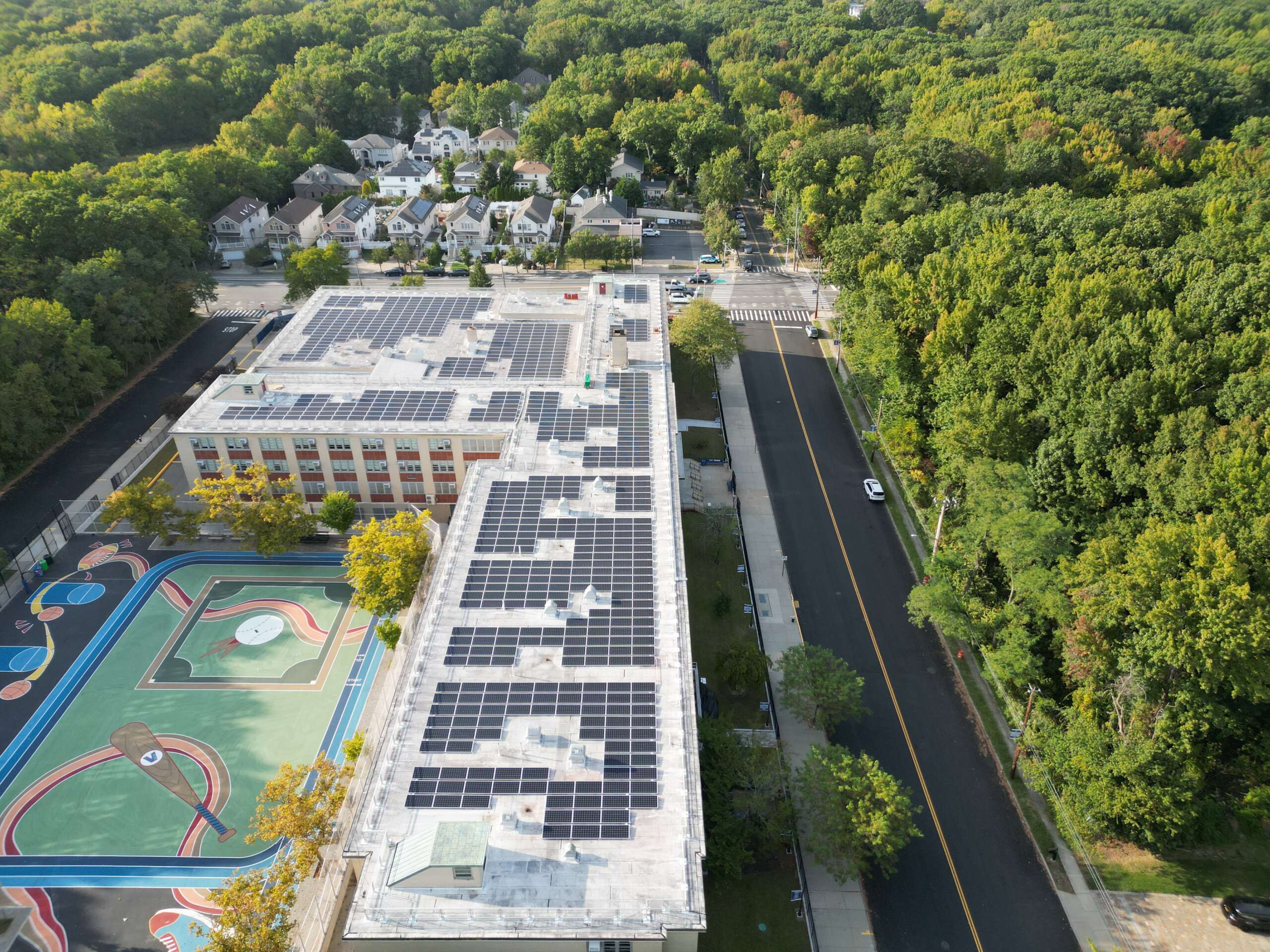
Solar panels at I.S. 007 Elias Bernstein, one of over 100 city schools with new solar arrays. (Photo via DCAS)
As the federal government retreats from taking meaningful action on the global climate crisis, cities and states must rise to the occasion and uphold our moral obligation to create a more sustainable world for future generations. I am proud to share that New York City government is leading by example in this critical mission.
As New York City’s chief decarbonization officer, and a deputy commissioner at the Department of Citywide Administrative Services (DCAS), it is my duty to lead the city government’s carbon reduction efforts. Our mandates are ambitious: Local Law 97 of 2019 requires us to reduce greenhouse gas emissions 50 percent by 2030.
Thanks to a transformative mobilization led by DCAS and partner agencies, the city is currently on track to reach the 50 percent reduction target ahead of our 2030 deadline.
As cited in our Executive Order 89 report issued today, and in the New York City Greenhouse Gas Inventory, as of 2024, the city has reduced emissions 31 percent from the 2006 baseline. We’ve also reduced energy consumption in buildings by 16 percent over this same period.
So, how did we get here in the face of numerous headwinds?
The basis of this progress has depended—and still depends—on a holistic effort: we identified every source of emissions throughout the government and devised interventions aimed at maximizing the impact of taxpayer dollars to achieve our aggressive reduction targets.
To start, we zeroed in on buildings, which are responsible for 70 percent of citywide greenhouse gas emissions and are central to this work. We are replacing fossil fuel systems with electric ones, retrofitting equipment, upgrading lighting, improving operations, and installing solar panels on city facilities, including our public schools. These improvements mean healthier indoor air, improved public spaces, and opportunities for students to learn about clean energy firsthand.
The results speak for themselves. Since 2014, we have implemented over 17,500 energy conservation measures across 2,500 city-owned buildings, culminating in 460,000 metric tons of carbon dioxide equivalent reduced, the equivalent of removing over 100,000 cars off the road. These measures have also saved the city $150 million dollars in annual energy costs, proving that the public sector can make the economics of sustainability work at scale.
These efforts have also strengthened our public infrastructure and uplifted local communities—notably, 51 percent of projects have been in disadvantaged communities, ensuring the benefits of decarbonization flow equitably across the city.
Beyond buildings, the City of New York is investing in a cleaner electricity grid, which will serve all New Yorkers. Four years ago, DCAS entered into a contract with the New York State Energy Research and Development Authority to advance the Champlain Hudson Power Express, an energy infrastructure project that will deliver 1,250 megawatts of clean energy directly from Quebec to New York City and will cover 100 percent of the city government operations.
This project will be transformational for our energy grid, estimated to supply 20 percent of the power needed for the city, and is essential for meeting the clean energy supply needs of both city government and the private sector. We expect to begin enjoying the benefits of this project in the spring.
New cogeneration Plant Fluid Cooler at the Bronx Zoo, completed as an efficiency upgrade project between DCAS, NYPA, and WCS. (Photo via DCAS)
As we look toward the city’s longer-term commitment to carbon neutrality by 2050, there is no doubt that challenges remain. Issues with the supply chain continue to affect equipment lead times, and the closure of the Indian Point Energy Facility in 2021 increased reliance on fossil fuels for the city’s electricity supply. The city has made great strides in reforming its procurement, but the process continues to take longer than we would like; and all this work continues to take place in a tight budgetary environment.
More recently, existing challenges have been compounded by the federal government’s passage of the “One Big Beautiful Bill” act, which repeals a critical tax credit for solar systems, in addition to new tariffs, which drive up costs across the board.
Yet despite these obstacles, New York City is pressing forward. DCAS is working to accelerate all of our efforts to speed up project delivery, invest in our green workforce across city agencies, electrify our buildings and fleet, and invest in solar and storage to strengthen the grid.
When we began this journey over six years ago, our success was not guaranteed, and many aspects of the mission were clouded by uncertainty. However, the progress we’ve made and the momentum we continue to build are the result of strong commitments from leadership, a unifying citywide approach that prioritizes collaboration and accountability, and a spirit of innovation and continuous improvement.
New York City’s experience demonstrates that large-scale carbon reduction is not only essential but entirely within reach. The path forward is clear; cities can win the climate fight. They just need the collective will to pursue it.
Sana Barakat is New York City’s chief decarbonization officer and the deputy commissioner for energy management at the Department of Citywide Administrative Services.
The post Opinion: Cities Can Win the Climate Fight. NYC is Setting the Stage. appeared first on City Limits.
Leave a Reply