
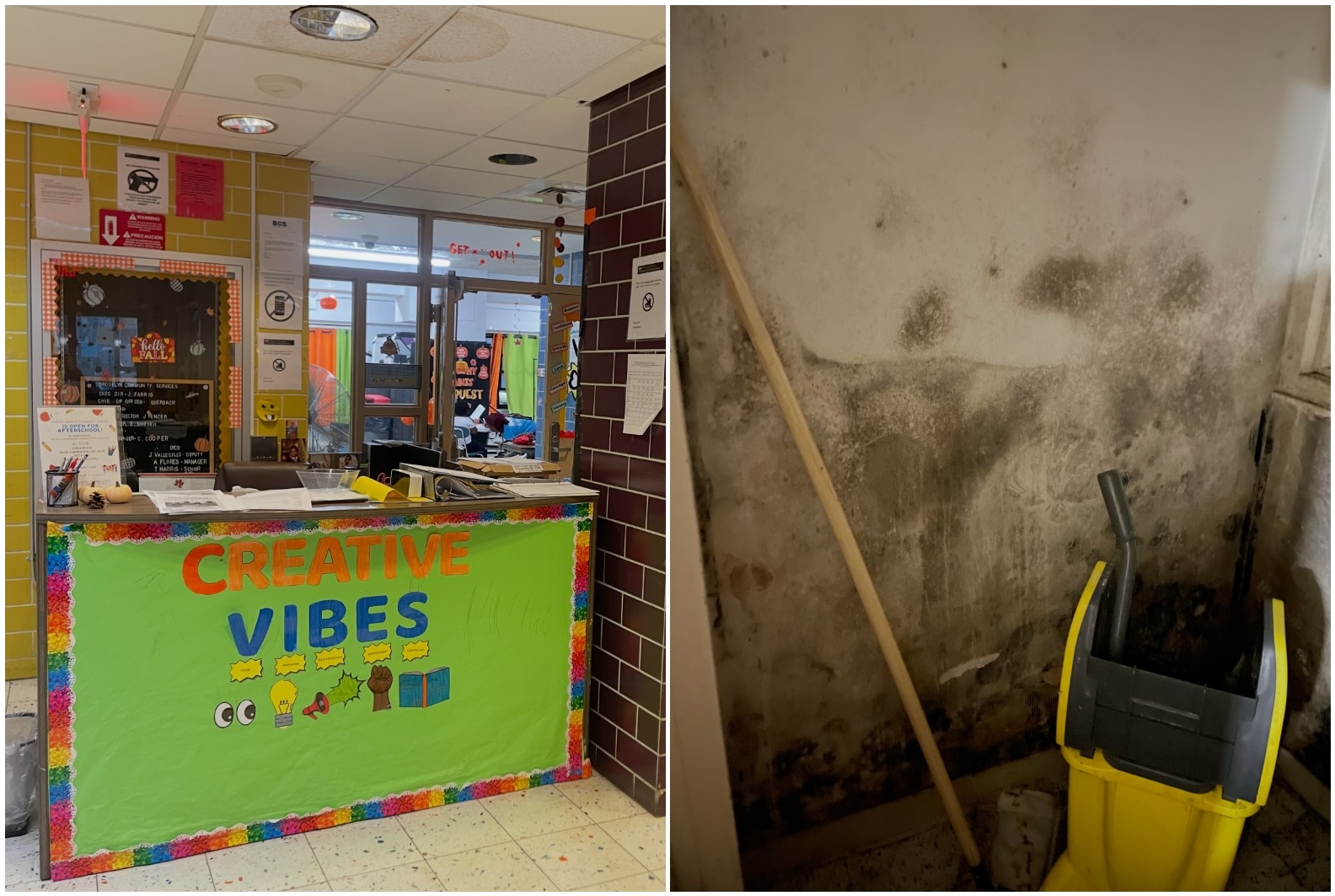
Staff at the center, many of whom also live in NYCHA housing, say they keep the door to the mold-filled closet closed as much as possible. They say they’ve filed multiple repair tickets with NYCHA, but the agency has yet to address the problem.
The maintenance closet (right) at NYCHA’s O’Dwyer Gardens Community Center, where dark mold has covered the walls and ceiling for almost a year. (Photos by Bella Week)
Just before 3 p.m. at the Community Center at O’Dwyer Gardens, a NYCHA public housing complex in Coney Island, a dozen small kids run in and drop their backpacks. A few greet staff with knee-high hugs as they enter the main room, where after-school programming is about to begin. Behind the door of a maintenance closet near the foosball table, dark mold has been spreading across the walls and ceiling for almost a year.
Staff at the center, many of whom also live in NYCHA housing, say they keep the closet door closed as much as possible to protect themselves, the children, and seniors who use the space. They say they’ve filed multiple repair tickets with NYCHA, but the agency has yet to address the problem.
“We’re all hesitant to go in the closet,” said Chyanne Cooper, who has worked at the center for seven years and participated in its programs before that. “A lot of us have kids as well, so we don’t want it to affect us or affect these kids.”
Sadaf Sheikh, the center’s program director, said the smell is overwhelming. “If you open the closet, it is so strong,” she said. “One time I went in the closet, I felt sick.”
Exposure to mold can cause or worsen asthma and other respiratory illnesses, conditions that disproportionately affect Black and brown children living in low-income households, where environmental triggers, including mold, are common.
Visible mold covers the ceiling of the maintenance closet in a community center that hosts daily programming for dozens of kids. Photo by Bella Week.
Coney Island has struggled with persistent mold outbreaks since flooding from Hurricane Sandy in 2012, and many residents experience ongoing respiratory issues. A 2023 report by the New York State Department of Health found that asthma rates among NYCHA residents in Coney Island are two-and-a-half times that of residents who don’t live in public housing.
“We definitely have a few kids that have asthma,” said Cooper. She described one child whose parents ask staff to hold on to his inhaler and assist him with it when needed.
Staff say they try to keep the closet door shut and avoid going inside unless necessary, which it sometimes is. “That’s where all our toilet tissue, extra soaps, and cleaning products are,” said Cooper. “But with kids constantly being in that room, it’s hard to just let it air out because we don’t want to get exposed to it, or for the kids to get exposed.”
For some workers, avoiding the closet is not an option. “Mostly the maintenance people are in contact with the mold,” said Sania Riley, who has worked at the center for a year. “So they still have to suffer with it.”
Maintenance worker LaTanya Thomas was the first to notice mold. “When I went in to clean out the closet and straighten it up, the boxes were full of mold,” she said. “They were wet and moldy, so I threw away a lot of stuff.” (Photo by Bella Week)
One of those maintenance workers is LaTanya Thomas, 50, who said she often spent time in the closet after her shifts until a few months ago. “That was my little solace place after I finished work,” she said. “I would go sit in the closet and be on my phone.”
Thomas said she stopped spending extended time in the closet around the time she began experiencing frequent headaches and nausea that led her to call out sick. She was recently diagnosed with lung cancer, which is not known to be related to mold exposure. After using many of her sick days earlier this year, she is now on unpaid leave while undergoing treatment.
Staff say they first submitted a repair ticket in February, a month or two after noticing that the mold had spread from the ceiling to the walls. They were told it would be addressed in October. Since then, NYCHA has sent workers to inspect the closet, but no repairs have been made, and staff say they haven’t been given a timeline.
“They come in, observe it, then leave without saying when work will be done,” Sheikh said, adding that at one point, NYCHA marked the ticket as resolved, requiring staff to submit a new request. “Now it’s December and it’s still like that. It’s been almost a year.”
In a statement, NYCHA Press Secretary Michael Horgan said the agency has improved its average response time for mold complaints at O’Dwyer Gardens from 83 days in May 2022 to approximately two days as of December 2025. Horgan added that open mold-remediation work orders across the development have decreased by up to 80 percent through more efficient resolution of mold and moisture conditions.
Staff at the community center say those figures mean little as long as the mold in the closet remains unaddressed. “Do better,” said Angoinette Batey, a staff member at the center. “They’re not doing enough. They’re just not doing it.”
Staff say they first submitted a repair ticket for the closet in February, a month or two after noticing that the mold had spread from the ceiling to the walls. (Photo by Bella Week)
NYCHA has a well-documented history of failing to address repairs effectively and on time, including mold. Since 2014, the agency has been under a court order to remediate mold within 15 days of a complaint.
In 2019, when conditions still hadn’t improved, a judge appointed an Ombudsperson to address unresolved complaints about mold and leaks. That same year, as part of a lawsuit settlement, a federal monitor was appointed to oversee NYCHA’s efforts to improve conditions, including reducing mold.
In response to questions about the mold at the community center, NYCHA Deputy Press Secretary Andrew Sklar said the agency would send an inspector on Dec. 29 to assess conditions and determine next steps. Batey confirmed that the inspector arrived that day.
“When they come in they tell us it’s so bad,” said Sheikh. “We know it’s so bad. We want to know: When are you gonna fix it?”
To reach the editor, contact Jeanmarie@citylimits.org
Want to republish this story? Find City Limits’ reprint policy here.
The post NYCHA Has Ignored Mold at This Brooklyn After-School Center for a Year, Staffers Say appeared first on City Limits.
Leave a Reply