
As of Friday, St. Thomas was the 116th-ranked program in all of Division-I men’s basketball, per the NCAA’s NET Rankings.
The Tommies played in the Summit League Tournament final last spring and are a legitimate threat to win the league and reach the Big Dance this March in their first year of eligibility. So, why are they hosting a 2-9 Division-III team on Sunday? Welcome to the wacky world of Division I scheduling.
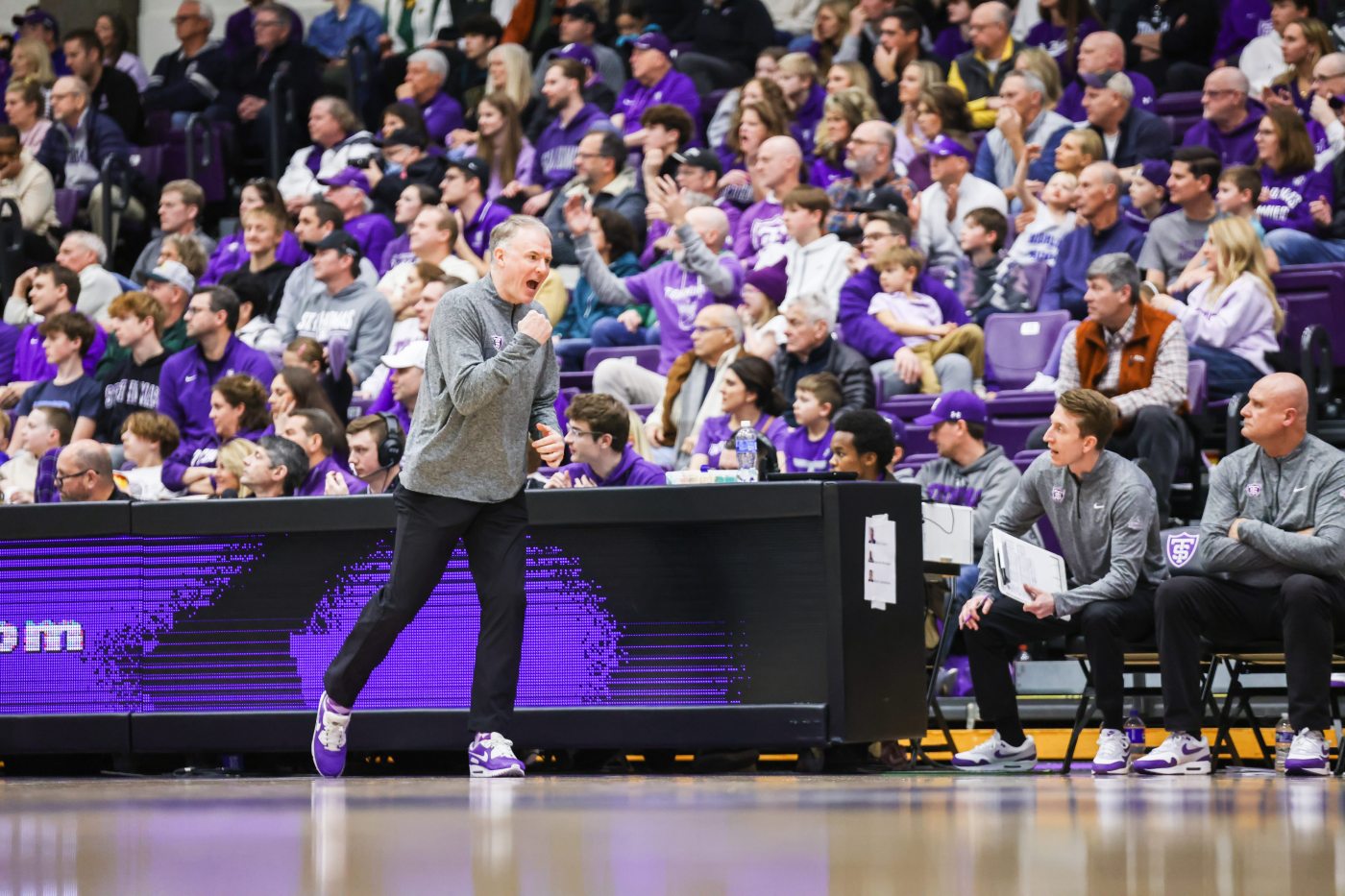
St. Thomas head coach Johnny Tauer, left, talks with leading scorer Nolan Minessale during the Tommies’ victory over Army at Lee & Penny Anderson Arena in St. Paul on Nov. 8. (Nick Wosika / St. Thomas Athletics)
The challenge of finding teams to play in the nonconference slate is still the biggest surprise for St. Thomas coach John Tauer since the Tommies made the jump from Division III to Division I in 2021.
At the Division-III level, you had to schedule five nonconference games a year. So, the Tommies would play a few of the top regional, non-MIAC teams, and also take one trip to go play a couple other national powers.
This year, the Tommies have 15 nonconference games, the last of which is Sunday, when they host Minneapolis-based North Central, which is struggling with its Division III schedule thus far this season.
It’s the third Division III opponent the Tommies will play this season. They already have beaten Lawrence of Appleton, Wis., by 35 and former rival St. John’s by 24. Why schedule such foes?
Frankly, it’s standard operating procedure for mid-major clubs across the country. Every Summit League team played three or more non Division I opponents last season. No one else is knocking on the door to come play nonconference games in your gym — especially not in St. Paul, where the Tommies have won 24 straight games.
St. Thomas has played the likes of Marquette and Creighton in past seasons. It opened its season at St. Mary’s (Calif.) this fall. Those games take too much of a physical toll to be littered in your early season schedule.
Coaches aren’t looking to schedule non-premier opponents that might beat you, and St. Thomas qualifies for that. Even though a road game in St. Paul currently qualifies as a Quad 2 game — which doesn’t kill your NCAA Tournament resume if you drop it — coaches have cracked the code that your NET Ranking, a major data point for programs trying to get earn at at-large berth in the dance, is more positively affected crushing some of the country’s worst teams.
“We don’t have a lot of people calling us to come play,” Tauer said. “Can you imagine if we had a high-major team to come play here? It would be one of the best events we’ve ever had on campus. We hope someday that would happen but, understandably, it would take a lot. … High-major teams, when you look at what a home game is worth to them in terms of revenue, it’s understandable why they wouldn’t want to go play on the road.”
But St. Thomas has its own checklist it’s attempting to fill via its nonconference schedule. According to Tauer, the Tommies want:
—Good games.
—To be competitive and have success.
—An “excellent experience” for student-athletes in terms of who they play and where they go.
—To go either where many alumni are based, or a site they might want to visit.
—To minimize missed class time.
—To generate revenue
Not included on that list is NCAA Tournament positioning. The Tommies play in what’s almost exclusively a one-bid league, and while résumé could impact a seed in the Big Dance, the fact that it takes three conference tournament wins to even reach the NCAAs makes it a lesser priority.
This season, St. Thomas already has traveled to California, Oregon, Missouri, Washington, Montana and North Carolina, and the season is not yet two months old. It’s not ideal, but it’s a reality for St. Thomas, which has few possibilities for regional, nonconference opponents. The one obvious one, Minnesota, won’t play the Tommies. So they have to play elsewhere.
That type of travel is difficult for players to balance along with practice and academics. The latter remains of high importance at St. Thomas, where athletes typically perform better in the classroom than the general student body. That’s a standard athletics director Phil Esten demands.
The travel has to be balanced with home games to allow players to maintain some semblance of a normal schedule. Games at the new Lee & Penny Anderson Arena also are a major source of revenue for the program.
The only way for St. Thomas to get those in the nonconference slate with Division I opponents is seemingly to schedule home-and-home series. For example, the Tommies traveled to UC-Riverside last December, and the Highlanders returned the favor last weekend.
But even those are growing increasingly difficult to book because everyone wants to know what type of team they’re scheduling. Now, no one knows. In the era of the transfer portal and Name, Image and Likeness, rosters are fluid. A team’s competitiveness can change drastically season to season.
Associate head coach Mike Maker is the Tommies’ scheduling czar. Already, next season’s schedule is written on the whiteboard of his office. He’s working year round to try to find the right games for the Tommies to play. That process for this season wasn’t completed until early September, two months out from the start of the season.
“It feels almost never ending,” Tauer said.
Scheduling is an inexact science, but one that coaches deem nearly as important as coaching and recruiting. Tauer noted there is no one game that checks every box for what the program wants to achieve, before quickly correcting himself.
“I suppose a home game that’s a sellout,” he said.
Which is why the Tommies played St. John’s earlier this month; Division III opponents provide home games mid-major programs in the Midwest can’t otherwise get.
Tauer insists it was more of a risk than others may presume. Other Summit League programs have struggled against quality D3 programs this season, and the Tommies won 10 games in their first season playing Divison I basketball while largely fielding a Division III roster. The Johnnies last week trailed by just four at the half before St. Thomas pulled away.
But even with the risk, Tauer believed “the benefits of it were a lot of interest.”
“If you asked basketball fans in the state of Minnesota, it would be probably the second-most interesting game between two teams in the state that they could see,” he said. “It was a home game, it was a sellout, it allowed alums from both schools to come back. … It brought all these people together. It brought (together) two schools that used to have a wonderful rivalry, but also have a mutual respect. And so when you look at all of those (benefits), we thought that, yes, there was a risk of it, but it also was the right thing to do at the right time.”
And it was a win, which when it comes to scheduling nonconference Division I games for schools of St. Thomas’ size, aren’t easy to come by.
Related Articles
St. Thomas found a silent knight in sophomore Nolan Minessale
Men’s basketball: St. Thomas rolls past old rival Johnnies
St. Thomas volleyball: Tommies fall in a first-round thriller
NCAA Women’s Volleyball: Gophers, Tommies both start in Minneapolis
Women’s Volleyball: St. Thomas wins Summit League title to punch ticket to D-1 NCAA Tournament
Leave a Reply