
“New Yorkers, and Mayor-Elect Mamdani in particular, have an open window of opportunity to fundamentally shift the city from maintaining the status quo between the haves and have-nots to actively pursuing housing justice.”
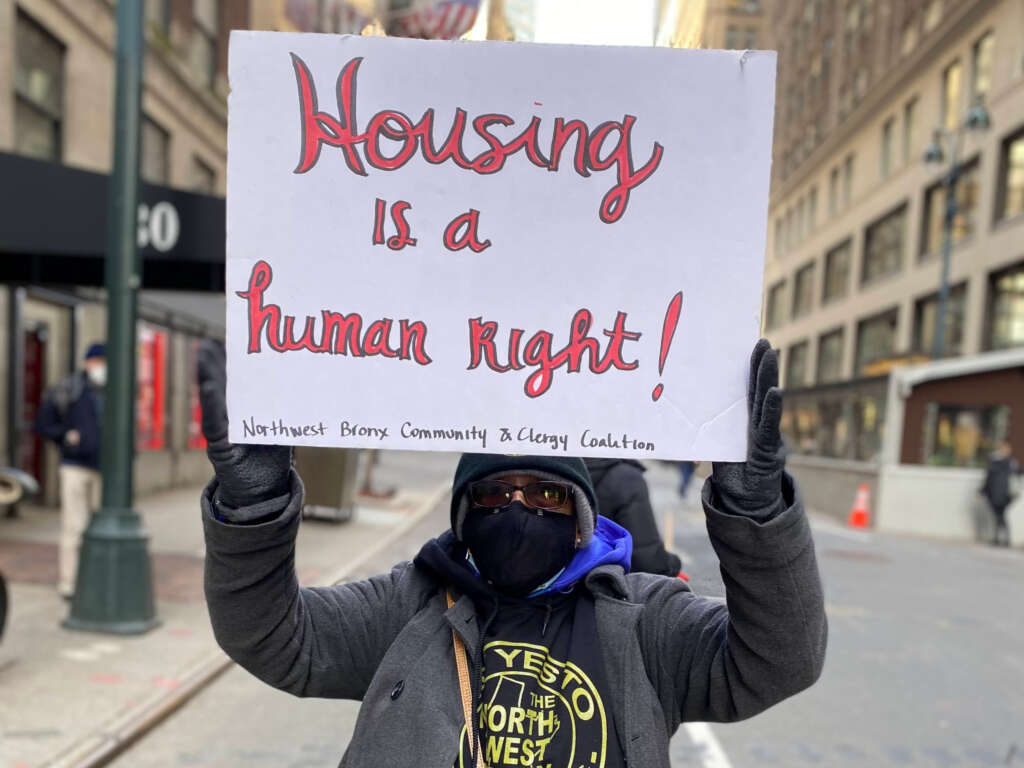
Housing advocates at a rally in Manhattan in 2022. (David Brand/City Limits)
With housing affordability as the linchpin of his platform—and half of all New York City renters rent-burdened—Mayor-elect Zohran Mamdani has an opportunity to make right what decades of leaders could not.
The Mayor-elect’s ambitious agenda has the potential to provide more than verbal affirmations to freeze rent and foreshadows a political will to enter a trailblazing era of human rights enforcement, with the fights for housing justice and homelessness decriminalization as gateways to other rights-based reforms.
Widening the view, it is clear as day that our global order is splintered when it comes to human rights and justice issues. The United States’ repressive conduct and enhanced surveillance of its own poor, working class, people of color have made us stand out in a lackluster way on the world stage, while also signaling a dangerous message that our country’s leadership may proceed business-as-usual, with impunity.
In November, the United States federal government did not appear for its own review before the United Nations Human Rights Council, an opportunity afforded to each nation just once every five years. Despite the federal absence, a strong cross-section of state and local officials, and agency representatives—including our own deputy commissioner of the New York City Human Rights Commission—and a delegation of zealous human rights advocates briefed U.N. representatives both in Geneva and here in New York.
We discussed what an evasion of accountability means in cities like ours, which have become frontline defenders of human rights in combatting the scale of their violations. This builds on public dialogues with high-level U.N. experts on New York City’s affordability and criminalization of homelessness challenges, and a hearing before the Inter-American Commission on Human Rights. In all these instances, our message was clear: our federal, state, and local leadership’s failures to solve the affordable housing crisis are violations of New Yorkers’ fundamental human rights.
But as the richest city in the world undergoes a promising political transition, we can and will demand a better road ahead if we truly want it to be a safer and more accessible place for everyone to call home.
To start, solutions to housing affordability must integrate a perspective about land and its social function. The community land trust model of de-privatizing housing and preserving affordable housing stock is not a foreign concept in our neck of the woods. In fact, over 20 community land trusts exist citywide, offering low-income communities of color the right to reclaim land and be stewards of it for the public good. And just this week, the New York City Council passed the Community Opportunity to Purchase Act.
Not only should these and other vulnerable communities be afforded collective land rights, but it is imperative for structural, public land displacement practices to be eradicated from the onset. A human right to housing cannot be achieved without repealing criminalization policies, such as the involuntary commitments and sweeps of homeless New Yorkers—actions that universally fail to promote inclusive, humane management of public space.
Criminalization does not solve homelessness, but in fact, worsens it. The Mamdani administration should prioritize reinvesting the over $6.4 million its predecessor expended in its interagency sweeps task force toward comprehensive, community-based, non-punitive solutions—such as free public bathroom facilities and staffing culturally competent mental health outreach workers, and voluntary supportive housing units, among others. As he has publicly committed to ending sweeps, these solutions are necessary for preserving his homeless constituents’ dignity and diverse needs.
Finally, the human right to housing demands the city challenge abusive, predatory housing schemes that make housing inaccessible for tens of thousands of New Yorkers. Our City Commission on Human Rights monitors one of the most expansive human rights laws in the country, making way for a particularly high volume of housing discrimination inquiries in its docket (over 51,000 from 2019-2024), and it needs more support.
Moreover, as many advocates and City Council leaders have correctly identified, the human right to housing is intersectional and requires administration-wide coordination with agencies dealing with policies from immigration to healthcare, education to public safety. As human rights are truly indivisible and interdependent, mandates around affordable housing and each of these other key areas would benefit from a synergy of advocates and municipal staff that models community-driven, holistic participation and enforcement.
Having just commemorated Human Rights Day and Homeless Persons Memorial Day, New Yorkers, and Mayor-Elect Mamdani in particular, have an open window of opportunity to fundamentally shift the city from maintaining the status quo between the haves and have-nots to actively pursuing housing justice.
In a city where everyone knows the rent is too damn high, no one deserves criminal punishments for not being able to afford a home, and we all deserve the right to safe, affordable housing. Let us make 2026 the year we bring the human right to housing home to New York and as a model to the rest of the world.
Siya Hegde is a staff attorney for the National Homelessness Law Center’s “Housing Not Handcuffs Campaign.”
The post Opinion: How Mayor-elect Mamdani Can Achieve a Human Right to Housing appeared first on City Limits.
Leave a Reply