
After weeks of watching products on its store shelves dwindle, customers and employees of the Oxendale’s Market grocery in West St. Paul received bitter news this past week. The store, which opened in 2014 in the strip mall off Dodd Road and Bernard Street, will close by Dec. 23, if not sooner.
The announcement was first carried by the West St. Paul Reader, which noted that Oxendale’s was the fourth grocery store to try to make a go of it in the aging and outdated Doddway Center, preceded by Jim’s Market, R.C. Dick’s and Applebaum’s. Employees, according to the Reader, will not be transferred to Oxendale’s other locations.
What triggered its coming closure?
Oxendale’s Market in West St. Paul on Dec. 11, 2025. Oxendale’s is set to close Dec. 23, 2025. (Claudia Staut / Pioneer Press)
Managers at the West St. Paul location and two other Oxendale’s groceries in St. Paul and Minneapolis declined comment on Wednesday and referred all questions to a central office, which did not immediately return calls.
Road construction this summer realigning the intersection of Smith Avenue and Dodd Road likely played a part, but experts in the grocery industry say small-to-midsized independent grocers have been buffeted by the same headwinds affecting everyday consumers, from inflation and economic uncertainty to the recent government shutdown that temporarily froze SNAP food benefits.
On top of that, a wave of deportations has heightened a labor shortage and customer hesitancy in ethnic markets.
El Burrito Mercado trims hours, shelves
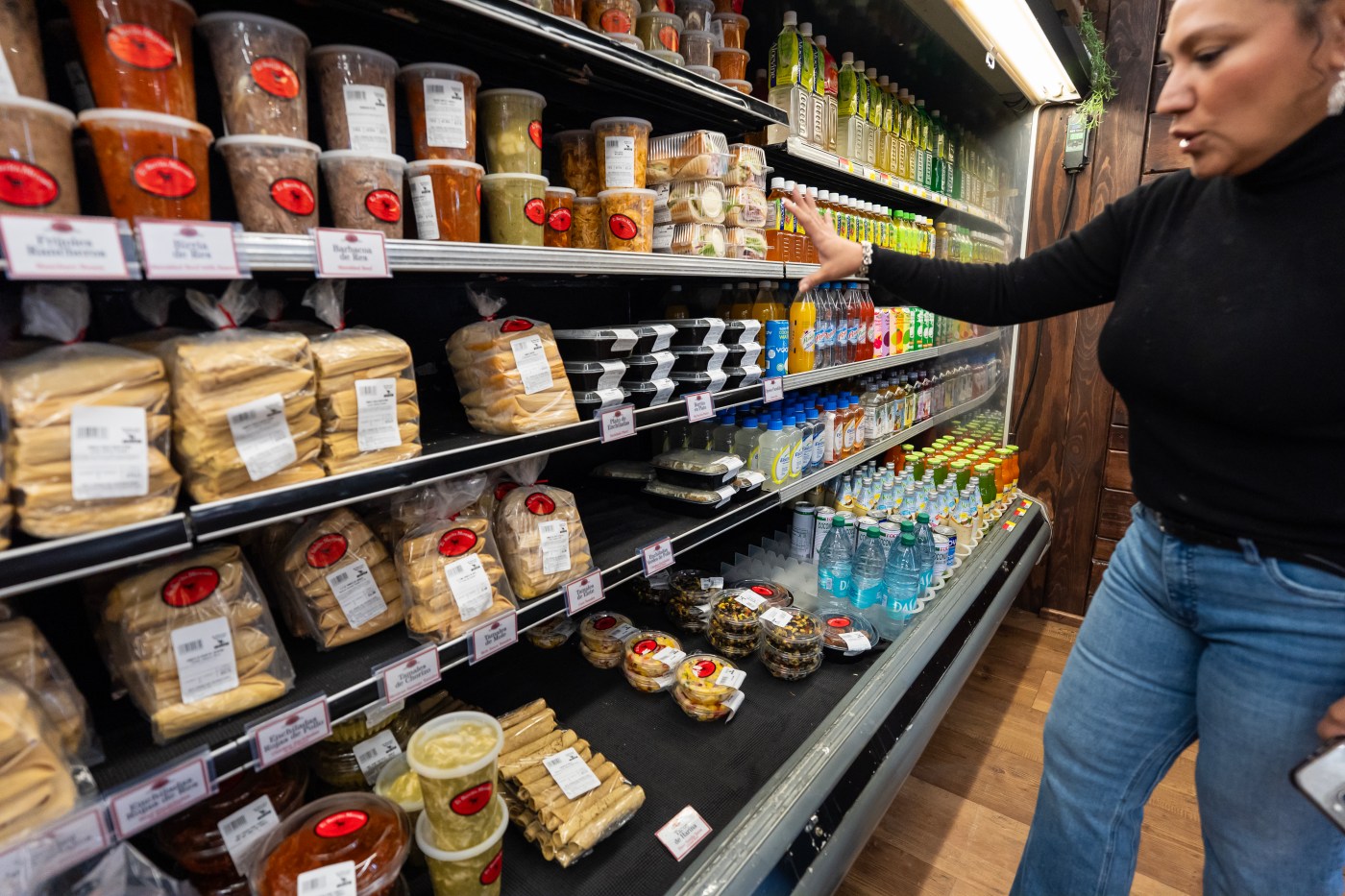
Oxendale’s isn’t the only grocery going through tough times. Two miles to the northeast, El Burrito Mercado on Cesar Chavez Street in St. Paul announced over the past week that it would limit the hours of its deli, restaurant and grocery come January while removing about 18 feet of store shelving.
“There will be fewer products on the shelves, limited item availability, shortened business hours — and the hardest part of all, reduced hours for many of our staff,” reads a statement posted to social media by Milissa Silva, co-owner and chief executive officer of the storied establishment, long a staple of the city’s West Side Latino community.
A shelf sits mostly empty while in preparation to be removed from the store floor in El Burrito Mercado in St. Paul on Dec. 11, 2025. (Claudia Staut / Pioneer Press)
Silva, in an interview Wednesday, said she’s seeing fewer customers, and those who do come in are buying less.
“It is foot traffic,” said Silva, whose parents opened the restaurant and grocery in 1979. “It’s shopping habits. They’re buying smaller quantities. The immigrant community being very fearful … that’s obviously keeping folks away.”
“We’re trying to pivot, but it’s hard,” she added. “We’ve cut a lot of staff hours. It’s really tough. This can’t be forever. We’re trying to be optimistic that there’s a light at the end of the tunnel.”
Silva has urged state and local government to do more to help independent grocers, and she encourages elected leaders to join others in shopping local. In a post to social media, she asked customers to help by buying gift cards online to share with families in need and ethnic foods to donate to food shelves, as well as by dining and shopping at independent grocers.
“We need to start a campaign where people say ‘I pledge to shop small,’” Silva said, “and call out our political leaders to be louder on this messaging, because there’s so many restaurants and small businesses that are hurting. And yes, send a little extra love to Latino-owned businesses. Many of us are feeling these hardships even more deeply.”
Other recent grocery closures have included the Midway Cub Foods in the Snelling/University Avenue area of St. Paul and, earlier this year, the Lunds and Byerly’s market in downtown St. Paul, both of which were frequent targets of shoplifters and magnets for other unruly behavior. A Cub Foods on Lagoon Avenue in Uptown Minneapolis closed in June for renovations but reopened in August.
Food prices, economic uncertainty
Pat Garofalo, president of the Minnesota Grocers Association, said grocery stores are capital- and labor-intensive, making them sensitive to even minor economic changes.
While Oxendale’s isn’t a recent member of his association, he said it’s not hard to see why many independent grocers are struggling following periods of high inflation, workforce shortages and food prices affected by government tariffs and supply-chain issues like avian flu.
Minnesota recipients of federal SNAP food benefits lost access to those benefits for just about three days during the 43-day government shutdown that ended Nov. 12, a situation that could have been much worse but for how the state schedules distribution of its federal allotment of SNAP funding. For many grocers, the SNAP situation still affected how they ordered inventory.
“Affordability impacts small businesses just as much as it impacts consumers,” he said. “Rising property taxes, increasing labor mandates and a shrinking workforce create a lot of headwinds for independent grocery stores.”
He added: “As consumer confidence has declined, and there’s more uncertainty in the economy, this impacts people’s shopping patterns. And that applies to flat incomes, higher costs, immigration uncertainty — all of those play a role.”
New business mandates also carry costs and other challenges. A statewide paid family-leave benefit that begins Jan. 1 is already raising questions about how small businesses will schedule around 12 to 20 weeks of paid leave during a labor shortage. The leave, available to almost all workers, will be funded by new payroll taxes, with costs split between employers and employees.
Bright spots?
It’s unclear if the worst is truly behind the American consumer in terms of rising food prices, but there’s a few more bright spots in the grocery aisles these days compared with just a few months ago.
The Trump administration recently relented on international tariffs around beef, coffee and dozens of other agricultural goods. Egg prices have largely stabilized since outbreaks of avian flu in early 2025 sent them soaring. Beef prices are still high, but milk prices have come down a bit because of oversupply.
“I think that the worst is over,” Garofalo predicted. “A lot of these factors involved the supply chain, particularly with beef, where we had a drought a couple years ago. Reducing or eliminating the new tariffs that have been imposed will make things better.”
Related Articles
Member-owners of Mississippi Market and River Market co-ops approve merger
Missouri-based Schnucks buys Wisconsin’s Festival Foods, including new Hudson store
If food prices do fall, or at least stabilize, that could spell welcome relief for independent grocers, including others at risk of closing in 2026.
“Certainly, no one benefits from food deserts, and food deserts exist in both urban areas and rural areas,” said Garofalo, who for 20 years was a Republican state representative for rural Farmington and surrounding suburbs. “It seems like something Republicans and Democrats could work together to prevent from happening. Everyone eats.”
Leave a Reply