
His bone-crushing jaws ready, William frightfully honed in on his prey — bathing suit-clad me. Crazily, I was willingly submerged in the Cage of Death, a clear plastic cylinder plunged into an adrenalin-jolting tank occupied by a pair of homicidal saltwater crocodiles.
At first, 15-foot-long, 1,521-pound William stealthily swam around the dunked cage while his aloof royal partner Kate lurked deeper in the water. The two-person-max Cage of Death — a thrill in Australia’s croc-centric city of Darwin — also encased my husband, who was gung-ho to do this and hmm, might be the more desirable target meat-wise, sparing me.
In Darwin, the Cage of Death gives brave humans a chance to see saltwater crocodiles just inches away. (Photo by Norma Meyer)
To get in this predator predicament, we descended a ladder into the cage that was suspended by chains and then swung by a monorail over the carnivores in their big pool. Dangling above, we were slowly lowered as croc-shared saltwater from below filled up to our chests. I thought I’d wet my wet pants. We’d have 15 everlasting minutes in this acrylic contraption that was already ominously scratched from crocodile claws and teeth. Wearing goggles, we maneuvered underwater in our cage to “swim” with the humongous, astounding assassins who glided close to us. Although I soon lost sight of William.
The Cage of Death is lowered into a tank with a waiting crocodile at Crocosaurus Cove in Darwin, Australia. (Photo by Norma Meyer)
That’s when my husband tapped me on the shoulder and pointed skyward. Standing up, we exhilaratingly came face-to-scaly-face with Willam, his massive head horizontally smack against the cage that was only 1.5 inches thick. I could’ve flossed his not quite pearly whites just a finger’s length away; only earlier I read a sign saying a croc’s bite force is “equivalent to the weight of a large diesel truck.” William’s slit-shaped membrane-coated right eye hypnotically stared at his gawking entrees. I swear he sneered at us. But he might’ve been distracted — we couldn’t see but his handler at reptile park Crocosaurus Cove had been extending a pole to feed him his favorite non-human snack, crabs.
It’s ironic that Croc Cove saved 60-year-old Willam and a couple other “problem” salties from death — they were escapees from a commercial crocodile farm and instead of becoming wallets, they nabbed this starring role.
A sign outside the Crab Claw Island Resort reminds visitors of what lurks in Australia’s Top End. (Photo by Norma Meyer)
Darwin is the tropical capital city and most populated of Oz’s Northern Territory, a vast, mostly uninhabited “outback” region and the must-visit “crocodile capital of the world.” The territory — twice the size of Texas — is home to an estimated 100,000 wild “salties” (that’s what Aussies call them) and 260,000 people, which is roughly one salty for every couple with a baby. I’m from croc-less California, so there’s no such dangerous beasts lying on beaches, infesting rivers, creeks and harbors, eating you when you swim, and making cameos in public pools, women’s water aerobic classes and backyards. Very weirdly, it’s legal to keep a crocodile as a pet in Darwin if you have a permit and obey strict rules about its enclosure.
The murky Adelaide River in the Northern Territory is believed to contain more than 1,000 saltwater crocodiles. (Photo by Norma Meyer)
Besides the Cage of Death, we boated alongside jumping crocs, soared in a helicopter over salties (and the Lost City and towering termite mounds), discovered but didn’t try an abundance of croc cuisine (szechwan crocodile dumplings), and perused countless croc merchandise (claw back scratchers, anyone?).
As she showed me beautiful Aboriginal paintings, I excitedly recounted some of this to Bryony Nainby, art curator at the impressive Museum and Art Gallery of the Northern Territory. “Oh,” she said with a knowing look.“You’re a crocophile.”
In fact, I couldn’t wait to see the museum’s stuffed crocodile Sweetheart, a beloved icon who in life gained fame for attacking outboard motors.
Croc around the clock
A souvenir T-shirt says it all in Darwin, part of Australia’s croc-invaded Northern Territory. (Photo by Norma Meyer)
The Aussies, perhaps the most easygoing folks on the planet, take it all in stride. This area Down Under is known as the Top End and its irrepressible quirkiness is a real hoot. Among notable milestones: The still-active Rocksitters Club, a group of mates who in 1974 started sitting on a Darwin rock and drinking beer for lengthy stretches, finally achieving a 12-day world record in 1980; the late Brahman bull Norman who was a beer-guzzling title winner at his owner’s Humpty Doo Hotel near Darwin; and the Darwin Ice Hockey Club which went undefeated for 32 years because the city didn’t have an ice rink then and the team never played a game. The “world champions,” however, starred in a humorous 2011 commercial for Vegemite, that strange dark spread Australians slap on their toast.
Crocodile Darwin is a company that sells its namesake products at the Mindil Beach Sunset Market. (Photo by Norma Meyer)
On our first afternoon, after checking into the contemporary Hilton Darwin, we set off for popular Mindil Beach, where the wacky 51st annual Beer Can Regatta took place a few months earlier. The usual Mindil Beach Sunset Market buzzed with over 150 colorful craft and food stalls on an embankment across from the Timor Sea.
A plethora of crocodile products are sold at Mick’s Whips at the Mindil Beach Sunset Market in Darwin. The prices are in Australian dollars. (Photo by Norma Meyer)
“The goods are real and the prices are unreal!” shouted Mick Denigan, owner of Mick’s Whips and “the world’s fastest whip cracker” with a record 127 cracks in 10 seconds wielding two whips. Denigan, a rugged character in his late 50s, had just been outside his crocodile skin-draped Mindil booth, fiercely lashing kangaroo hide whips on the ground. For a few scary moments, I thought the sharp loud cracks were gunfire.
Got an itch? Crocodile claw back scratchers are sold in stalls at the Mindil Beach Sunset Market in Darwin. (Photo by Norma Meyer)
Wild salties are protected by law but Denigan is a licensed crocodile hunter who, with government permission, can cull crocodiles or shoot those who have devoured cattle or endangered people. His retail wares included crocodile dog collars, croc stubby beer holders, croc skulls, croc tail key rings, croc tooth necklaces, croc purses, croc foot back scratchers and more. Other vendors peddled similar items and crocodile jerky. Crocs are also raised in farms near Darwin for products (high-fashion Hermes handbags) and vittles. At Mindil, you could dine on crocodile skewers with peanut sauce, croc burgers on brioche buns and creamy croc-vegetable pies.
Crocodiles can eat humans and vice versa. Burgers were on the menu at the Mindil Beach Sunset Market in Darwin, Australia. (Photo by Norma Meyer)
As evening approached, attendees flocked en masse from the Mindil market to sit on the sprawling beach. Four camels, topped with tourists, surreally padded by the shoreline as the sky glowed Halloween orange. When the last drop of the stunning sunset disappeared beneath the horizon, all 1,000 or so onlookers heartily applauded in unison. That’s a funny Darwin custom too.
A tourist caravan of camels strolls along Mindil Beach in Darwin, Australia, (Photo by Norma Meyer)
Snap-happy heights
In the morning, we hopped aboard a three-passenger Nautilus Aviation helicopter for a day exploring the Northern Territory (where “Crocodile Dundee” lived onscreen). Taking off, pilot Jim Collins told me not to keep anything in my pocket because of strong winds — neither he nor I had a door. Nautilus also offers a Heli Pub Crawl that transports imbibers by air to four of the area’s unconventional bars.
A passenger helicopter from Nautilus Aviation finds a dandy parking place at Sandy Creek Falls in Litchfield National Park. (Photo by Norma Meyer)
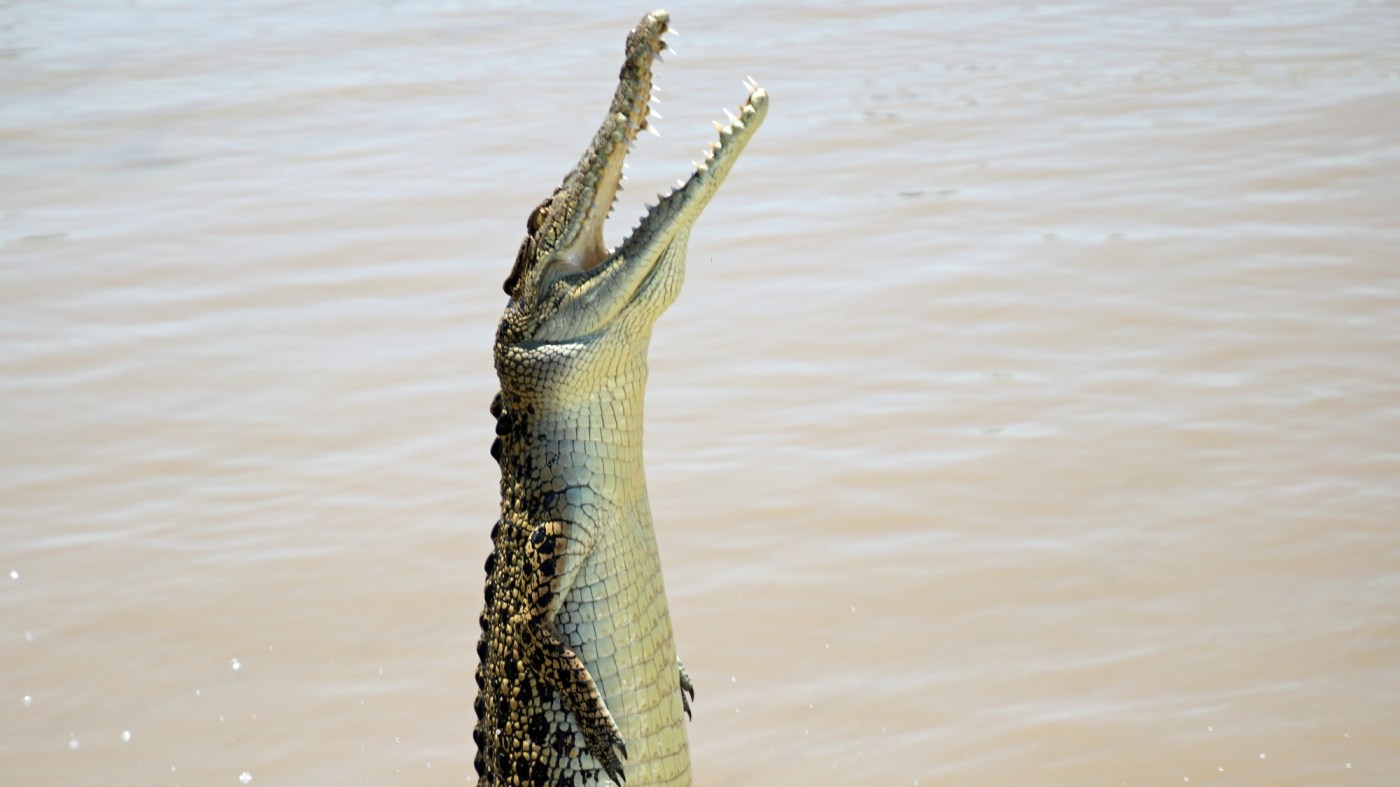
Even before our copter touched down in the desolate Top End, we spotted salties below in the croc-swarming Adelaide River. While Collins waited for us, we sailed on the Spectacular Jumping Crocodile Cruise with captain Shane Clugston patrolling for Casanova and Stumpy. Instead, we’d encounter Marilyn, Scooby, Snappy, Checkers, Lola and juvenile Bubba in the muddy river, and each time Clugston’s assistant swung a stick with buffalo meat or chicken over their snouts to provoke them to fling themselves vertically, a natural prey-snatching behavior. Some crocs looked bored at the bait, like “I’m not playing this game today.” A few ferociously jumped high in the air, causing a child onboard to squeal with delight.
Saltwater crocodiles, such as this one in the Adelaide River, have the most powerful bite force of any animal in the world.(Photo by Norma Meyer)
Salties had been hunted to near-extinction — there were 3,000 left — when protection laws were enacted in 1971. Now with 100,000 roaming, Clugston warned, “Always have the assumption that one is next to you — because there usually is.”
Crab Claw Island, in the remote Northern Territory, offers camping and cabins at its one resort… but be croc aware. (Photo by Norma Meyer)
Returning to the clouds, we floated (or bounced) over never-ending untamed landscapes of woodlands, mangroves, rivers, and rocky cliffs. “It goes on and on and on,” Collins said about the Top End’s topography. He continued to our lunch locale, the casual Crab Claw Island Resort, which is all that’s on the isle and caters to mud-crabbing fishermen. It sits along picturesque Bynoe Harbour but don’t dare go for a dip. Salties will also hang on the beach. I sipped a frosty one in the pub and kept eyes peeled.
Known as the Lost City, these are not ancient ruins but weathered sandstone formations possibly dating back 500 million years. (Photo by Norma Meyer)
We’d soon whirl over part of breathtaking 579-square-mile Litchfield National Park. Under us rose the Lost City, apparent ruins of a mystical ancient civilization.The “city,” however, is actually comprised of gigantic eroded sandstone formations that mimic an archeological site. Elsewhere, hundreds of magnetic termite mounds covered the plains, eerily resembling tombstone-studded graveyards. Those mounds stood about six feet high while Litchfield’s church-like cathedral termite mounds imposingly reached up to 26 feet. Crafted by different species, the colonies were built by grass-cutting termites who added saliva, feces, and sand to construct palaces for their king, queen, nymphs, workers and soldiers.
Hundreds of grave-like magnetic termite mounds are seen from a helicopter in Litchfield National Park. (Photo by Norma Meyer)
Litchfield is lauded for its sparkling waterfalls, and Collins swooped at a tilted angle over cascading wonders. (Remember, no door.) For the grand finale, he dramatically landed on a tiny rocky outcrop at magnificent Sandy Creek Falls.
Sprawling Litchfield National Park has a number of beautiful waterfalls, such as this one seen from a helicopter. (Photo by Norma Meyer)
Back in Darwin I needed the scoop on Sweetheart, who was male.
“This fella would come up to small boats and dinghies, grab the motor and shake it and throw the people out into the water. But he never even bit anyone,” said Jared Archibald, history curator of the Northern Territory museum.
The preserved body of notorious crocodile Sweetheart is a main attraction at the Museum and Art Gallery of the Northern Territory. (Photo by Norma Meyer)
In 1979, Sweetheart was captured and sedated by rangers, but when he was being towed, his line snagged on a sunken log and he accidentally drowned. Jared’s father, taxidermist Ian Archibald, was called upon to prepare and stuff 17-foot-long Sweetheart for exhibition.
“We had his skull and his skin in a freezer on our back porch,” the younger Archibald recalled.
At Darwin Harbour, beachgoers can safely swim in a large lagoon separated by a seawall from crocodiles in the ocean. (Photo by Norma Meyer)
Around busy Darwin Harbour — named for English naturalist Charles by a former shipmate — up to 300 salties are caught in baited traps annually, most sold to crocodile farms. But no worries: At the bay’s stylish Waterfront Precinct, everyone can safely swim in a saltwater lagoon because a surrounding seawall keeps out crocodiles — and venomous box jellyfish that can kill a person within five minutes. That’s another story.
Related Articles
Escape to Nevada’s oldest town: A Silver State spot worthy of the silver screen
Deep in the heart of Texas is wine country and more
The Polish ‘magicians of glass’ who create Christmas baubles for clients worldwide
In Lubbock, Texas, musician Buddy Holly’s influence is everywhere
New holiday movie features the off-season charms of Door County, Wisconsin
Leave a Reply