
“New York City has a long history supporting these types of building conversions, often led by tenants and nonprofit organizations. COPA builds on this legacy and lays groundwork for a new generation of tenant- and community-run housing.”
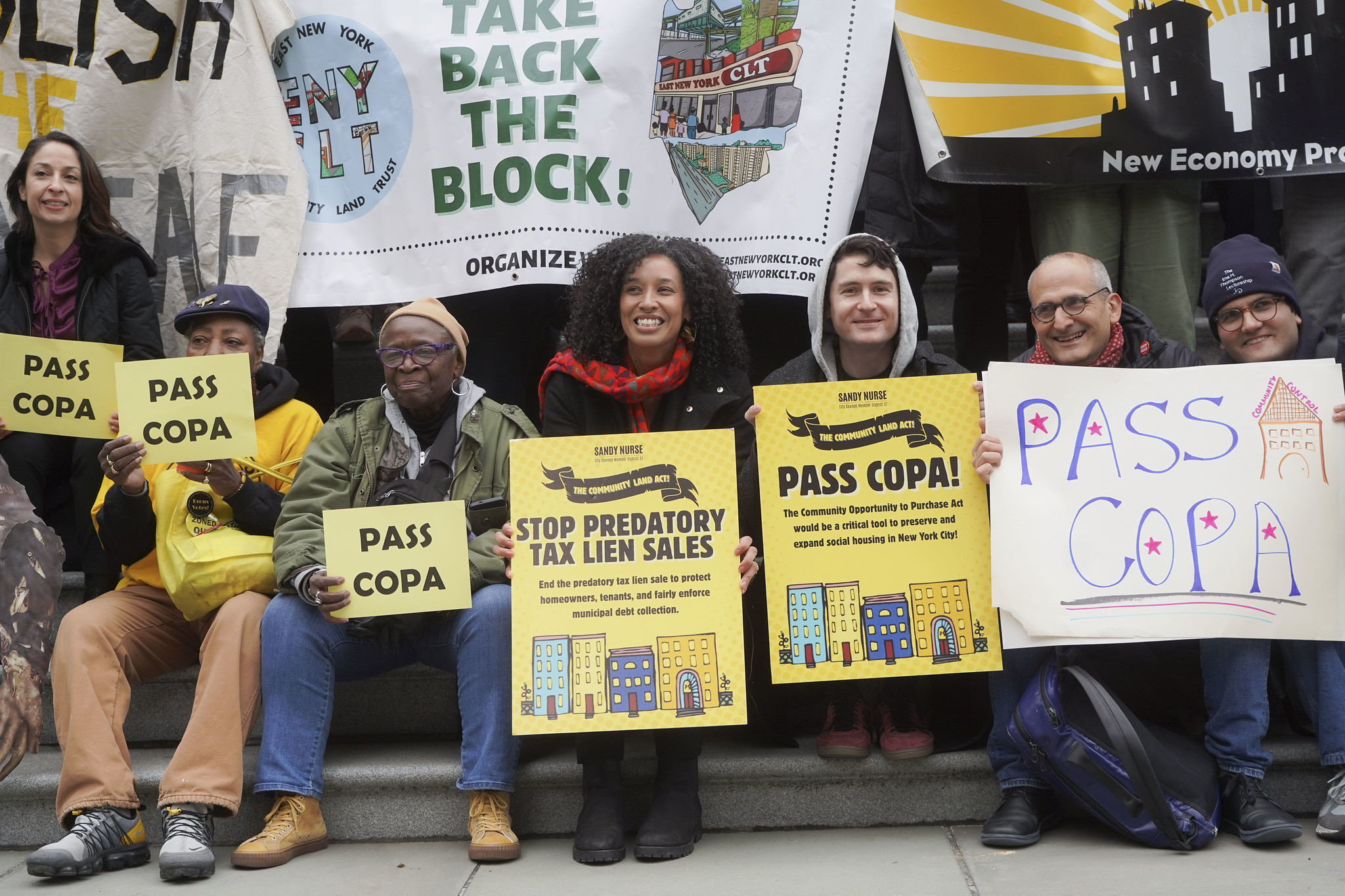
Councilmembers and COPA supporters at a rally for the bill at City Hall on Nov. 12, 2025. (Gerardo Romo / NYC Council Media Unit)
As real estate attorneys who have spent decades representing clients in affordable housing transactions in New York City, we felt it was important to respond to the concerns raised in Erica Buckley’s op-ed regarding Int. 902-A, the Community Opportunity to Purchase (COPA).
In our view, the version of COPA now before the Council is a practical, well-crafted framework that will meaningfully strengthen New York City’s ability to preserve stable, affordable housing.
COPA creates pathways for tenant ownership, as well as preservation of rental apartments, without forcing parties into negotiations. It leverages existing state and local preservation financing programs, such as Neighborhood Pillars and the NYC Acquisition Fund, which are already geared to mission-driven developers. Private lenders, including New York’s expansive network of community development financial institutions, will be at the ready with additional capital to execute COPA purchases.
We applaud the City Council for taking meaningful steps to restore balance to an affordable housing market that, in our experience, is frequently distorted by speculative pressures. We urge the City Council to pass COPA immediately.
The legislation would create a proven, common-sense policy that gives mission-driven developers with demonstrated financial capability and track records of success a first opportunity to buy buildings, when a landlord chooses to sell. These prequalified buyers must make competitive offers, which owners are free to reject.
Where offers are successful, these mission-driven buyers would work with tenants to determine their building’s future—whether that means preserving apartments as permanently affordable rentals or converting them to limited-equity cooperatives.
New York City has a long history supporting these types of building conversions, often led by tenants and nonprofit organizations. COPA builds on this legacy and lays groundwork for a new generation of tenant- and community-run housing.
New York has a robust landscape of housing preservation organizations, ranging from nonprofit community development corporations and community land trusts to M/WBEs and other for-profit developers. Our firms have represented these kinds of organizations in preservation deals for years.
While debates around the housing crisis currently focus on zoning changes to enable new construction, preserving existing affordable housing remains one of the most cost-effective and reliable strategies for keeping low-income New Yorkers securely housed.
Yet in today’s market, responsible purchasers are at a disadvantage when competing with deep-pocketed investors and all-cash buyers who can move quickly and bankroll projects. As a result, most preservation opportunities are lost before responsible buyers even learn a building is for sale.
That’s where COPA comes in. COPA gives carefully vetted nonprofits, as well as for-profit affordable housing developers, something they rarely have today: notice that a building is being sold, a brief window to express interest, and the opportunity to make a competitive, market rate offer. Under COPA, sellers remain free to reject those offers and sell their buildings on the open market.
We know this approach works. San Francisco enacted its COPA law in 2019, and it has quickly become one of the city’s most effective preservation tools—without slowing the market. Today, the city’s real estate market remains among the fastest and most active in the country.
The City Council’s five years of work designing and refining COPA—based on feedback from New York’s affordable housing community and lessons from San Francisco and other cities—reflects a thoughtful and collaborative process.
Int. 902-A is a balanced bill that focuses on a strategic subset of multifamily buildings where expiring affordability agreements or physical or financial distress expose tenants to heightened risk of harassment or evictions. Notably, small properties—including owner-occupied buildings with five or fewer units—and property owners experiencing hardship are fully exempt from COPA.
It’s a legally-sound and market-compatible policy that will meaningfully advance the city’s affordable housing and preservation goals. The City Council should pass the bill this session.
David Dubrow is senior of counsel at ArentFox Schiff LLP, writing in his individual capacity. Matthew Hall is a senior partner at Goldstein Hall PLLC, writing in his individual capacity.
The post Opinion: The Legal Case for Passing COPA Now appeared first on City Limits.
Leave a Reply